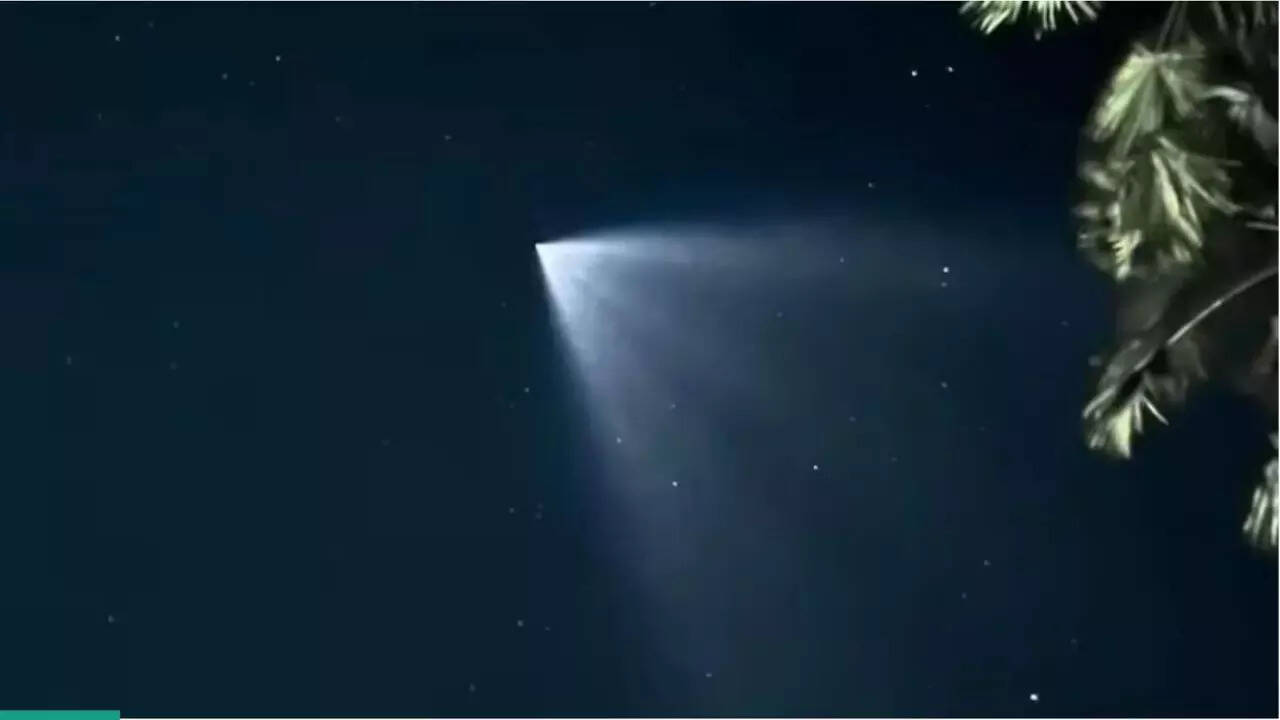
The appearance of a "jellyfish-shaped" luminous object over Sikkim is not a mystery of intent, but a failure of optical literacy. When civilian observers report highly symmetrical, translucent, or trailing biological-looking structures in the upper atmosphere, they are typically witnessing the intersection of high-altitude rocket plume dynamics and the twilight phenomenon. This event provides a structural case study in how propellant expansion in a vacuum-like environment creates specific geometric signatures that the untrained eye miscategorizes as "unidentified."
The Mechanics of Vacuum Expansion
The primary driver behind the jellyfish morphology is the pressure differential between a rocket’s nozzle and the surrounding atmosphere. At ground level, atmospheric pressure constrains a rocket's exhaust into a tight, cylindrical stream. As an aerospace vehicle ascends into the thermosphere, the ambient pressure drops toward zero.
According to the principles of fluid dynamics, the exhaust gases must expand until their internal pressure matches the external environment. In the near-vacuum of the upper atmosphere, this results in a massive radial expansion. The "head" of the jellyfish is the immediate plume from the primary engine, while the "tentacles" are the result of secondary atmospheric interactions, persistent vapor trails, or the firing of Reaction Control System (RCS) thrusters used for orientation.
The Twilight Phenomenon and Photon Scattering
Visibility of these objects often occurs while the ground is in darkness but the high-altitude plume is still illuminated by the sun. This is known as the twilight phenomenon. The specific luminosity observed in the Sikkim event is governed by Mie scattering.
- Particle Size: The plume consists of water vapor, charred carbon, and various chemical byproducts. If these particles are roughly the same size as the wavelength of sunlight, they scatter light forward with extreme efficiency.
- The Contrast Effect: Because the observer is in the Earth’s shadow (the umbra), the background sky is dark. The plume, situated at an altitude of 200 to 500 kilometers, remains in direct sunlight. This creates a high-contrast, glowing effect that appears self-luminous to a terrestrial viewer.
- Chemical Fluorescence: Depending on the fuel type—specifically if hydrazine or liquid oxygen/hydrogen mixes are used—the exhaust can exhibit faint chemiluminescence, though sunlight scattering remains the dominant visual factor.
Structural Categorization of Atmospheric Signatures
To analyze the Sikkim sighting rigorously, the object must be measured against known flight profiles. Most "mysterious" aerial sightings in the Himalayan corridor align with specific orbital injection phases from regional space agencies, including ISRO (India) or CNSA (China).
The Vector of Ascent
The trajectory reported by observers in Sikkim often matches the polar or sun-synchronous orbit paths utilized for reconnaissance and weather satellites. When a multi-stage rocket performs a stage separation, the momentary shutdown and reignition of engines create a "halo" or "pulse" of gas. This gas expands spherically, which, when viewed at an angle, produces the translucent bell-shape associated with medusoid sightings.
The Persistence of Ice Crystals
At high altitudes, the water vapor in the exhaust flash-freezes into ice crystals. Unlike low-altitude clouds that dissipate quickly, these high-altitude clouds can persist for minutes or hours because of the lack of atmospheric turbulence. They are moved by high-altitude winds, stretching the "bell" of the plume into elongated, trailing "tentacles."
Data Constraints and Observational Error
The "jellyfish" description is a byproduct of Pareidolia—the human tendency to impose meaningful interpretations on nebulous visual data. From a strategic analytical perspective, the reports lack three critical vectors required for a non-prosaic identification:
- Instantaneous Acceleration: No report from the Sikkim event cited the object moving at speeds that defy Newtonian physics. The motion was described as a steady drift or a consistent trajectory, consistent with orbital velocity.
- Hypersonic Maneuverability: The object did not exhibit right-angle turns or sudden reversals of direction.
- Multi-Spectrum Validation: The evidence is exclusively optical. Without radar cross-section data or infrared signatures, the "mystery" remains a matter of light refraction rather than an anomaly of physics.
The Geopolitical Context of Himalayan Airspace
The Sikkim region is a high-sensitivity corridor characterized by dense SIGINT (Signals Intelligence) and ELINT (Electronic Intelligence) monitoring. The tendency for local populations to label these events as "UFOs" overlooks the more probable reality of regional military or civil space activity.
In the event of a secret or unannounced launch, the lack of a public NOTAM (Notice to Airmen) leads to a vacuum of information. This vacuum is invariably filled by speculative narratives. However, the "jellyfish" signature is a known byproduct of the SpaceX Falcon 9, the Soyuz, and the Long March series of rockets. The visual data from Sikkim is a 1:1 match for the exhaust expansion of a liquid-fueled rocket engine transitioning through the exosphere.
Strategic Framework for Anomaly Identification
Future sightings should be filtered through a tri-stage verification logic to determine if they warrant scientific investigation beyond standard aerospace explanations:
- Temporal Correlation: Does the sighting coincide with known launch windows or re-entry burns from global space tracking databases?
- Optical Geometry: Is the shape consistent with a pressure-driven gas expansion? (i.e., does it expand as it gains altitude?)
- Luminosity Origin: Is the sun's position relative to the object’s altitude sufficient to explain the brightness via twilight scattering?
Failure to apply these filters results in the "Mystery" narrative seen in the competitor's reporting, which prioritizes engagement over empirical accuracy. The Sikkim event represents a clear case of a "Space Jellyfish," a well-documented phenomenon of the space age that serves as a visual testament to the physics of gas dynamics in a vacuum.
The primary objective for observers and analysts in the region should be the integration of real-time flight tracking data with meteorological optical theory. To categorize this as an unexplained phenomenon is to ignore a century of fluid dynamics and the reality of an increasingly crowded low-Earth orbit. The logical conclusion is that the Sikkim "jellyfish" was a man-made artifact of propulsion, momentarily illuminated by the sun's geometry relative to the Earth's curvature.
Deploying high-resolution spectrographic cameras at regional observatories would negate the need for speculative reporting by providing the chemical signature of the "tentacles," which would almost certainly reveal the presence of nitrogen tetroxide or unsymmetrical dimethylhydrazine—the fingerprints of modern rocketry.