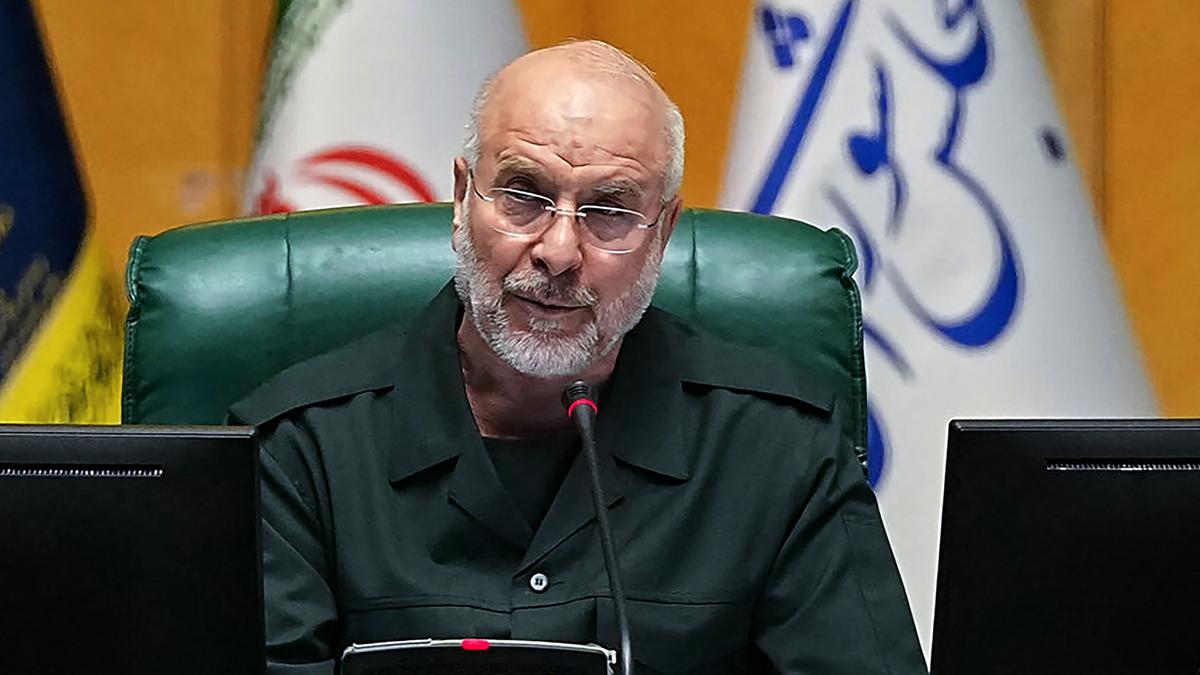
The public posture of a state at war rarely reflects its operational reality. When Iranian Parliament Speaker Mohammad Bagher Ghalibaf declared that the United States is secretly plotting a ground attack while publicly extending diplomatic channels, he was not merely making an accusation. He was defining the central friction of modern asymmetric warfare: the use of diplomacy not to find peace, but to sequence military operations.
The standard media analysis of Ghalibaf's statement treats it as standard wartime rhetoric or a simple accusation of duplicity. This fundamentally misreads the strategic calculus. The tension between the public 15-point peace plan passed through Pakistani intermediaries and the arrival of the USS Tripoli with 3,500 Marines in the Middle East is not a contradiction. It is a highly structured application of coercive leverage. Meanwhile, you can read related developments here: The Cold Truth About Russias Crumbling Power Grid.
To understand the current state of the conflict, one must strip away the political optics and analyze the hard mechanics governing both Washington and Tehran.
The Dual-Track Constraint Model
States do not choose between diplomacy and military force; they execute them in parallel to manipulate the opponent's cost functions. The current US strategy operates on a dual-track model where the probability of a ground transition increases directly as the perceived utility of negotiations decreases. To understand the bigger picture, check out the detailed report by BBC News.
1. The Diplomatic Anchor
The US administration has floated a structural framework aimed at securing specific concessions without the heavy financial and political friction of a ground campaign. The core variables in this diplomatic track include:
- The Resource Chokehold: Attempting to force Iran to yield its de facto blockade of the Strait of Hormuz, which currently bottlenecks a massive percentage of global energy flows.
- The Nuclear Ceiling: Enforcing strict compliance on uranium enrichment to prevent breakout capacity.
- The Sovereign Concession: Demanding that Tehran accept terms that the Iranian leadership categorizes as total surrender.
2. The Ground Attack Probability Function
From an operational perspective, planning a ground attack while negotiating is standard military contingency planning, not necessarily a sign of bad faith. However, for a state like Iran, which is operating under extreme survival stress following the initial February 28 strikes that decapitated its top leadership, these preparations are viewed as an imminent threat.
The probability of a US ground operation is governed by three specific bottlenecks:
- The Domestic Political Cost: Long-drawn conflicts like Iraq and Afghanistan created massive political scarring. Any administration attempting a ground operation in Iran must prove it can execute a rapid, high-impact campaign rather than a multi-year occupation.
- The Energy Crisis Metric: With oil prices surging due to the halted traffic in the Strait of Hormuz, the US is under intense pressure to restore transit. If diplomacy cannot open the Strait, a localized ground operation to seize strategic islands or coastal launch sites becomes an operational necessity.
- The Attrition Rate: Iran has explicitly stated its intent to use extreme asymmetric measures on its own soil. The threat of carpet-bombing their own territory to destroy invading forces raises the projected casualty cost for US ground units.
The Asymmetric Deterrence Framework
Ghalibaf’s response to the perceived US strategy relies on a classic doctrine of asymmetric deterrence. Because Iran cannot match the conventional aerial and naval power of the US and its regional allies, it must maximize the projected cost of any ground entry to deter it entirely.
Iran's defensive posture relies on three distinct pillars.
The Geography of Attrition
Iran’s mountainous terrain and vast landmass make a full-scale occupation mathematically improbable with the current US troop levels in the region. By signaling that "our men are waiting," the Iranian command is attempting to shift the battlefield from the air—where they have a severe deficit—to the ground, where local knowledge, entrenched positions, and human-wave tactics can equalize technical superiority.
The Proxy and Missile Reach
While the US mainland remains outside the reach of conventional Iranian strikes, American forward operating bases, regional allies, and critical energy infrastructure are highly vulnerable. Iran’s strategy relies on holding these regional assets hostage to deter a direct ground invasion of the mainland. The continuous firing of missiles and drone deployments against regional targets serves as a proof-of-concept for this capability.
The Mobilization of the Street
Ghalibaf’s directive for citizens not to "abandon the street" is a calculated move to maintain internal cohesion. In a hybrid war where the adversary attempts to exploit internal economic grievances and civil unrest, visible public support is a metric of regime resilience. It signals to outside observers that the cost of regime change will involve fighting a hostile population, not just a military force.
The Institutional Limitations of the Strategy
While both sides are executing highly calculated strategies, the entire framework is highly unstable because it relies on perfect signaling in a chaotic environment.
For the United States, the primary limitation is the credibility of its timeline. Insisting that operations will be completed in "weeks" ignores the historical reality of conflict in the region. If a ground operation is launched and fails to achieve rapid dominance, the political cost will scale exponentially.
For Iran, the limitation is the severe degradation of its command-and-control structures. Following the loss of its Supreme Leader and top military commanders at the onset of the conflict, the state is operating in a highly fractured environment. When authority is decentralized, the risk of a local commander overreacting and triggering a massive escalatory response increases dramatically.
Furthermore, relying on the closure of the Strait of Hormuz as a primary weapon is a double-edged sword. It successfully applies pressure to global markets, but it also isolates Iran from potential neutral arbiters who are harmed by the resulting energy crisis.
The Strategic Trajectory
The current posturing points toward a definitive operational pivot. The US will likely continue to push the 15-point plan or variations of it through Pakistani and Egyptian backchannels for a strictly limited window.
If these diplomatic efforts do not produce a verifiable agreement to reopen the Strait of Hormuz and cap nuclear activities within that window, the probability of a targeted, limited-objective ground operation will reach near certainty. This will not be a march on Tehran. Instead, expect a high-intensity, localized operation focused on seizing the coastal infrastructure and islands directly controlling the Strait.
The Iranian leadership is fully aware of this specific geographic vulnerability, which is why their rhetoric is hyper-focused on punishing ground troops. The theater is set not for a comprehensive peace or a total war, but for a violent calibration of leverage in the narrowest waters of the Persian Gulf.