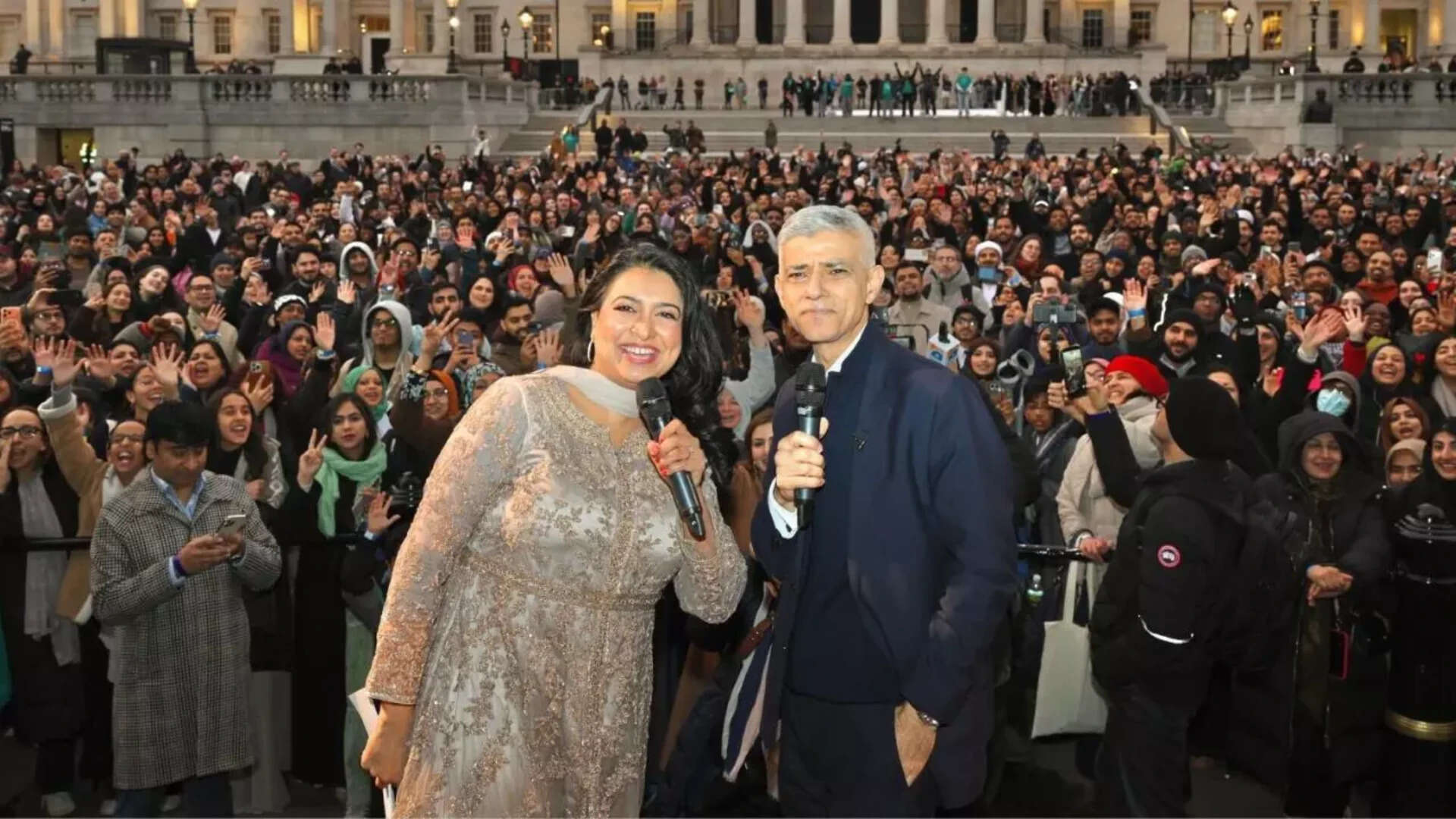
The controversy surrounding the Open Iftar at Trafalgar Square and the subsequent critique by Member of Parliament Nick Timothy is not a localized dispute over religious observance; it is a manifestation of the tension between competing models of public space management. At the center of this friction lies a conflict between Pluralistic Visibility—the belief that public squares should mirror the demographic diversity of the populace—and Civic Neutrality, which posits that the state-managed commons should remain indifferent to sectarian identity to preserve a universal identity.
When a public figure characterizes a religious gathering in a landmark square as an "act of domination," they are applying a specific political framework: the Territorial Sovereignty of the Secular. This logic suggests that the physical occupation of symbolic space by a specific group, even temporarily, alters the psychological ownership of that space for the broader collective. Analyzing this event requires deconstructing the operational mechanics of urban events, the legal precedents for public expression, and the sociological impact of high-visibility religious rituals in secular Western democracies.
The Triad of Urban Space Functionality
To understand why a single event in Trafalgar Square triggers national debate, we must categorize the square’s utility through three distinct lenses. Each lens dictates how an observer perceives the "appropriateness" of an event like an Open Iftar.
- The Ceremonial Function: Trafalgar Square serves as the "stately" core of London. It is designed for national narratives—celebrations of military history, royal transitions, and collective triumphs. Critics of religious events in this space often view them through this lens, arguing that sectarian rituals dilute the "national" character of the site.
- The Agnostic Forum: Historically, the square is a site of protest and assembly. In this capacity, it is a neutral vessel. Its value is derived from its ability to host any group. Under this logic, an Iftar is no different from a political rally or a concert; it is a temporary permit-based usage of the commons.
- The Social Integration Engine: For organizers like the Ramadan Tent Project, the square is a tool for social cohesion. By moving a private religious act (breaking a fast) into the most public venue possible, they aim to normalize the presence of the Muslim community within the British mainstream.
The "row" erupted because these three functions are currently in direct competition. When Nick Timothy references "domination," he is arguing that the Social Integration Engine is being prioritized at the expense of the Ceremonial Function, creating a perceived imbalance in how the state allocates its most prestigious symbolic capital.
The Mechanics of Symbolic Capital Allocation
The state—represented here by the Greater London Authority (GLA)—acts as a gatekeeper of symbolic capital. By granting a permit for an Open Iftar, the GLA is not merely providing a location; it is providing State Endorsement of Presence.
This allocation follows a measurable process of escalation:
- Permit Issuance: The logistical transition from private or communal space to the civic center.
- Visual Dominance: The use of PA systems, signage, and physical barriers that temporarily redefine the square's boundaries.
- Narrative Capture: The media coverage that associates the landmark with the specific event, creating a lasting mental link between the site and the group.
The friction arises when the "price" of this symbolic capital is perceived as zero for one group while being prohibitively high or restricted for others. The critique of "multiculturalism" in this context is often a critique of Preferential Neutrality, where the state is accused of abandoning its neutral stance to favor certain identity markers under the guise of "inclusion."
The Legal and Sociological Boundary of Public Nuisance vs. Public Expression
The British legal framework regarding public assembly is governed by the Human Rights Act 1998, specifically Articles 9 (freedom of thought, conscience, and religion) and 11 (freedom of assembly and association). However, these are not absolute rights. They are balanced against "the interests of public safety" and "the protection of the rights and freedoms of others."
The debate over the Open Iftar often confuses Aesthetic Disruption with Legal Infringement.
- Aesthetic Disruption: The feeling that a space "looks" or "feels" different than it did in a previous cultural era. This is a subjective experience and is usually the root of political commentary regarding "domination."
- Legal Infringement: Actual obstruction of movement or the imposition of religious law within a secular jurisdiction.
Because the Open Iftar is a scheduled, permit-bound event, it rarely crosses into legal infringement. The conflict is therefore purely sociological. It reflects a breakdown in the Social Contract of Shifting Usage. This contract relies on the unspoken agreement that "today this space is yours, tomorrow it is mine." When one side feels that the "yours" is becoming permanent or representative of a broader demographic takeover, the "act of domination" rhetoric gains traction.
The Cognitive Dissonance of Modern Secularism
Modern Western secularism is not a monolith; it operates on a spectrum between Assertive Secularism (French laïcité) and Passive Secularism (the UK model).
The UK’s model is historically intertwined with an established church (The Church of England), which creates a paradox. If the state is not truly secular—given the presence of Bishops in the House of Lords and the Monarch as Head of the Church—it lacks the moral authority to enforce strict religious absence in public squares. This "soft" secularism allows for a high degree of religious visibility but leaves the system vulnerable to claims of inconsistency.
If a Christmas tree is acceptable in Trafalgar Square, the logical byproduct of Passive Secularism is that an Iftar must also be acceptable. The "row" occurs because the transition from a monocultural Christian heritage to a poly-religious public square happens faster than the underlying cultural identity of the citizenry can adapt. The backlash is a signal of Cultural Lag, where the institutional reality of a diverse city outpaces the nostalgic expectations of its political representatives.
Strategic Divergence in Political Rhetoric
The language used by Nick Timothy serves a specific strategic function: the mobilization of Loss Aversion. In behavioral economics, the pain of losing something is twice as powerful as the joy of gaining something. By framing the Iftar as "domination," the rhetoric suggests that the "traditional" British public is losing their square.
This is contrasted by the rhetoric of Mayor Sadiq Khan, which focuses on Utility Maximization. From a municipal governance perspective, hosting diverse events reduces the risk of social alienation and positions London as a global, open city—a key "brand" requirement for attracting international capital and talent.
The two sides are not actually debating the Iftar; they are debating the Primary Stakeholder of London.
- The Nationalist Stakeholder: Views the square as a repository of historical continuity.
- The Globalist Stakeholder: Views the square as a dynamic platform for contemporary demographic reality.
Operational Limitations of the "Neutral" Square
Maintaining a truly neutral square is logistically impossible. Any decision—whether to host an event or to ban all events—is a political act.
- Scenario A: The Empty Square. Total neutrality. This satisfies no one and reduces the economic and social value of the land.
- Scenario B: The Rotating Square. Current model. This creates "fringe" friction where groups compete for the most prestigious dates and locations.
- Scenario C: The Curated Square. The state picks "approved" cultural expressions. This leads directly to the accusations of favoritism and "domination" seen in the current discourse.
The current friction is an inevitable feature of Scenario B. As long as Trafalgar Square remains the premier site for public assembly, it will remain the primary theater for the UK’s identity crisis. The "row" is not a failure of the system, but a confirmation that the system is functioning as a high-pressure valve for social tensions that would otherwise remain subterranean.
The Strategic Path Forward for Civic Management
For municipal authorities and political strategists, the resolution of these "rows" does not lie in more inclusive rhetoric or harsher bans, but in the Decentralization of Symbolic Capital.
London’s reliance on a single "center" (Trafalgar Square) for all major cultural expressions creates a winner-take-all environment that invites conflict. A more resilient strategy involves elevating secondary and tertiary public spaces—such as Granary Square in King's Cross or Exhibition Road—to a similar level of "ceremonial" status. By diffusing the geographic focus of religious and cultural celebrations, the state reduces the perceived "threat" of any single event being an "act of domination."
Furthermore, the state must move toward a Clearer Metric of Public Utility. Permits should be granted based on transparent criteria that include social impact, economic contribution, and historical relevance, rather than opaque "diversity" targets. This transparency would strip away the power of the "favoritism" narrative and force critics to argue against the specific logistics of an event rather than the identity of the participants.
The long-term stability of the UK's public commons depends on shifting the discourse from "Who owns this space?" to "How is this space being utilized for the collective benefit?" Failure to make this shift ensures that every religious or cultural gathering will continue to be weaponized as a proxy war for national identity.
Relocate the focus of civic identity from the singular occupation of space to the multi-nodal distribution of cultural activity across the city's districts to lower the stakes of individual landmark usage.