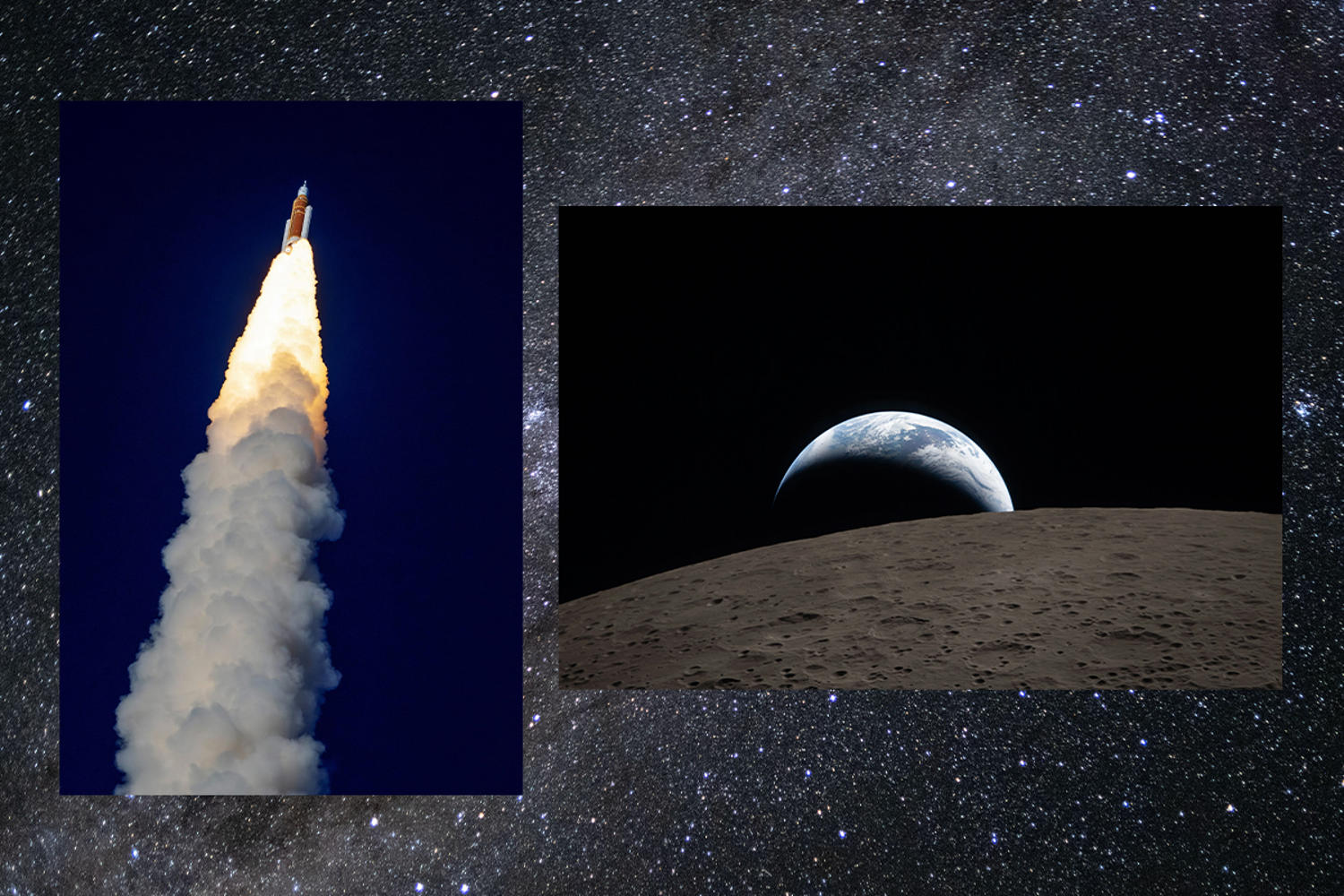
The return of the Artemis II Orion spacecraft represents a transition from deep-space ballistic trajectories to controlled atmospheric dissipation, where the vehicle must shed $11,000$ kilometers per hour of velocity while maintaining structural integrity. Unlike Low Earth Orbit (LEO) returns, which begin at roughly $28,000$ km/h, the Artemis II crew will hit the atmosphere at $40,000$ km/h. This difference in kinetic energy is not linear; because kinetic energy scales with the square of velocity ($KE = \frac{1}{2}mv^2$), the thermal protection system must manage nearly twice the energy of a standard ISS return. Success depends on a high-stakes sequence of orbital separation, plasma-induced communications blackout, and a multi-stage parachute deployment designed to transition a falling projectile into a stable maritime vessel.
The Separation Sequence and Entry Interface
The reentry process begins long before the first molecule of air touches the heat shield. The Orion Service Module (SM), which provides power and propulsion throughout the lunar mission, becomes a liability during atmospheric entry. It lacks a heat shield and possesses a high ballistic coefficient, meaning it would likely survive long enough to pose a debris risk if not discarded with precision.
The separation occurs at a predetermined "Entry Interface" altitude, typically cited as $121,920$ meters (400,000 feet). At this juncture, the Crew Module (CM) must orient its base toward the direction of travel. This orientation is critical. The center of mass in the Orion capsule is offset from the geometric center, allowing the vehicle to generate aerodynamic lift. By rotating the capsule (varying the bank angle), controllers can steer the vehicle through the atmosphere, extending the flight path to reduce $g$-loading or shortening it to hit a specific splashdown target. This "skip entry" capability is the defining technical advancement over the Apollo-era ballistic descents.
The Physics of Plasma and the Blackout Window
As the Orion CM descends into the denser layers of the mesosphere, the air in front of the heat shield is compressed so violently that it disassociates into a plasma. This ionized gas layer creates a temporary electromagnetic shroud around the vehicle.
The communication blackout is a function of plasma frequency. When the electron density of the plasma surrounding the capsule exceeds the frequency of the radio waves used for transmission (S-band or Ka-band), the signals are reflected or absorbed rather than transmitted. For Artemis II, this blackout is expected to last approximately seven minutes. During this window, the crew is effectively isolated, and the vehicle’s onboard Guidance, Navigation, and Control (GNC) systems must operate with absolute autonomy. The heat shield, composed of AVCOAT (a phenolic formaldehydic resin with silica fibers), undergoes ablation. This is a sacrificial process where the material chars, melts, and sublimates, carrying the intense thermal energy—peaking at nearly $2,760$°C ($5,000$°F)—away from the pressurized cabin.
Aerodynamic Deceleration and the Parachute Architecture
Once the vehicle survives the thermal peak and decelerates to subsonic speeds, the mission enters the most mechanically complex phase: the Landing Recovery System (LRS). The deceleration profile is managed through a sequence of eleven parachutes, deployed in four distinct stages.
- Forward Bay Cover (FBC) Jettison: The protective cap at the top of the Orion must be cleared to expose the parachute mortars. This is a pyrotechnic event that must occur precisely to avoid re-contact with the vehicle.
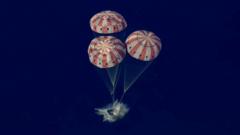
- Drogue Deployment: Two drogue parachutes deploy at approximately $7,600$ meters ($25,000$ feet) while the capsule is still traveling at $480$ km/h. These stabilize the capsule and pull it into a vertical orientation, slowing it to roughly $160$ km/h.
- Pilot Parachutes: Three small pilot chutes are mortar-deployed to pull the three massive main parachutes out of their packing bags.
- Main Parachutes: These chutes, which span nearly an acre of fabric when fully inflated, undergo a process called "reefing." They open in stages (10%, 50%, then 100%) to prevent the sudden deceleration force from snapping the risers or injuring the crew.
The redundancy built into this system is a core safety requirement. Orion is designed to land safely with only two of its three main parachutes functioning, though the impact velocity would increase from $32$ km/h to approximately $40$ km/h.
The Maritime Recovery Framework
Splashdown is not the end of the mission; it is the beginning of the recovery operation, led by a joint NASA and U.S. Navy team. The Pacific Ocean serves as a kinetic energy absorber, but it introduces the variable of sea state. The recovery window is dictated by wave height and wind speed to ensure the safety of both the crew and the divers.
Upon contact with the water, the capsule must remain upright. The Crew Module Uprighting System (CMUS) consists of five bright orange balloons that inflate on the top of the capsule. These ensure that the antennas remain above water for GPS and satellite communication and that the crew is not suspended upside down. The recovery ship, typically a San Antonio-class amphibious transport dock, approaches the capsule. Divers attach lines, and the vehicle is winched into the "well deck"—a flooded compartment at the rear of the ship. This method allows the crew to exit the capsule in a stable, climate-controlled environment rather than being hoisted via helicopter, which minimizes the physical strain on astronauts who have just spent ten days in microgravity and undergone a high-$g$ reentry.
Strategic Operational Constraints
The margin for error in the Artemis II reentry is governed by three primary constraints:
- Thermal Gradient: The interior cabin temperature must remain below $24$°C ($75$°F) despite the external plasma heat. Any failure in the multilayer insulation or the active cooling loops during the $5,000$°F soak would result in immediate loss of crew.
- Precision Targeting: The splashdown target is a $10$-kilometer-wide box. Missing this target complicates recovery logistics and delays medical intervention for the crew.
- Structural Loading: The vehicle must withstand $g$-forces that can reach $4$ to $7$ times Earth's gravity depending on the entry angle. A "shallow" entry risks skipping off the atmosphere back into space; a "steep" entry creates excessive thermal and structural loads that exceed the material limits of the airframe.
The Artemis II mission serves as the final validation of the Orion thermal protection system before it is used for the Artemis III lunar landing. The data collected during the plasma blackout—specifically the pressure distribution across the heat shield and the timing of the parachute reefing stages—will dictate the final hardware specifications for the next decade of deep-space exploration.
The recovery team must prioritize the extraction of the crew within 120 minutes of splashdown to mitigate the effects of post-flight orthostatic hypotension and vestibular dysfunction. Long-term mission success is defined not just by the survival of the hardware, but by the rapid stabilization of the human biological systems upon return to a 1g environment. Failure to execute the recovery within this window increases the risk of medical complications that could delay subsequent mission cadences.