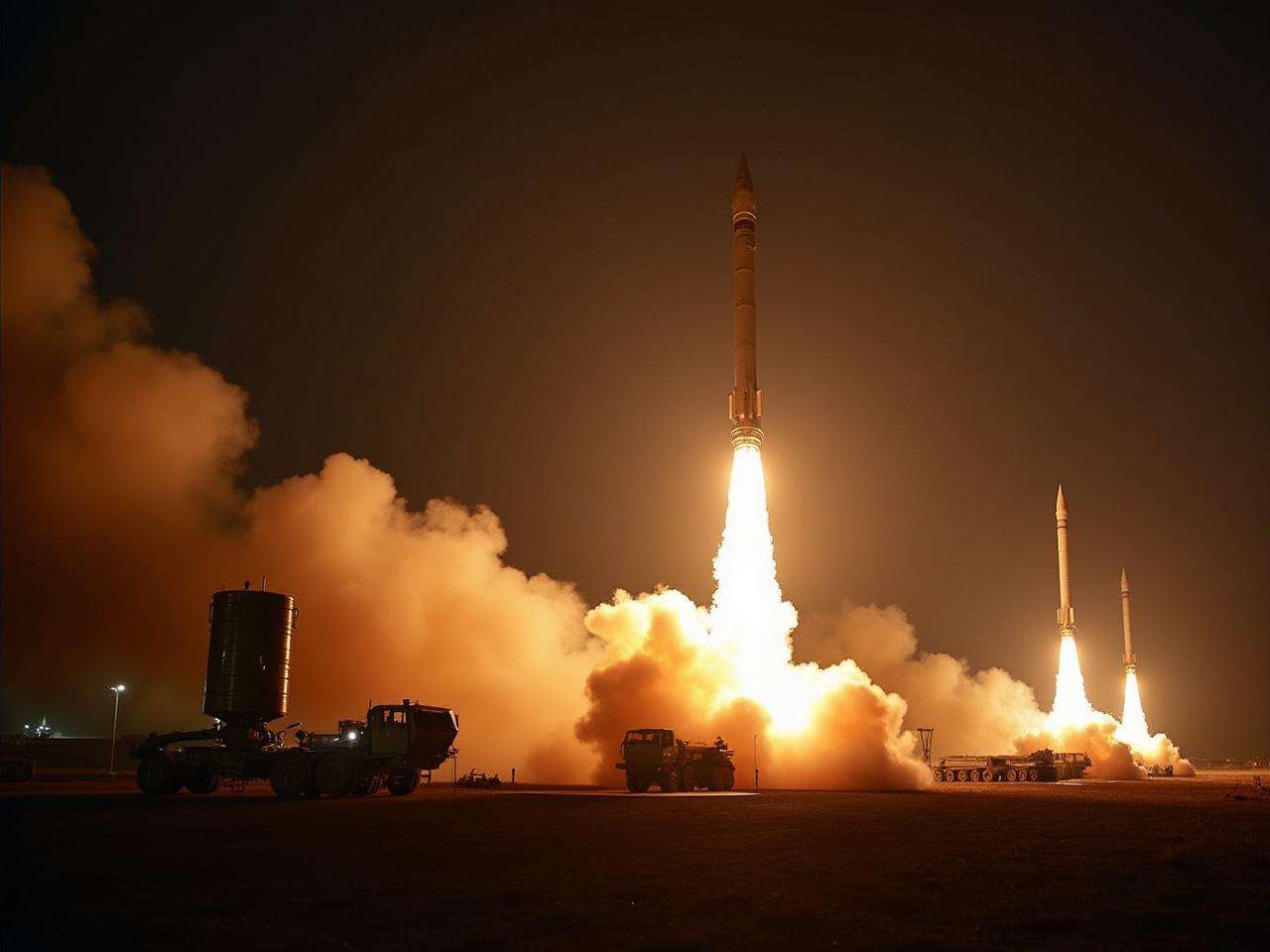
The visual confirmation of smoke over Doha following the interception of Iranian ballistic missiles represents more than a localized kinetic event; it is a stress test of the Integrated Air and Missile Defense (IAMD) architecture within the Persian Gulf. While headlines focus on the spectacle of explosions, the strategic reality is defined by the sensor-to-shooter loop, the physics of terminal phase interception, and the political signaling inherent in targeting a state that hosts the forward headquarters of U.S. Central Command (CENTCOM). The presence of debris over a capital city does not necessarily indicate a failure of the defense system; rather, it often confirms the successful execution of an engagement at an altitude where gravity dictates that neutralized components must eventually reach the surface.
The Kinematics of Interception and Debris Distribution
To understand why smoke appeared over Doha, one must categorize the event within the physics of ballistic missile defense (BMD). A ballistic missile follows a predictable trajectory: boost, mid-course, and terminal phases. Intercepting a medium-range ballistic missile (MRBM) requires a high-velocity kinetic kill vehicle or a fragmentation warhead to meet the threat at speeds often exceeding Mach 5. For a more detailed analysis into this area, we suggest: this related article.
The "smoke" witnessed by observers is typically the byproduct of three distinct mechanical occurrences:
- Booster Separation and Motor Burnout: If the interception occurs during a late mid-course phase, the visible plumes may simply be the discarded stages of the interceptor missiles (such as the Patriot PAC-3 or THAAD) or the terminal burn of the incoming threat.
- Kinetic Energy Transfer: When a hit-to-kill interceptor strikes a reentry vehicle (RV), the massive transfer of kinetic energy converts solid materials into a plasma and debris cloud. This cloud expands and drifts based on high-altitude wind currents.
- Low-Altitude Engagement: If an interceptor engages a target in the terminal phase (within the atmosphere), the resulting explosion interacts with air density, creating long-lasting smoke trails that are visible from the ground for several minutes.
The "success" of an interception is measured by the "Leakage Rate"—the percentage of warheads that reach their intended Mean Point of Impact (MPI). If the warhead is neutralized, the fall of "spent" interceptors and shattered missile casings is an unavoidable secondary effect of urban defense. For further details on the matter, comprehensive reporting is available on Al Jazeera.
The Strategic Triad of Qatari Defense
Qatar's vulnerability and subsequent defense response are governed by three structural pillars. These pillars dictate how the state and its allies respond to an aerial incursion from the north.
Pillar I: The Sensor Grid and Al Udeid Integration
Qatar sits at the nexus of the world's most dense radar environment. The Al Udeid Air Base serves as the Combined Air Operations Center (CAOC). The detection of a launch from Iran occurs within seconds via Space-Based Infrared System (SBIRS) satellites, which detect the heat signatures of rocket motors. This data is fed into the AN/TPY-2 X-band radar systems stationed throughout the region, providing the high-resolution tracking necessary for a firing solution.
Pillar II: Operational Overlap
The defense of Doha is not a solo endeavor. It involves a layered overlap between the Qatari Emiri Air Force (QEAF) and U.S. assets. Qatar has invested heavily in the Patriot PAC-3 MSE (Missile Segment Enhancement), designed specifically for hit-to-kill interceptions of ballistic missiles. The "smoke" over the city suggests these systems were active, likely engaging targets at the "last ditch" terminal phase to protect high-value infrastructure.
Pillar III: Geographic Proximity and Reaction Windows
The flight time for a ballistic missile from southern Iran to Doha is approximately 4 to 7 minutes. This creates a compressed decision window. The "Cost Function" of a missed interception in such a small geographic area is catastrophic, leading to an engagement doctrine that favors "salvo firing"—launching multiple interceptors at a single incoming threat to ensure a high Pk (Probability of Kill). This explains the multiple reports of explosions; for every one incoming missile, there were likely two or three interceptors launched.
The Economic and Diplomatic Friction of Interception
The quantification of this event extends beyond military hardware into the realm of regional stability and the "Insurance Premium" of the Gulf.
- The Cost Asymmetry: A single Iranian Fattah or Shahab-3 missile may cost between $100,000 and $500,000 to produce. In contrast, a single Patriot PAC-3 MSE interceptor costs approximately $4 million. When a capital city is targeted, the defender is forced into a negative economic exchange ratio to protect the vastly more expensive civilian and energy infrastructure.
- Aviation Gridlock: Doha is a global transit hub. The presence of missiles and interceptors in the flight information region (FIR) necessitates the immediate grounding or diversion of hundreds of commercial flights. The economic "drag" of a single hour of closed airspace over Hamad International Airport runs into the tens of millions of dollars in lost fuel, rescheduling, and logistical cascading.
Identifying the Iranian Intent: Signal vs. Noise
In military strategy, the choice of target is a form of communication. By targeting the vicinity of Doha, Tehran signals a willingness to bypass the traditional "red lines" associated with U.S. forward presence.
If the missiles were aimed at Al Udeid and were intercepted over the city, it demonstrates a "circular error probable" (CEP) that is unacceptably high for precision strikes, or a deliberate attempt to cause psychological terror among the civilian population. The mechanism of the attack suggests a "Saturation Strategy"—overwhelming the TPY-2 radars with more targets than the system can concurrently track and engage.
The failure of several missiles to hit their marks, resulting in mid-air interceptions, indicates that while Iran possesses the volume, the IAMD (Integrated Air and Missile Defense) remains technologically superior. However, the "smoke over the capital" serves as a visual proof-of-concept for Iran: they can reach the heart of the GCC's financial and logistical centers.
Engineering Limitations of Urban BMD
The primary bottleneck in defending a city like Doha is the "Debris Footprint." When an interception occurs at 30,000 feet, the debris field can span several square kilometers.
- The Interceptor Stage Fall: Patriot missiles use solid rocket boosters. Once the booster is spent, it detaches and falls. This is a heavy metal cylinder falling at terminal velocity.
- Unburned Propellant: If an incoming missile is broken apart rather than vaporized, unburned liquid or solid fuel can fall to the ground, causing secondary fires or chemical hazards.
- Psychological Cascading: In a high-density urban environment, the sound of a supersonic interceptor breaking the sound barrier (sonic boom) is often mistaken for a successful strike by the enemy, leading to panic even when the defense system is functioning perfectly.
The Defensive Pivot
The escalation over Doha forces a transition from a "Point Defense" posture to an "Area Defense" posture. Future deployments will likely see an increased reliance on THAAD (Terminal High Altitude Area Defense) to intercept threats further out in the exo-atmosphere, thereby moving the "smoke and debris" cloud away from populated centers.
The strategic play for regional actors is now the acceleration of the "Middle East Air Defense" (MEAD) alliance. This involves real-time data sharing between nations that previously kept their radar signatures proprietary. The event over Doha proves that a missile launched at one state is a threat to the entire flight corridor.
States must now quantify their risk not by the likelihood of a "hit," but by the inevitable disruption caused by a "successful defense." The smoke over Doha is the new baseline for regional conflict: a state of permanent high-altitude friction where the absence of a direct hit is still a victory for the defender, despite the falling steel.
The tactical imperative for the QEAF and CENTCOM is the immediate recalibration of interceptor launch logic to favor "up-range" engagements. This requires pushing the interception point further into the Persian Gulf waters, minimizing the debris risk to the Doha metropolitan area. Future procurement will likely prioritize maritime-based Aegis systems to provide a "picket line" that engages threats before they reach the Qatari coastline.


