The air in the hallways of power usually smells of expensive floor wax and stale coffee. But when the reports of fire over the desert reach the high-backed chairs of the United Nations or the briefing rooms of the Pentagon, the atmosphere shifts. It becomes electric, ionized by the weight of decisions that move borders.
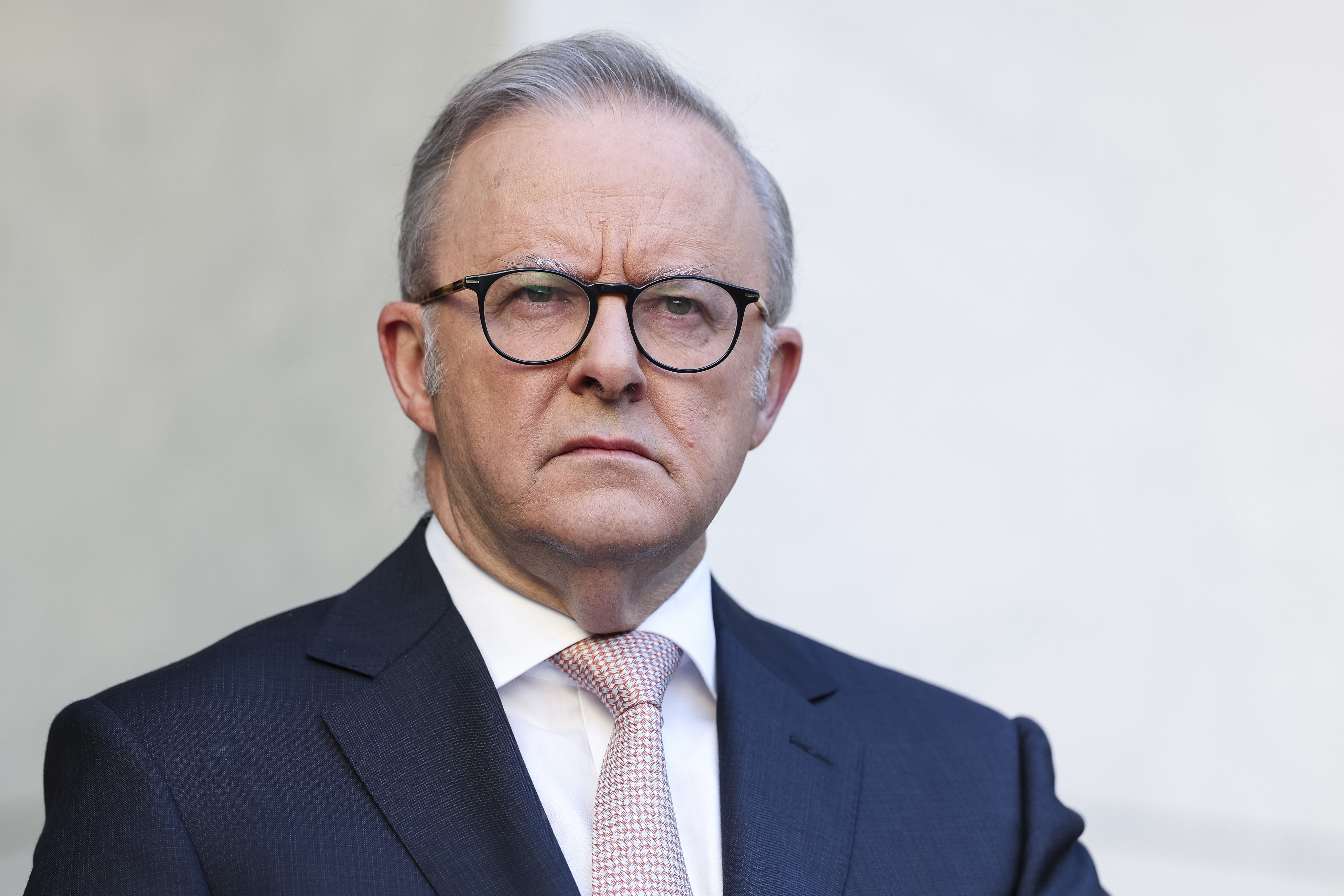
Anthony Albanese, standing at a lectern half a world away from the dust of the Levant, didn't just deliver a diplomatic critique this week. He spoke of a ghost. He spoke of a regime in Tehran that has, in his view, forfeited the right to call itself a representative of its people. The word he used was "legitimacy." It is a heavy word. In the world of international relations, losing your legitimacy is like losing your shadow; you are still there, you still take up space, but the world no longer recognizes your connection to the ground you stand on. If you found value in this piece, you might want to look at: this related article.
The backdrop for this rhetorical shift was a series of precision strikes. Metal met concrete. Fire met fuel. The United States, responding to the deaths of its own soldiers, reached out across the map to strike at the nervous system of Iranian-backed influence.
The Arithmetic of the Street
Consider a woman in Shiraz. We will call her Leyla—a hypothetical name for a very real demographic. Leyla does not wake up thinking about the maritime security of the Red Sea or the ballistic capabilities of the Islamic Revolutionary Guard Corps. She wakes up thinking about the price of eggs. She thinks about the fact that her internet was throttled again last night, cutting her off from a cousin in Toronto. For another angle on this development, see the recent coverage from The New York Times.
For Leyla, legitimacy isn't found in a UN resolution. It is found in the social contract. I give you my taxes, my compliance, and my silence, and in return, you give me a future where my children don't have to flee the country to breathe. When the state spends its dwindling treasury on proxy militias in Iraq or drones for a war in Europe, that contract isn't just breached. It is shredded.
Albanese’s assertion mirrors this internal fracture. By stating that the regime is "without legitimacy," he is aligning Western diplomatic posture with the shouts heard during the "Woman, Life, Freedom" protests. He is suggesting that a government which must consume its own people to survive has stopped being a government and has become a siege engine.
The Geography of a Proxy
The strikes weren't just about revenge. They were about the map. To understand the current tension, you have to look at the Middle East not as a collection of nations, but as a series of overlapping circles of influence.
Iran has mastered the art of "forward defense." The logic is simple: if you fight your enemies in Baghdad, Damascus, and Sana’a, you never have to fight them in Tehran. It is a brilliant, ruthless strategy of outsourcing risk. But the risk has finally come home to roost.
When an Iranian-made drone kills American service members at a remote base called Tower 22, the distance between the proxy and the patron vanishes. The "deniability" that Tehran has polished for decades becomes a transparent lie. The US strikes were a physical manifestation of that realization. They were a message written in kinetic energy: We know who holds the leash.
The Weight of the Word
Why does it matter if a Prime Minister in Canberra calls a regime illegitimate?
It matters because legitimacy is the currency of the global order. Without it, you cannot easily borrow money. You cannot sit at the table of civilized nations. You become a pariah. For decades, the West tried to treat Iran as a difficult, often bad-faith actor that was nonetheless a permanent fixture of the landscape. There was a hope that through deals—like the 2015 nuclear agreement—the regime could be incentivized to join the modern world.
That hope is dying.
The shift in language from "troubling actor" to "without legitimacy" signals a move toward containment rather than engagement. It is a confession of failure. It is an admission that the regime's ideology is fundamentally incompatible with the stability of the region.
But there is a danger in this clarity. When you tell a regime it has no right to exist, you remove its incentive to play by the rules. A cornered animal does not negotiate; it bites. The Iranian leadership knows that its survival depends on its ability to project strength. If it looks weak at home, the Leylas of Shiraz might find their voices again. If it looks weak abroad, its proxies might look for new masters.
The Invisible Stakes
We often talk about these events in terms of "geopolitical chess." It’s a clean metaphor. It suggests grandmasters sitting in quiet rooms moving wooden pieces.
The reality is much messier. It is the sound of a secondary explosion in a residential neighborhood in Baghdad where a militia kept its rockets. It is the trembling hands of a diplomat who knows that one miscalculation could turn a "limited strike" into a regional conflagration. It is the silence of the Iranian people who are watching their leaders gamble with the nation’s remaining wealth and security.
Albanese noted that the regime’s actions are "contrary to the interests of their own people." This is the core of the argument. A legitimate state acts as a shield for its citizens. An illegitimate one acts as a parasite.
The strikes in Iraq and Syria were meant to degrade the parasite's ability to strike out. But the deeper wound is internal. Every time a Tomahawk missile finds an IRGC warehouse, it highlights the regime's inability to protect its assets or its allies. It exposes the rot.
The Echo in the Silence
There is a specific kind of quiet that follows a massive explosion. It is the sound of the world holding its breath, waiting to see what happens next.
Will Tehran escalate? Or will it retreat into the shadows, waiting for the heat to die down before resuming its long-game strategy? The answer likely lies in how much legitimacy they feel they have left to lose.
If the regime truly feels the ground shifting beneath them—if they see the international community aligning behind the idea that they are an illegal entity—they may lash out with everything they have. Or, perhaps, they will realize that the cost of their "forward defense" has finally exceeded their ability to pay.
The tragedy is that the people of Iran are the ones who pay the bill. They pay it in inflation. They pay it in blood. They pay it in the loss of a future that should have been theirs.
As the smoke clears over the latest targets, the maps remain the same, but the air has changed. The labels are being rewritten. "Legitimacy" is gone. Only the power remains. And power without legitimacy is a flame that eventually consumes the candle.
The sun sets over the Persian Gulf, casting long, distorted shadows of the tankers and the warships. The water is dark, deep, and indifferent to the names we give the men who claim to rule the land. But on the shore, the people are still there, waiting for a government that sees them not as a shield or a weapon, but as a reason to exist. Until that day comes, the fires in the desert will continue to burn, lighting up a landscape where the only thing certain is the cost of the next strike.
It is a high price to pay for a shadow.
Would you like me to analyze the specific economic impacts of these strikes on regional trade routes?