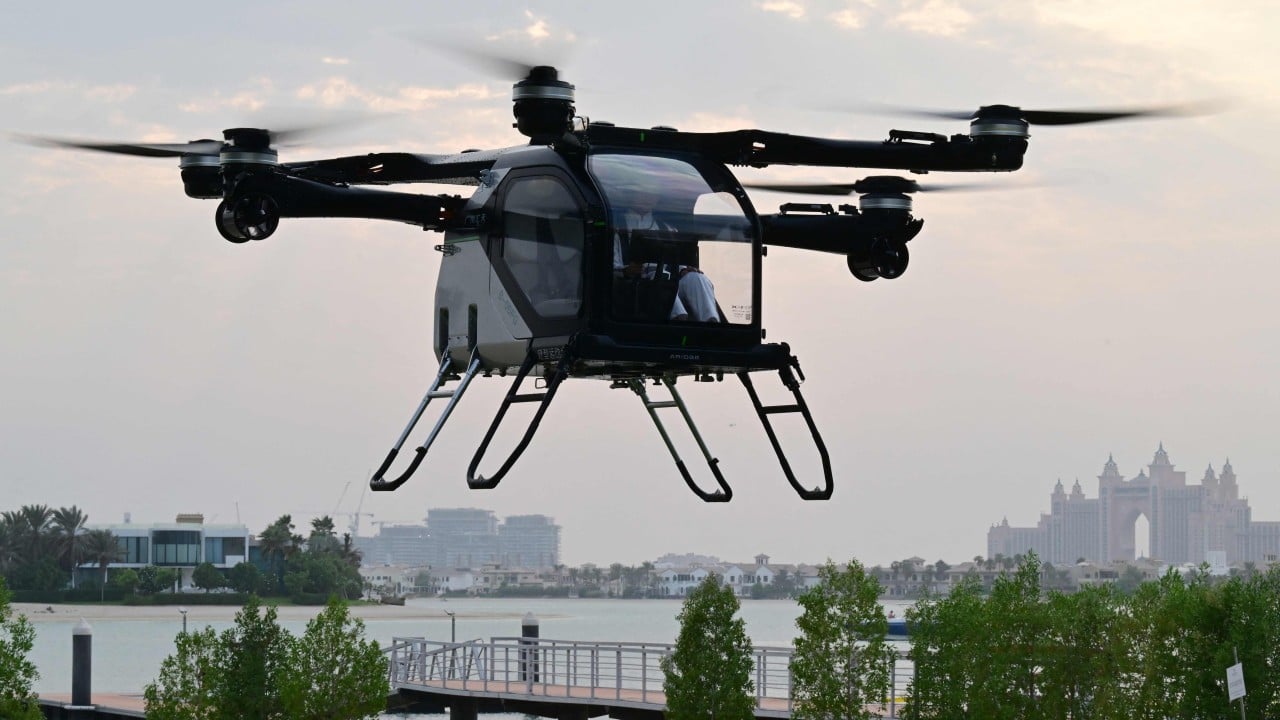
Xpeng Aeroht, the aviation arm of Chinese EV giant Xpeng, recently secured $200 million in Series B1 funding to push its modular flying car toward mass production. While the headline suggests a triumphant ascent for urban air mobility, the capital injection masks a desperate race against physics, regulatory inertia, and the unforgiving economics of the aerospace industry. This isn't just about building a car with wings. It is about whether a company can survive the transition from venture-backed prototyping to the brutal reality of a certified assembly line.
The dream of the flying car has been a recurring trope of the future for a century, yet it remains tethered to the ground by a simple, inconvenient truth: gravity is expensive. Xpeng Aeroht’s latest design, a "modular" vehicle that carries a separate flight component in the back of a six-wheeled ground vehicle, attempts to sidestep the engineering nightmares of traditional eVTOL (electric vertical takeoff and landing) craft. By splitting the machine in two, they avoid the weight penalties of carrying wings and rotors on the highway. However, this clever workaround introduces a new set of logistical and safety hurdles that the industry has yet to solve.
The Modular Gamble
Most competitors in this space are chasing the "air taxi" model—sleek, integrated pods designed for ride-sharing. Xpeng is taking a different path by targeting the private owner first. The "Land Carrier" consists of a mother ship that looks like a futuristic van and a detachable flight module.
This modularity is a pragmatic response to the weight problem. Batteries are heavy. Aerospace grade materials are expensive. If you try to make one vehicle do both jobs perfectly, you usually end up with a mediocre car and a dangerous plane. By separating them, Xpeng allows the ground vehicle to handle the daily commute while the air module waits for the weekend.
But pragmatism comes with a price tag. Selling a two-part vehicle to enthusiasts requires a specialized supply chain that doesn't exist. You cannot fix a carbon-fiber rotor at a local Pep Boys. The $200 million raised is a drop in the ocean when compared to the billions required to establish a global service network for a product that literally falls out of the sky if a single component fails.
Why the Tech is Only Half the Battle
Innovation is easy; certification is hard. The CAAC (Civil Aviation Administration of China) is moving faster than the FAA in the United States, but speed does not equate to simplicity. To fly over a city, a vehicle must prove a failure rate of less than one in a billion flight hours.
Compare that to the automotive world. If your Tesla's motor dies, you pull over. If an Aeroht module loses power at 500 feet, you are a kinetic energy event.
The current funding will likely be swallowed by the "Iron Bird" testing phase—a grueling process where every mechanical system is pushed to its breaking point on a stationary rig. Xpeng must prove that the docking mechanism between the van and the flight module won't degrade after five hundred cycles of rain, salt, and vibrations. If that connection fails, the entire business model collapses.
The Energy Density Wall
We must talk about the batteries. Current lithium-ion technology is sufficient for a 300-mile drive in a sedan. It is barely sufficient for a 20-minute hop in a vertical takeoff craft. Vertical takeoff is the most energy-intensive maneuver in aviation. It requires a massive burst of power to fight gravity before the wings can take over the burden of lift.
- Takeoff: Consumes roughly 30% of the total battery capacity in the first 90 seconds.
- Cruise: More efficient, but limited by the weight of the battery itself.
- Reserve: Aviation laws require a 20-minute fuel reserve, which for an electric craft, means carrying "dead weight" battery cells that you hope to never use.
Xpeng is betting on rapid improvements in solid-state batteries or high-nickel chemistries. If those breakthroughs don't arrive in the next twenty-four months, the Land Carrier remains a luxury toy for the ultra-wealthy with a very short range.
The Infrastructure Mirage
Even if the vehicle works perfectly, where does it go? The current "vertiport" maps look great in marketing brochures but ignore the reality of urban zoning. Residents who complain about the noise of a leaf blower are not going to tolerate a high-pitched electric rotor spinning at 3,000 RPM in their neighbor's driveway.
The noise profile of eVTOLs is lower than helicopters, but it isn't silent. It is a distinctive, "shredding" sound that carries. Without a massive overhaul of noise ordinances and the construction of thousands of charging pads, these vehicles will be relegated to rural areas and private estates. This limits the market size significantly, potentially choking off the revenue needed to pay back that $200 million.
The Geopolitical Flight Path
China is currently the world leader in low-altitude economy policy. The central government has designated this sector as a "strategic emerging industry," which explains why Xpeng Aeroht can raise $200 million while Western counterparts like Lilium and Joby struggle with fluctuating stock prices and skeptical regulators.
However, this state-backed momentum creates a bubble. When the government dictates that an industry must succeed, capital flows in regardless of the underlying unit economics. We saw this with the Chinese bike-sharing craze and the early days of the EV surge. Dozens of companies will be funded, but only one or two will survive the "valley of death" between the first prototype and the ten-thousandth unit.
Xpeng has the advantage of the parent company’s manufacturing expertise. They know how to bend metal and manage a warehouse. But building a car at scale is not the same as building an aircraft. In the car world, a 1% defect rate is a recall. In aviation, it is a catastrophe that ends the company.
The Cost of Entry
Early estimates put the price of the Land Carrier around $200,000 to $300,000. That puts it in the range of a high-end Porsche or a base-model Ferrari. The difference is that a Ferrari doesn't require a pilot's license.
Xpeng claims they are developing autonomous flight systems to make flying as easy as driving. This is a massive "if." Autonomous flight in a controlled airspace is one thing; autonomous flight in a chaotic urban environment with birds, drones, and unpredictable weather is an entirely different level of complexity. The software requirements alone will likely cost more than the hardware development.
The Safety Narrative
To win over the public, Xpeng Aeroht is leaning heavily on safety features like multi-rotor redundancy and a whole-vehicle parachute. If one motor dies, the others compensate. If the whole system dies, the parachute deploys.
This sounds comforting until you realize that parachutes have a minimum deployment altitude. If a failure occurs during the critical takeoff or landing phase—where most accidents happen—a parachute is just extra weight. The engineering team is fighting a war against the clock to ensure the transition from vertical to horizontal flight is seamless every single time.
Financial Sustainability
$200 million sounds like a lot of money. In the aerospace world, it is barely enough to cover the payroll of a top-tier engineering team for eighteen months.
To reach profitability, Xpeng Aeroht needs to move beyond the "Series B" mindset and start delivering a product that generates recurring revenue. This might mean pivoting toward emergency services, search and rescue, or high-speed logistics before they ever sell a single unit to a private commuter. The "flying car" might actually be a "flying ambulance" for the first decade of its existence.
The investors aren't just betting on Xpeng; they are betting that the Chinese government will force the infrastructure into existence. They are betting that the regulatory hurdles will be cleared by decree rather than by decades of debate. It is a high-stakes gamble on a top-down revolution.
Watch the flight tests scheduled for late 2025. If Xpeng can demonstrate a fully autonomous transition from ground to air with a human passenger in a non-simulated environment, the $200 million will look like a bargain. If they hit a technical snag, that capital will evaporate as quickly as the lift under a stalled wing.
Check the local zoning laws in your region before you start clearing space in the garage for a rotorcraft. The sky might be open, but the paperwork is still very much on the ground.


