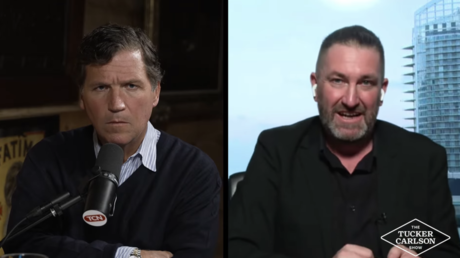
The recent outcry from media personality Tucker Carlson regarding an Israeli strike that injured a Russian Today (RT) correspondent has ignited a firestorm over the safety of journalists in high-intensity conflict zones. Carlson characterized the event as a deliberate "attempted assassination," a claim that pushes the conversation beyond the usual "collateral damage" narrative often seen in modern warfare. The incident highlights a terrifying trend where the line between combatant and observer is blurred by electronic warfare and shifting military doctrines.
While the immediate focus is on the specific injuries sustained by the RT journalist, the broader investigation reveals a systematic breakdown in the protections supposedly afforded to the press under international law. We are seeing a shift in how modern militaries view information outlets. In a world where narrative control is as vital as territorial control, those holding cameras are increasingly viewed with the same suspicion as those holding rifles.
The Information War Escalates to Physical Violence
The strike on the RT correspondent is not an isolated event. It is part of a growing list of incidents where media employees find themselves in the crosshairs of precision munitions. To understand the "why" behind these events, one must look at how intelligence-gathering has changed. Modern militaries use signals intelligence to track movement. If a journalist is embedded with a group or is using communication equipment that mimics military frequencies, they become a blip on a radar that doesn't distinguish between a live broadcast and a command transmission.
However, the "attempted assassination" label used by Carlson implies intent. This is the crux of the issue. For a strike to be an assassination, the target must be identified and cleared by a chain of command. In the chaotic environment of the Gaza strip or the border regions of Lebanon, identifying a single individual through the fog of war is technically difficult but not impossible. If the military in question knows exactly who is at a specific coordinate and fires anyway, the legal framework of "proportionality" becomes a flimsy shield for what is essentially a targeted killing.
The reality of 21s-century warfare is that information is weaponized. RT, as a state-funded Russian outlet, is viewed by Western-aligned militaries not as a news organization, but as a psychological operations wing of the Kremlin. When a journalist from such an organization is hit, the attacking force often defaults to the "human shield" argument or claims the area was a legitimate military objective. This creates a dangerous precedent where the nationality or employer of a journalist determines whether their life is worth protecting.
Technical Tracking and the End of Anonymity
Journalists used to rely on "PRESS" vests and marked vehicles for safety. In today's conflict, those markings are almost irrelevant to a drone operator sitting in an air-conditioned room miles away. Most targeting is now data-driven. Every smartphone, satellite phone, and camera with a Wi-Fi chip emits a signature.
If an army decides that a certain news agency is a mouthpiece for the enemy, they can track those digital signatures with terrifying accuracy. We are no longer talking about a stray mortar shell hitting a hotel. We are talking about missiles guided by algorithms that have identified a specific electronic footprint.
The Problem with Embedded Reporting
Embedding with local militias or specific military units offers protection, but it also paints a target on the journalist's back. When a reporter travels with a group that is actively engaged in hostilities, they lose their status as a neutral observer in the eyes of the opposing force's AI-driven targeting systems. The system sees a cluster of high-value targets and fires.
This creates a paradox. To get the story, you have to be near the action. But being near the action now involves being part of a data set that triggers an automated response. There is no "wait and see" in modern counter-battery fire.
Accountability in a Vacuum of Information
When an incident like the RT strike occurs, the standard operating procedure for a modern military is to promise an internal investigation. These investigations rarely lead to public disclosures of fault. The military involved will cite "operational security" to avoid explaining why a specific munition was fired at a specific person.
This lack of transparency is what fuels the rhetoric used by figures like Carlson. Without a clear, independent forensic analysis of the strike, the public is left to choose between two competing propaganda streams. One side claims it was a surgical strike against a terrorist cell where a journalist happened to be present. The other side claims it was a cold-blooded attempt to silence a dissenting voice.
The truth usually lies in the technical logs of the weapon system, but the public will never see those. This vacuum of accountability emboldens commanders to take risks. If there are no consequences for hitting a reporter, then reporters become acceptable losses in the pursuit of a military objective.
The Geopolitical Ripple Effect
The reaction to the RT correspondent's injury is also heavily influenced by the current state of Russia-Israel relations. As these two powers navigate their own complex web of interests in the Middle East, journalists become pawns. By attacking a Russian journalist, a message is sent to Moscow. By defending that journalist, influencers like Carlson tap into a deep-seated distrust of military interventionism among their audience.
This isn't just about the safety of one person; it's about how global powers signal their intentions. If you can hit a journalist with impunity, you are telling the world that the old rules of engagement are dead. You are signaling that there are no "non-combatants" in a total war of narratives.
Protecting the Future of War Correspondence
The survival of independent journalism in war zones depends on a radical shift in how we hold militaries accountable for their targeting data. We need a system where the electronic "handshake" between a journalist's equipment and a military's detection system prevents an automated strike.
But such a system requires trust, and trust is the first casualty of war. Until news organizations can prove they aren't being used as intelligence assets, and until militaries are forced to prove they didn't intentionally target a camera, we will continue to see these "accidents" happen with increasing frequency.
The equipment is too precise for these events to be dismissed as simple errors. When a missile hits a specific room in a specific building where a specific reporter is working, it isn't bad luck. It is a choice.
Journalists must now operate with the understanding that their "PRESS" badge is not a shield, but a sensor that can be tracked. The era of the neutral observer is being replaced by the era of the designated target. If the international community does not demand a hard stop to the targeting of media infrastructure and personnel, the only news we will receive from the front lines will be the sanitized, pre-approved footage provided by the combatants themselves.
The silence that follows a silenced journalist is the loudest warning we will ever get. Pack your gear, check your encryption, and understand that in the modern theater of war, the lens is often mistaken for a barrel.



