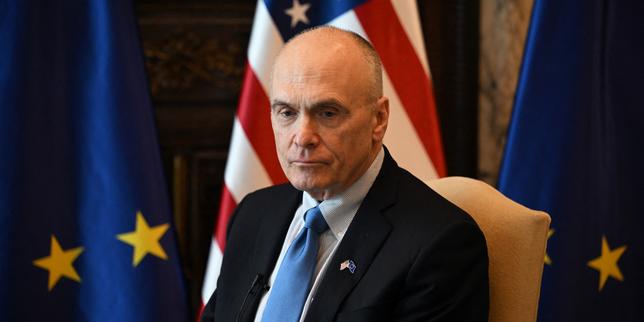
The air in a boardroom at the European Commission is usually thin, filtered, and heavy with the scent of expensive espresso and ancient bureaucracy. It is a place where sentences are constructed like fortifications, layered with clauses and sub-clauses designed to ensure that nothing radical ever happens too quickly. But the arrival of Andrew Puzder as the United States Ambassador to the European Union feels less like a diplomatic appointment and more like someone driving a monster truck through the front doors of a silent cathedral.
For decades, the bridge between Washington and Brussels was built by career diplomats—people who spoke the language of treaties and knew exactly which fork to use at a state dinner. Puzder, however, is a man whose legacy is built on charbroiled meat, scantily clad models in television commercials, and a fierce, uncompromising devotion to the bottom line. He is the former CEO of CKE Restaurants, the parent company of Carl’s Jr. and Hardee’s. He is a titan of the American fast-food industry. He is, by every definition, a disruptor. Meanwhile, you can explore similar developments here: The Russian LNG Gamble Testing Washington Sanctions in Indian Waters.
Now, he is being asked to trade the "Thickburger" for the thicket of European regulations.
The friction is already audible. Imagine a veteran European trade negotiator, a person who has spent thirty years perfecting the art of the compromise, sitting across from a man who once said that he liked the provocative ads for his burger chain because they were "very American." The gap between them isn't just geographical. It’s ideological. It’s the difference between the slow-cooked, protected economies of the Old World and the high-heat, grease-splattered volatility of the New. To explore the full picture, we recommend the recent article by CNBC.
The Man Behind the Counter
To understand why this appointment has sent a shudder through the corridors of the Berlaymont, you have to look at what Puzder represents. He isn't just a political ally of Donald Trump; he is a philosophical twin. Puzder didn’t climb the ranks of the State Department. He climbed the ranks of corporate law and franchise management. He saved a failing burger empire by stripping away the excess, leaning into aggressive marketing, and fighting tooth and nail against minimum wage hikes and labor regulations.
In the world of CKE Restaurants, efficiency was the only god worth worshipping. Puzder famously mused about the benefits of automation, noting that machines never take vacations, never show up late, and never file age, sex, or race discrimination cases. For a European audience—where the social safety net is treated as a sacred text and labor unions hold significant sway over national policy—this isn't just a difference of opinion. It’s a threat to a way of life.
Consider the hypothetical, yet highly plausible, first meeting between Puzder and a French labor leader. The Frenchman speaks of the "dignity of the worker" and the "thirty-five-hour work week." Puzder looks at a spreadsheet. To him, the dignity of the worker is found in the opportunity to have a job in the first place, a job that he believes is often regulated out of existence by the very protections the European claims to cherish.
This is the central tension of his tenure. He isn't there to learn the local customs. He is there to export a specific brand of American capitalism that many in Europe find distasteful, if not outright dangerous.
The Invisible Stakes of a Trade War
Diplomacy is often viewed through the lens of high-level summits and photo ops, but the real stakes are found in the grocery aisles and the factory floors. When Puzder sits down to discuss trade, he isn't just talking about abstract percentages. He is talking about the cost of a car made in Stuttgart or the regulations governing a digital startup in Tallinn.
The European Union has long positioned itself as the world’s "regulatory superpower." Whether it’s data privacy through GDPR or the aggressive pursuit of climate goals, Brussels sets the rules that the rest of the world often feels forced to follow. Puzder represents the American counter-punch. He views these regulations not as protections, but as "non-tariff barriers to trade."
He sees a Europe that is over-regulated, under-innovated, and dangerously comfortable in its decline.
If you are a small business owner in Ohio trying to export medical devices to France, Puzder is your champion. He wants to tear down the "fortress" of European standards that keep American products out. But if you are a consumer in Berlin who cares deeply about the chemicals in your food or the privacy of your emails, Puzder is the wolf at the door. He is the man who wants to bring "American standards"—which often means fewer standards—to your backyard.
The stakes are personal. They are about whether the future looks more like a regulated, stable, but slower-growing Europe, or a fast, lean, but precarious America.
A Parachute into Unfamiliar Terrain
There is a specific kind of arrogance required to be a "parachutist" in the world of diplomacy. It requires the belief that your success in one arena—selling burgers to the American masses—will naturally translate to navigating the complex, multi-national ego of the European Union.
Puzder is not the first businessman to be sent to a high-level diplomatic post, but he is perhaps the most "un-European" choice possible. He doesn't believe in the "Social Market Economy." He believes in the market. Period.
One can almost see him standing in the middle of the Grand Place in Brussels, surrounded by guild houses that have stood for centuries, and seeing not history, but missed opportunities for redevelopment and deregulation. There is a fundamental clash of time scales. Europe thinks in centuries; Puzder thinks in fiscal quarters.
But there is a risk for the Europeans in dismissing him too quickly. While his style may be abrasive and his rhetoric blunt, he carries the weight of the largest economy in the world. You don't have to like the man who runs the burger joint to realize that he owns the lease on your favorite parking spot.
European leaders are now forced into a delicate dance. They must engage with a man who fundamentally disagrees with their worldview, without ceding the ground they have spent decades defending. They have to find a way to talk to a "Trumpiste" who doesn't speak their language and doesn't particularly care for their accent.
The Cost of the Disconnect
The real tragedy of this appointment might not be the policy shifts, but the widening of the emotional Atlantic. For decades, despite trade spats and political disagreements, there was a sense of shared purpose between Washington and Brussels. There was a common vocabulary.
With Puzder, that vocabulary has been replaced by the jargon of the leveraged buyout.
We are witnessing the "corporatization" of the alliance. When every interaction is viewed as a transaction, something vital is lost. The nuance of history, the shared values of democracy, and the delicate balance of social cohesion are all sacrificed on the altar of the "Great Deal."
Puzder’s presence in Brussels is a signal that the era of the "special relationship" is over, replaced by a "franchise agreement." It’s a world where the customer—in this case, the United States—is always right, and if the service isn't fast enough, they’ll take their business elsewhere.
There is an undeniable coldness to this approach. It ignores the fact that countries aren't companies and citizens aren't customers. You can’t just fire a trade partner because they’re underperforming. You can’t "rebrand" a centuries-old alliance with a new marketing campaign and a few provocative slogans.
The Last Order
Late at night, after the cameras are off and the aides have gone home, one wonders what Puzder thinks of his new surroundings. Does he see the beauty in the complexity of the European project? Or does he just see a messy, inefficient organization that needs a new CEO to come in and trim the fat?
The answer will determine the fate of millions of people who will never meet him. It will dictate the price of their goods, the privacy of their data, and the stability of their jobs.
Andrew Puzder didn't come to Brussels to be a diplomat. He came to be a liquidator. He is there to see what he can get for the American interest, and he isn't particularly worried about the mess he leaves behind.
As the sun sets over the Cinquantenaire Park, casting long shadows across the monuments of a different era, the smell of change is in the air. It’s a familiar scent to anyone who has ever spent time in a fast-food kitchen: the smell of high heat, heavy oil, and a singular, relentless focus on the next order.
The burger king has arrived, and he isn't taking any more questions about the menu.