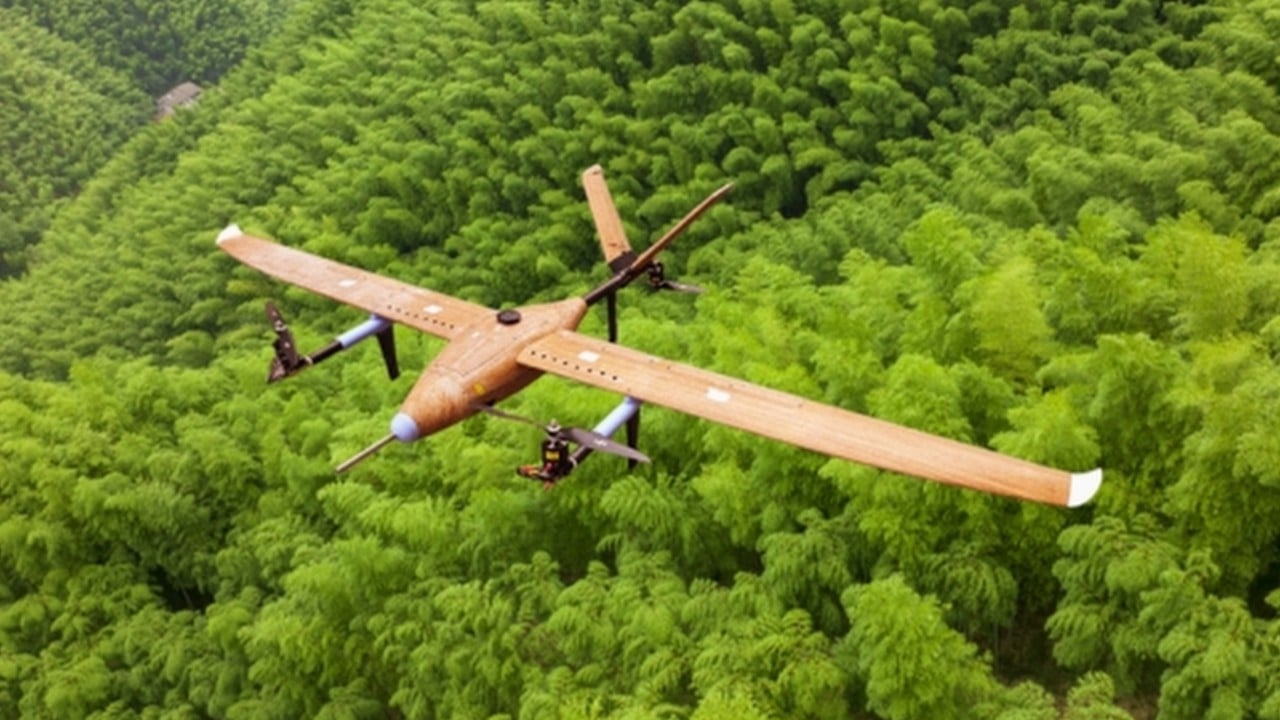
Building a high-performance drone used to mean one thing: expensive carbon fiber. It’s light, it’s strong, and it costs a fortune. But researchers at Nanjing University of Aeronautics and Astronautics just flipped that script. They’ve developed the world’s first fixed-wing drone made almost entirely from bamboo fiber. It isn't just a quirky science project. This move cuts production costs by a staggering 75%. That's the kind of math that changes an entire industry overnight.
If you've ever flown a professional-grade UAV, you know the dread of a crash. Replacing a composite fuselage can cost more than the electronics inside. By shifting to a bio-based material, we’re looking at a future where airframes are essentially disposable. This isn't just about being green. It's about the cold, hard economics of mass production.
The Problem With Modern Composites
Most people think carbon fiber is the peak of engineering. In many ways, it is. But it’s also a nightmare for the environment and the bank account. The energy required to produce carbon filaments is massive. Once a carbon fiber wing snaps, it's headed straight for a landfill because recycling it is nearly impossible.
Bamboo changes that. It grows at a ridiculous rate—some species can shoot up three feet in a single day. It’s naturally reinforced with longitudinal fibers that mimic the structural needs of an aircraft. The Chinese research team realized that by processing these fibers into a specialized composite, they could achieve a strength-to-weight ratio that rivals traditional materials while staying incredibly cheap.
Engineering the Bamboo Wing
You can't just hollow out a stalk of bamboo and expect it to fly. The magic happens in the resin infusion. The engineers took raw bamboo fibers and treated them to resist moisture and decay. One of the biggest hurdles with organic materials in aviation is "dimensional stability." Basically, wood swells when it gets wet. If your wing changes shape in a rainstorm, you’re going down.
The Nanjing team solved this by using a vacuum-assisted resin transfer molding process. They layered the bamboo fibers in specific orientations to handle the aerodynamic loads. The result? A fixed-wing UAV that handles high-stress maneuvers without splintering.
I’ve seen plenty of "eco-friendly" prototypes that fall apart the moment they hit a gust of wind. This is different. The structural integrity here is legitimate. During flight tests, the bamboo drone maintained its shape under high G-loads, proving that natural fibers aren't just for furniture anymore.
Why the 75 Percent Savings Matter
A 75% reduction in cost is unheard of in aerospace. Usually, we celebrate a 5% or 10% efficiency gain. If a drone that used to cost $10,000 to manufacture now costs $2,500, the tactical and commercial math shifts completely.
- Agricultural Swarms: Farmers can deploy dozens of these for crop monitoring without worrying about the ROI on a single crashed unit.
- Environmental Monitoring: We can send these into hazardous zones—like active volcanoes or chemical spills—knowing the loss of the airframe won't break the budget.
- Defense and Attrition: In modern conflict, quantity has a quality of its own. Cheap, mass-produced airframes are harder to defend against than a few expensive "exquisite" systems.
The weight penalty is also surprisingly low. Bamboo is denser than some foams but offers much higher rigidity. This means the drone can carry heavier sensors or larger batteries than a plastic equivalent could support.
The Sustainability Factor Nobody Talks About
We talk about "green tech" all the time, but the drone industry has a massive e-waste problem. Every time a hobbyist or a commercial pilot tosses a broken plastic or carbon frame, it adds to the pile. Bamboo is biodegradable. If a bamboo drone goes down in a forest and isn't recovered, the airframe will eventually break down and return to the soil.
The carbon footprint of the manufacturing process itself is also significantly lower. You aren't running high-heat furnaces for days to bake carbon sheets. You're essentially harvesting a crop and pressing it into a mold. It's a localized supply chain that doesn't rely on complex chemical precursors often sourced from overseas.
Addressing the Skeptics
Whenever I mention wooden or bamboo aircraft, people bring up the Spruce Goose or old WWI biplanes. They think we’re going backward. That’s a mistake. We aren't using 1914 technology; we’re using 2026 material science applied to a 1,000-year-old plant.
The biggest legitimate concern is long-term durability in extreme humidity. While the resin coating helps, organic fibers are still more susceptible to environmental degradation than synthetic ones. If you leave a bamboo drone in a damp hangar for three years, will it still be airworthy? Probably not without some serious maintenance. But for drones with a short operational lifespan—which is most of them—this doesn't matter.
Moving Toward Bio-Aviation
This breakthrough from China is a wake-up call for Western manufacturers who are obsessed with high-cost composites. We've spent decades trying to make drones more "premium," but the real innovation is making them more accessible.
If you're a developer or a hobbyist, start looking at bio-composites now. The software and the silicon are already cheap. The airframe was the last major price barrier. With bamboo fibers entering the mix, we’re about to see an explosion in specialized, low-cost UAVs that do the jobs carbon fiber was always too expensive to handle.
Check your local regulations and see how these weight classes affect your flight permits. Often, a lighter, cheaper airframe can slip into lower regulatory tiers, making your commercial operations much easier to manage. Stop overspending on carbon and start looking at what's growing in the backyard.