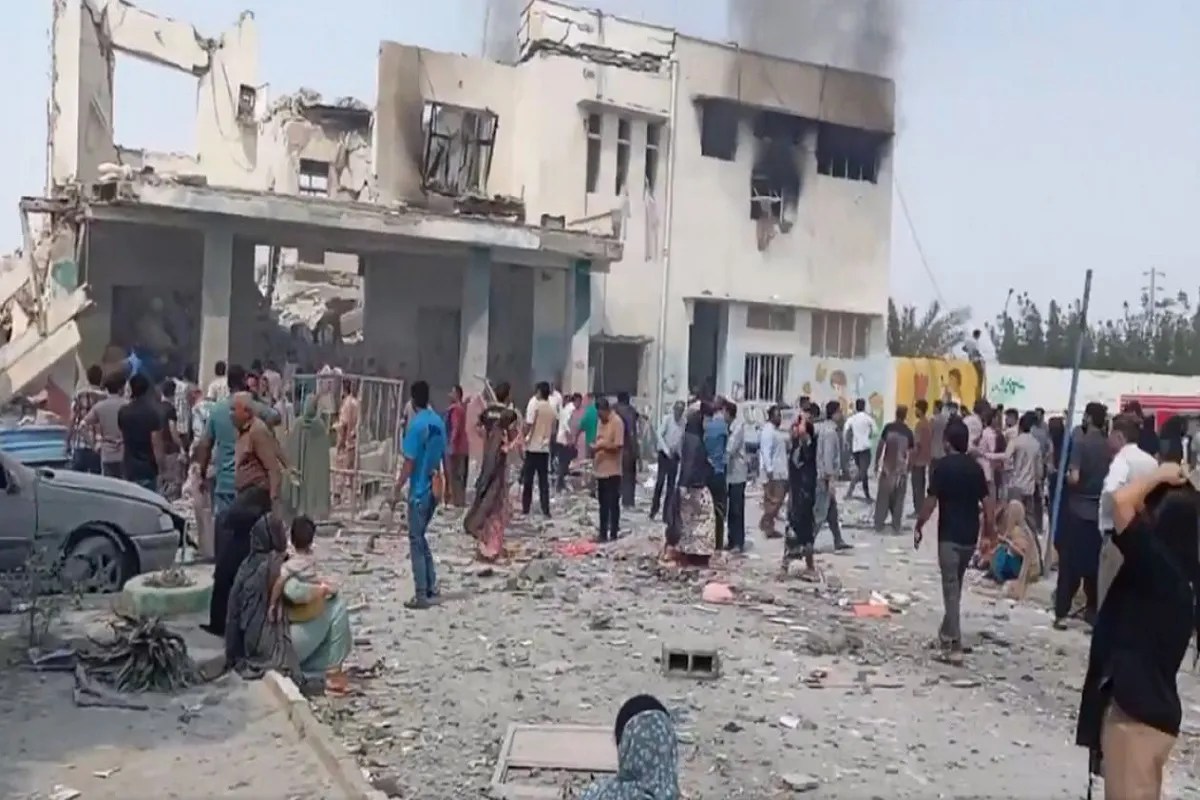
The headlines are screaming about 148 dead in an Iranian school. The media is doing what it always does: counting bodies, printing photos of rubble, and crying about the "escalation" of the Iran-Israel conflict. They want you to feel outraged. They want you to look at the blood and ignore the math.
Most news outlets are treating this like a tragic accident or a localized atrocity. They are wrong. If you are looking at the death toll as the primary metric of this conflict, you are watching the wrong movie. We aren't seeing a war of attrition; we are seeing the final death rattle of the "Proxy Era" and the birth of a direct-kinetic reality that neither side is actually prepared to manage.
The "148 dead" narrative is a distraction. It's a tragedy, sure, but in the cold logic of geopolitical chess, it’s a data point that hides a much uglier shift in how regional powers are now willing to gamble with total annihilation.
The Lazy Consensus of Proportionality
Every analyst on cable news is talking about "proportionality." They argue that if Israel hits a target, Iran must hit one back of equal value. This is a fundamental misunderstanding of how modern deterrence works.
Proportionality is for lawyers. Strategic dominance is for winners.
When a strike hits a school or a civilian-adjacent facility in this theater, the "lazy consensus" assumes it was a mistake or a sign of sheer cruelty. In reality, these targets are often chosen precisely because they force the opponent into a lose-lose PR cycle. I’ve seen intelligence briefings where "civilian density" wasn't a deterrent; it was a tactical layer.
By focusing on the tragedy, the media validates the human shield strategy used by IRGC-backed elements and the aggressive "clearance" tactics used by the IDF. You are being played by both sides. One side wants the body count to spark international sanctions; the other wants the body count to signal that nowhere is safe.
Stop Asking if the War is Starting—It Already Ended and Restarted
People keep asking, "Will this lead to a full-scale war?"
That question is ten years too late. The war has been happening in the shadows of Damascus, the ports of Eilat, and the server rooms of Tehran for a decade. What we are seeing now isn't the start of a war; it's the collapse of the "gray zone."
For years, Iran and Israel played by a set of unwritten rules:
- Use proxies (Hezbollah, Houthis, militias).
- Assassinate scientists, but don't claim it.
- Sabotage ships, but don't sink them.
Those rules are dead. When missiles fly directly from Iranian soil to Israel, or when Israeli jets hit high-value targets in the heart of Iranian-aligned infrastructure, the "proxy buffer" has evaporated. The 148 deaths reported in this latest strike are a symptom of "Targeting Fatigue." When you run out of military warehouses to blow up, you start hitting "dual-use" facilities. That’s where the bodies come from.
The Intelligence Failure Nobody Wants to Admit
The "148 deaths" isn't just a humanitarian disaster; it’s a massive signal of intelligence degradation.
If you believe these strikes are always surgical, you’ve bought into the Hollywood version of warfare. In the real world, "surgical" usually means "we hit the building we wanted, but we had no idea who was actually inside at 3:00 AM."
The hard truth? Both sides are currently operating with "Dirty Data."
- Iran's Dilemma: They rely on signal intelligence that is compromised by Israeli cyber-warfare.
- Israel's Dilemma: They rely on human intelligence (HUMINT) in areas where every informant is a potential double agent.
When the data is dirty, the collateral damage spikes. We aren't seeing more "vicious" attacks; we are seeing more desperate ones. They are firing at shadows and hoping they hit the monster.
The Myth of the "Innocent" Infrastructure
Here is the part that will get me cancelled: In modern urban warfare, the concept of a "purely civilian" target is a relic of the 1940s.
In the Middle East theater, the integration of military assets into civilian life isn't a conspiracy theory; it's a standard operating procedure. We see data centers underneath hospitals and drone assembly lines in the basements of vocational schools.
When you read that a "school" was hit, you picture desks and chalkboards. The military commander sees a reinforced concrete structure with a high-bandwidth fiber-optic line and a basement that can withstand a standard 500-pound bomb.
If you want to stop the killing of "148 innocents," you have to stop the militarization of the classroom. But neither the IRGC nor the IDF has any incentive to do that. The IRGC gets a martyr narrative, and the IDF gets to claim they destroyed a "command center." The civilians are just the grease in the gears.
Why Diplomacy is a Grift
The UN will convene. Statements will be "urged." "Deep concern" will be expressed.
It's all theater.
The current escalation path is baked into the math of the region. Iran needs a high-profile "victory" to keep its domestic population from revolting against a tanking economy. Israel needs to prove that its "Iron Dome" and "Arrow" systems aren't just expensive toys, but a total shield that allows them to strike with impunity.
Negotiation only works when both sides have something to lose. Right now, both regimes feel they have more to lose by stopping.
The Brutal Reality of the "New Normal"
If you’re waiting for a ceasefire that sticks, stop waiting. We have entered a period of "High-Intensity Friction."
Imagine a scenario where these types of strikes happen weekly. Not as a prelude to a world war, but as the standard cost of doing business in a multipolar world. The global markets have already priced in Middle Eastern instability. That’s why oil doesn't jump to $150 every time a missile is fired anymore. We’ve become desensitized to the slaughter because the slaughter has become a permanent feature of the landscape, not a bug.
The "148 deaths" article you read elsewhere wants you to feel a temporary spike of empathy. I’m telling you to feel a permanent sense of dread. Not because of the death toll, but because the mechanisms for stopping it have been dismantled by the very people who claim to be "protecting" their nations.
What You Should Actually Be Watching
Forget the body counts. If you want to know where this is going, track three things:
- The GPS Jamming Radius: If civilian aviation in Cyprus and Jordan is being blinded, the next strike isn't a "retaliation"—it's an offensive.
- The Currency Exchange: Watch the Rial. When it hits certain psychological floors, the Iranian government must create a foreign crisis to distract from the bread lines.
- The Logistics Hubs in Azerbaijan: That’s the real back-door. If those move, the war has moved beyond the "Israel-Iran" border and into a regional firestorm.
The media is giving you the obituary. I'm giving you the autopsy.
Stop mourning the 148 and start realizing that in this game, the civilians aren't the victims—they are the currency. Both sides are spending them like they have an infinite supply.
The strike on that school wasn't a tragedy of errors. It was a cold, calculated move in a game where the board is on fire and the players have forgotten how to quit.
Pick a side if it makes you feel better. But don't pretend for a second that your side isn't holding the match.
The era of "limited conflict" is over. Welcome to the age of the Perpetual Strike.
Don't look for a solution. There isn't one. There is only the next target.