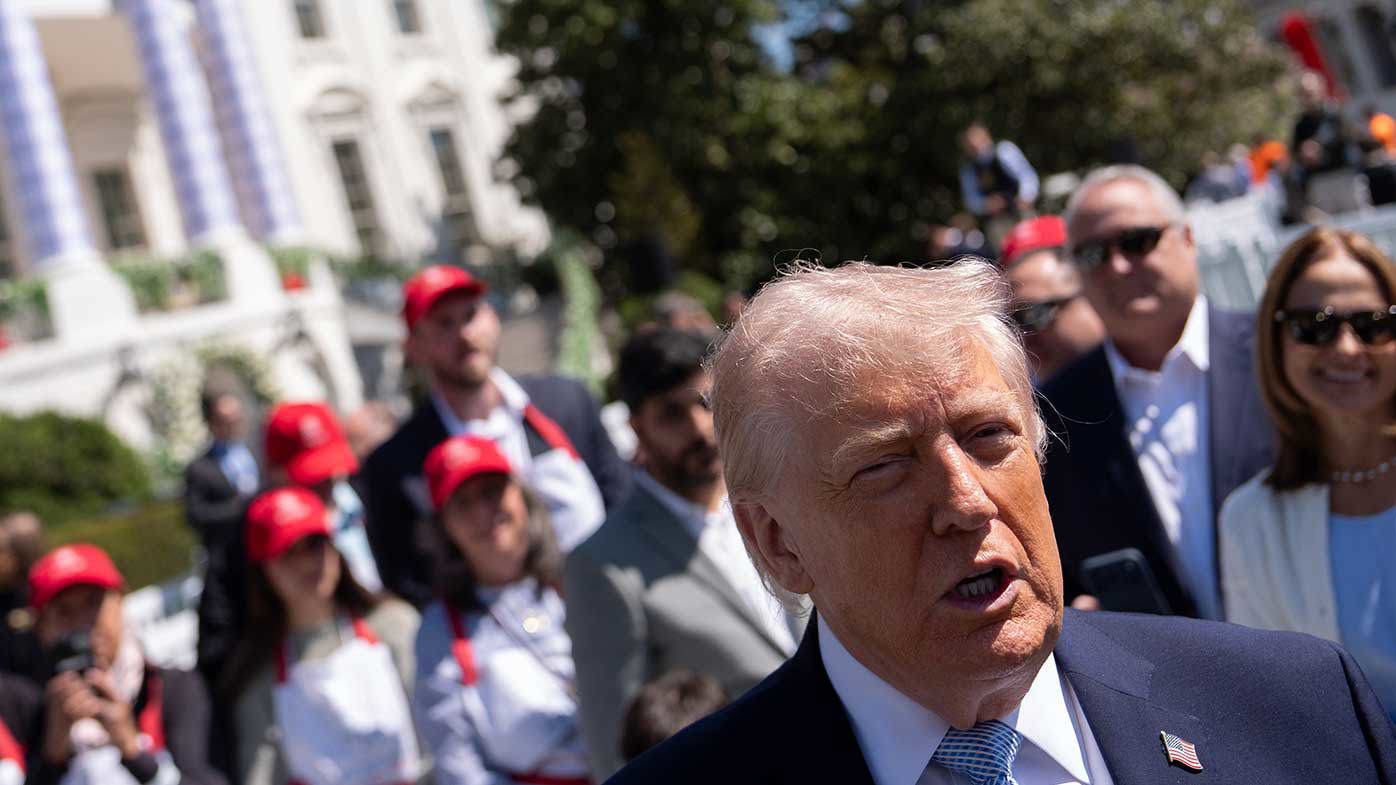
The political circus in Washington just hit a new high-decibel level. Representative Jamie Raskin, the ranking Democrat on the House Judiciary Committee, has officially demanded that White House physician Captain Sean Barbabella put President Donald Trump through a "comprehensive cognitive assessment." This isn't just another round of partisan bickering. It's a calculated response to a month of rhetoric that has left even some of Trump’s staunch allies feeling a bit shaky.
I’ve watched these cycles for years, and usually, it’s just noise. But when you look at the specifics—the Easter Sunday tirades about Iran, the bizarre war talk during a children’s event, and the sheer volatility of recent public statements—you realize why this isn't going away. Raskin isn't just throwing darts; he’s citing the exact same precedent Republicans used against Joe Biden just a couple of years ago. It’s a "what’s good for the goose" moment that has the White House on the defensive.
The trigger for Raskin’s demand
So, why now? The timing isn't accidental. It’s April 2026, and the U.S. is currently entangled in a high-stakes conflict with Iran. When a Commander-in-Chief starts making "mad threats" (as Raskin put it) while children are rolling eggs on the White House lawn, people notice.
Raskin pointed to several specific "disturbing" incidents:
- An Easter Sunday social media post where Trump used expletives to demand Iran open the Strait of Hormuz.
- A terrifying comment suggesting "a whole civilization will die tonight" if Iran didn't back down.
- Claims from critics that his rhetoric has become increasingly incoherent and profane compared to his first term.
The argument is simple: if the person with the nuclear codes is showing signs of "deteriorating condition," the country deserves more than a "trust me, I’m a genius" tweet. Raskin wants the results shared with Congress and a full briefing from the White House doctor. Honestly, it’s a bold play, but in a wartime scenario, the "mental capacity" argument carries a weight it doesn't usually have during a standard campaign season.
Comparing the MoCA to actual clinical reality
Trump often brags about "acing" cognitive tests, specifically the Montreal Cognitive Assessment (MoCA). Let's be real about what that test actually is. It’s not an IQ test. It’s a 10-minute screening tool designed to find "mild cognitive impairment." It asks you to draw a clock, identify a picture of a lion or a camel, and remember five words.
If you're a functioning adult, you should pass it. Getting a 30/30 on the MoCA means you probably don't have early-onset dementia or significant brain damage. It doesn't mean you have the temperament or the strategic focus to navigate a global conflict. This is where the disconnect lies. Trump uses the test as proof of high intelligence, while medical experts like Dr. David Knopman from the Mayo Clinic have long argued that these tests are just a "first pass."
The problem? A test taken in 2018 or even 2024 is effectively useless in 2026. Cognitive health isn't a trophy you keep on the shelf; it’s a moving target.
The 25th Amendment shadow
Raskin’s letter isn't just about a doctor’s visit. It’s the opening salvo for a much larger constitutional conversation: the 25th Amendment. Section 4 of that amendment is the "break glass in case of emergency" option. It allows the Vice President and a majority of the Cabinet to declare the President unable to discharge his duties.
- The Bar is Sky-High: To actually remove a president, JD Vance and the Cabinet would have to agree. Given the current political alignment, that’s about as likely as a snowstorm in Miami.
- The Definition of "Inability": The drafters of the 25th Amendment kept the language vague. Is a "mad threat" a sign of inability or just a negotiation tactic?
- The Precedent: Republicans set a heavy precedent by subpoenaing Biden’s physician and focusing on his "poor memory" in the 2024 Hur report. Now, Democrats are using that exact playbook.
It’s a messy, circular logic. Republicans argued that cognitive fitness is a matter of "urgent public concern" when it was Biden. Now that Raskin is using the same phrasing, the White House is calling him "a stupid person's idea of a smart person." The irony is thick enough to cut with a knife.
Why this matters for the 2026 midterms
Beyond the medical questions, there’s a massive political strategy at play. By demanding a dementia test, Democrats are forcing every Republican candidate to answer one question: "Do you think the President is mentally fit?"
It’s a "wedge" issue. Even if the test never happens—and let’s be honest, it probably won't—the headlines alone do the damage. They keep the conversation focused on "instability" rather than policy. For voters in the middle, the "unhinged" narrative is much harder to ignore when it’s backed by specific, profane outbursts during religious holidays.
The White House response has been to point to Trump’s "unmatched energy" and compare him to the "physical and mental decline" of his predecessor. It’s a deflection tactic, but one that resonates with the base. They see these demands as a "witch hunt" (to use a favorite phrase) rather than a legitimate medical inquiry.
What you should actually look for
If you're trying to cut through the spin, stop looking for a "pass/fail" grade on a memory test. Instead, watch the patterns. Experts in neuro-linguistic programming and psychiatry often look for:
- Tangentiality: Does he start a sentence about Iran and end up talking about a dishwasher?
- Phonemic Paraphasia: Is he substituting words that sound similar but make no sense in context?
- Emotional Lability: Are the outbursts becoming more frequent and less controlled?
Don't wait for a doctor to release a report that will likely be redacted or "sanewashed" anyway. Pay attention to the unscripted moments. The 25th Amendment was designed for a president who is "unable" to do the job, not just one who does it in a way people dislike.
If you want to stay informed on how this legal battle develops, keep an eye on the House Judiciary Committee's upcoming briefings. Raskin is scheduled to lead a briefing on the 25th Amendment this Friday. That’s where the real legal framework will be laid out. Don't expect a medical miracle or a sudden confession of decline; expect a long, drawn-out fight over who gets to define "sanity" in the Oval Office.



