The collapse of Fidesz’s supermajority in the 2026 Hungarian general election represents more than a localized shift in parliamentary seats; it is a systemic failure of the "illiberal democracy" model to maintain equilibrium under conditions of high inflation and information fragmentation. While media narratives focus on the emotional relief of European capitals, a rigorous analysis reveals that Viktor Orbán’s defeat was the result of a specific intersection between deteriorating macroeconomic fundamentals and the emergence of a viable counter-insurgent political movement. This transition alters the geopolitical risk profile for the European Union, NATO, and the Kremlin’s influence operations in Central Europe.
The Triad of Institutional Decay
To understand why the incumbent’s seemingly impenetrable grip on power failed, we must examine the three pillars that supported the previous administration: centralized media control, the distribution of patronage through state-aligned oligarchy, and the cultivation of a "wedge issue" electorate.
1. The Marginal Utility of Media Control
For over a decade, the Central European Press and Media Foundation (KESMA) operated as a unified signaling mechanism. However, the 2026 cycle demonstrated the law of diminishing returns in state propaganda. When the delta between state-reported reality (economic stability) and lived experience (double-digit food price inflation) becomes too wide, the credibility of the medium undergoes a phase transition from "trusted source" to "background noise." The rise of decentralized digital platforms further eroded the state’s ability to gatekeep information, allowing the opposition to bypass traditional broadcast monopolies.
2. Rent-Seeking and Capital Flight
The Hungarian economic model relied on the efficient recycling of EU structural funds into a loyalist business class. This system functioned as long as the cost of capital remained low and the flow of funds was uninterrupted. The EU’s Rule of Law Mechanism created a liquidity crunch within the patronage network. As the state’s ability to award lucrative contracts diminished, the internal cohesion of the pro-government elite fractured. Capital began seeking safer, less politically exposed avenues, weakening the incumbent’s campaign war chest and local mobilization capacity.
3. The Exhaustion of Identity Politics
Orbánism utilized a "fortress" strategy, framing every policy debate as a defense of national sovereignty against external threats (Brussels, migration, or non-governmental organizations). By 2026, the utility of these wedge issues hit a saturation point. Demographic shifts—specifically the entry of Gen Z voters into the electorate—introduced a cohort less susceptible to legacy nationalist tropes and more concerned with the functional collapse of the healthcare and education sectors.
Macroeconomic Catalysts of Political Volatility
The defeat was not a purely ideological rejection; it was a byproduct of fiscal mismanagement. The 2022 pre-election spending spree, characterized by tax rebates and "13th-month" pensions, created a temporary sugar high that exacerbated subsequent inflationary pressures.
- The Forint Volatility Index: The Hungarian Forint (HUF) faced consistent downward pressure, increasing the cost of imported energy and consumer goods. This functioned as a regressive tax on the Fidesz base in rural areas.
- The Debt-to-GDP Ceiling: With limited access to international markets at favorable rates, the government was forced to cut essential services, directly contradicting its promise of a "work-based society" that protects the common man.
- Energy Dependency as a Strategic Liability: The insistence on maintaining close ties with Rosatom and Gazprom, while intended to secure low-cost energy, resulted in a strategic bottleneck when global prices decoupled from Russian contractual rates.
The Counter-Insurgent Model: Peter Magyar and the Center-Right Pivot
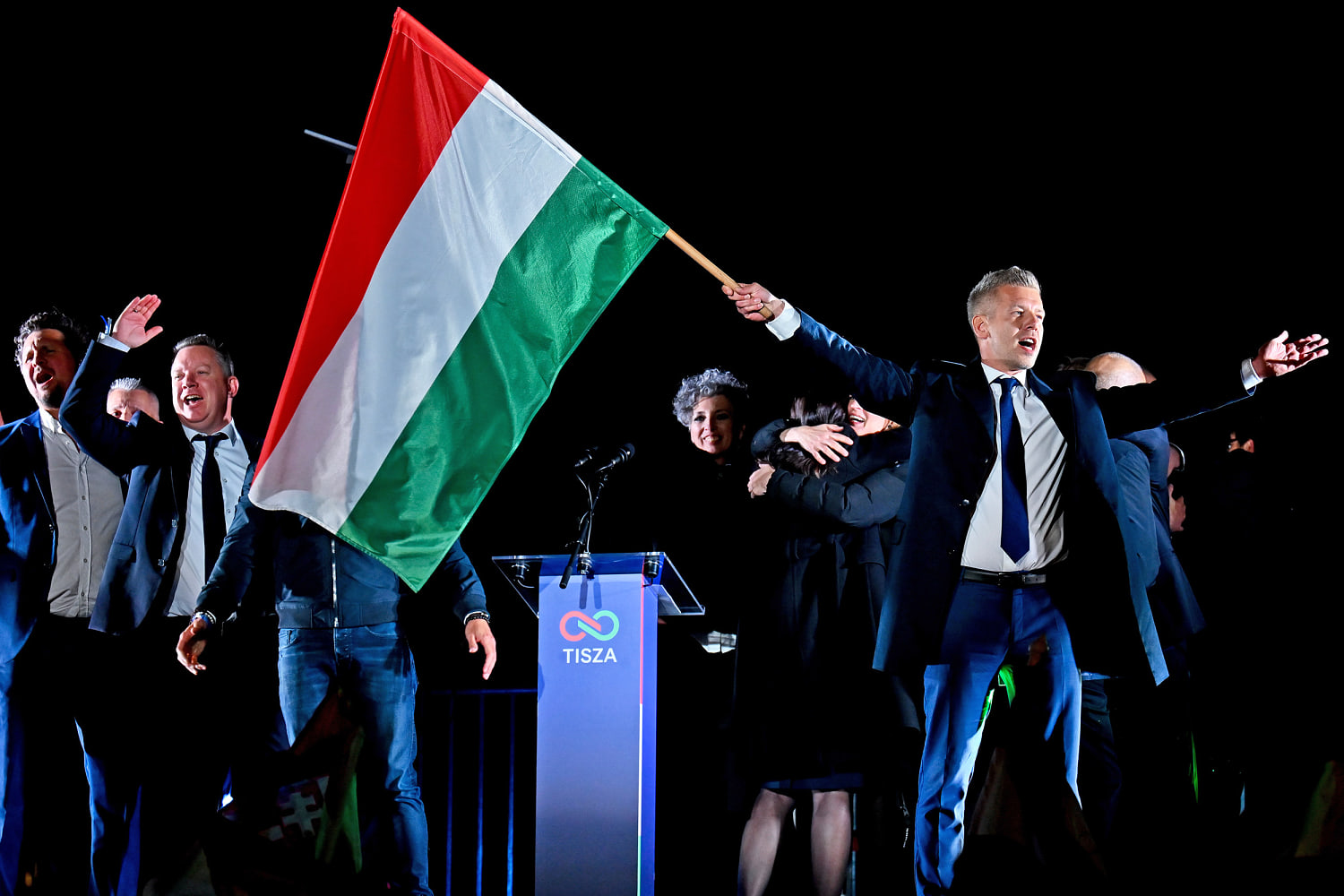
The success of the TISZA Party (Respect and Freedom) provides a blueprint for defeating entrenched populism. Unlike previous opposition attempts—which sought to build a "big tent" of disparate ideologies from the far-left to the far-right—the 2026 movement utilized a "Salami Slicing" technique in reverse.
Strategic Differentiation
The opposition did not run on a platform of total systemic reversal. Instead, they adopted "Soft Conservatism," neutralizing Fidesz’s most potent attacks. By refusing to challenge core national identity symbols, they kept the focus on administrative competence, corruption, and the restoration of institutional checks and balances.
Tactical Agility
The campaign operated as a lean, tech-heavy startup rather than a traditional political party. It prioritized:
- Hyper-Local Mobilization: Targeting small towns that were previously considered "impregnable" Fidesz strongholds.
- Digital Guerrilla Marketing: Using short-form video content to highlight the discrepancy between government luxury and public sector decay.
- The "Defector" Narrative: Leveraging former insiders to expose the mechanics of the "System of National Cooperation" (NER), which provided the movement with instant credibility among undecided voters.
Geopolitical Realignment and the Moscow-Mar-a-Lago Axis
Orbán’s defeat removes a critical veto point within the European Council, fundamentally altering the legislative velocity of the EU. The "spoiler" role that Hungary played in Ukraine aid packages and sanctions regimes has been neutralized.
Impact on the Kremlin’s European Strategy
Russia loses its most effective "Trojan Horse" within the EU and NATO. Hungary’s previous stance facilitated a gray-zone environment where Russian intelligence and financial interests could operate with relative impunity. The new administration’s commitment to "transparency and Western integration" implies a rigorous vetting of foreign investments and a pivot back to regional security cooperation via the Visegrád Four (V4), which had been paralyzed by Orbán’s pro-Moscow tilt.
The Trumpian Echo Chamber
For the American "New Right," Orbán was a proof-of-concept for how to use state power to dismantle liberal institutions. His loss signals the fragility of this model. It suggests that while illiberalism can win elections, it struggles to manage the complexities of a modern, integrated economy during a global downturn. The "Hungarian Model" is no longer a viable export; it is a cautionary tale of over-leverage and strategic overreach.
The Structural Constraints of the New Administration
Expectations for an immediate "Liberal Utopia" are misplaced. The incoming government inherits a landscape designed to resist change. The departing administration utilized "Deep State" engineering to ensure its influence persists beyond its electoral life.
- Foundational Entrenchment: High-level positions in the judiciary, the central bank, and public universities are held by loyalists with long-term mandates. Removing them requires a two-thirds majority, which the new coalition may struggle to maintain.
- The Debt Trap: The fiscal deficit remains high. The new government must implement austerity measures to stabilize the Forint, which risks alienating the very voters who put them in power to escape economic hardship.
- Coalition Heterogeneity: The anti-Orbán front is a delicate ecosystem. The primary risk is internal friction between progressives, technocrats, and conservative defectors. If the "common enemy" is gone, the unifying force may dissipate, leading to legislative gridlock.
The Restoration of Functional Governance
The victory in Budapest is a data point in a larger trend: the return of the "Competence Mandate." Voters are increasingly prioritizing the functional delivery of state services over ideological signaling. To solidify this shift, the new Hungarian leadership must move beyond the rhetoric of "democracy" and deliver tangible wins in the following sectors:
- Healthcare Modernization: Immediate injection of capital into the public hospital system to reduce wait times and stem the "brain drain" of medical professionals.
- Educational Reform: Restoring autonomy to teachers and updating curricula to reflect the demands of a high-tech European labor market.
- Anti-Corruption Enforcement: Establishing a high-profile, independent prosecutor's office to recover misappropriated state assets, which serves both a moral and a fiscal purpose.
The 2026 election results indicate that while a state can be captured, it cannot be indefinitely insulated from the consequences of its own inefficiency. The fall of the Orbán regime marks the end of the "Illiberal Experiment" in Central Europe and the beginning of a grueling, decade-long process of institutional reconstruction. The strategic play for the West is no longer containment, but the active stabilization of a recovered democracy that remains economically and legally scarred. Success depends on the EU's willingness to provide immediate liquidity in exchange for rapid, verifiable judicial reforms, ensuring the transition is not just a change in leadership, but a fundamental reset of the state's operating system.