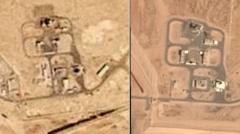
The desert at night is never truly quiet, but there is a specific kind of stillness that precedes a kinetic event. It is the sound of air conditioners humming against the heat of Iraq’s Al-Anbar province, the faint static of a radio, and the rhythmic breathing of several hundred soldiers who have learned to sleep with one eye on the abstract concept of "deterrence."
Then, the sky breaks.
When the Iranian ballistic missiles arced toward Al-Asad Airbase, they weren’t just delivery vehicles for high explosives. They were fiscal hammers. We often talk about modern warfare in terms of geopolitical chess or ideological friction, but there is a grittier, more mathematical reality beneath the smoke. To look at the wreckage of a hangar or the twisted remains of a MQ-1C Gray Eagle drone is to see a ledger bleeding out.
New forensic analysis suggests the price tag for that single evening of fire reached $800 million.
It is a staggering number. Yet, $800 million is an abstraction until you consider what it buys in the currency of metal, sweat, and lost time. This wasn’t just a "strike." It was a massive, involuntary redistribution of wealth from the American taxpayer into the sands of the Middle East, evaporated in a sequence of supersonic impacts.
The Anatomy of a Crater
Imagine standing in the middle of a runway. To your left, a dormitory where soldiers once wrote letters home. To your right, a maintenance bay filled with the most sophisticated avionics on the planet.
When a Fateh-313 missile—a weapon roughly the size of a telephone pole and traveling at several times the speed of sound—hits a concrete structure, the physics are indifferent to politics. The pressure wave liquefies internal organs before the heat even arrives. But if the humans have reached the bunkers in time, the damage shifts from the biological to the structural.
The $800 million isn't just the cost of the concrete. It is the cost of the "invisible infrastructure."
Replacing a destroyed hangar isn't like rebuilding a garage. These are pressurized, climate-controlled environments designed to shield sensitive electronics from the intrusive, fine-grained dust of the Iraqi desert. When the roof vanishes, the "brains" of the aircraft inside—the sensors, the radar arrays, the communication links—begin to die. They don't die from fire; they die from exposure. They die because the specialized environment required to keep a $30 million drone operational has been replaced by a hole in the ground.
The Ghost in the Ledger
Consider a hypothetical logistics officer we will call Sarah. Sarah’s job isn't to fire weapons; it’s to reconcile the irreconcilable. When the smoke clears at Al-Asad, Sarah isn't looking at "base damage." She is looking at a supply chain that has just been severed.
The $800 million includes the "replacement value" of equipment that, in many cases, is no longer in active production. If a specialized fuel truck is vaporized, you don't just call a dealership. You trigger a multi-year procurement process. You pay for the expedited shipping of parts from four different continents. You pay for the specialized contractors who must be flown into a combat zone, insured at astronomical rates, and housed in temporary facilities that cost more than luxury hotels.
This is the friction of war.
Every dollar spent replacing a burnt-out terminal is a dollar that wasn't spent on innovation, education, or even the basic maintenance of the fleet elsewhere. The Iranian strikes were a masterclass in "asymmetric accounting." The missiles used by the Islamic Revolutionary Guard Corps (IRGC) cost a fraction of the damage they inflicted. Iran spent thousands to destroy hundreds of millions.
It is a terrifyingly efficient ratio.
The Invisible Stakes of Precision
There was a time when hitting a base meant saturating an area with "dumb" bombs and hoping for the best. That era is dead. The analysis of the $800 million reveals a chilling level of precision.
The missiles didn't just hit the base; they hit the vital organs of the base.
They targeted the points of highest economic and operational density. They aimed for the intersections of runways, the fuel storage bladders, and the repair facilities. This wasn't a blind lashing out. It was a surgical strike on the U.S. Treasury. By hitting the "high-value" targets, the strikes ensured that the recovery would be slow and the cost would be maximized.
The emotional core of this story isn't found in the rubble, though. It’s found in the realization that our technology—our vast, expensive, world-shaping technology—is surprisingly brittle.
We build systems that cost billions to develop. We deploy them to corners of the map where the local economy functions on a fraction of that wealth. And then, in a few minutes of kinetic energy, we are forced to reckon with the fact that a piece of $50,000 guidance tech on a "cheap" missile can negate a decade of American defense spending.
The Weight of the Rebuild
Dust. It’s the one thing everyone remembers about Al-Asad. It gets into your teeth, your eyes, and your lungs. After the strikes, the dust was mixed with the acrid scent of burnt jet fuel and pulverized insulation.
The recovery effort began before the fires were even out. But the "recovery" isn't just about clearing debris. It’s about the psychological toll of rebuilding something you know can be taken away again for a fraction of the cost.
How do you justify spending $100 million on a new command center when the enemy has proven they can put a missile through the front door whenever they feel the geopolitical weather shifting?
The $800 million figure is a siren. It warns us that the nature of power is changing. It isn't just about who has the biggest carrier or the stealthiest jet. It’s about who can afford the bill. For decades, the United States has operated under the assumption that it could outspend any problem. We assumed that our "robust" presence was a shield.
But shields break. And when they break, they are expensive to fix.
The Long Echo
We are living in an age of fiscal warfare. Every time a drone is launched or a missile is fired, someone, somewhere, is doing the math. The IRGC knew that even if they didn't kill a single American soldier, they could inflict a wound that would show up on a spreadsheet in Washington, D.C.
They knew that $800 million represents more than just money. It represents a diversion of focus. It represents a logistical nightmare that stretches from the sands of Iraq to the halls of Congress.
The true cost of the Al-Asad strikes isn't found in the final tally of the analysis. It is found in the eyes of the technicians who have to piece together a mission from the scraps of a destroyed hangar. It is found in the quiet conversations of planners who realize that the old rules of engagement have been overwritten by a new, more expensive reality.
As the sun rises over the reconstructed runways today, the concrete looks the same. The hangars have been rebuilt. The drones are back in the air. But the silence of the desert feels different now. It feels like a pause between breaths. It feels like the heavy, thrumming weight of a debt that can never truly be settled, because in the game of modern conflict, the most dangerous weapon isn't the one that kills—it’s the one that makes the cost of staying too high to bear.
The craters have been filled, but the ledger remains open, and the ink is still wet.


