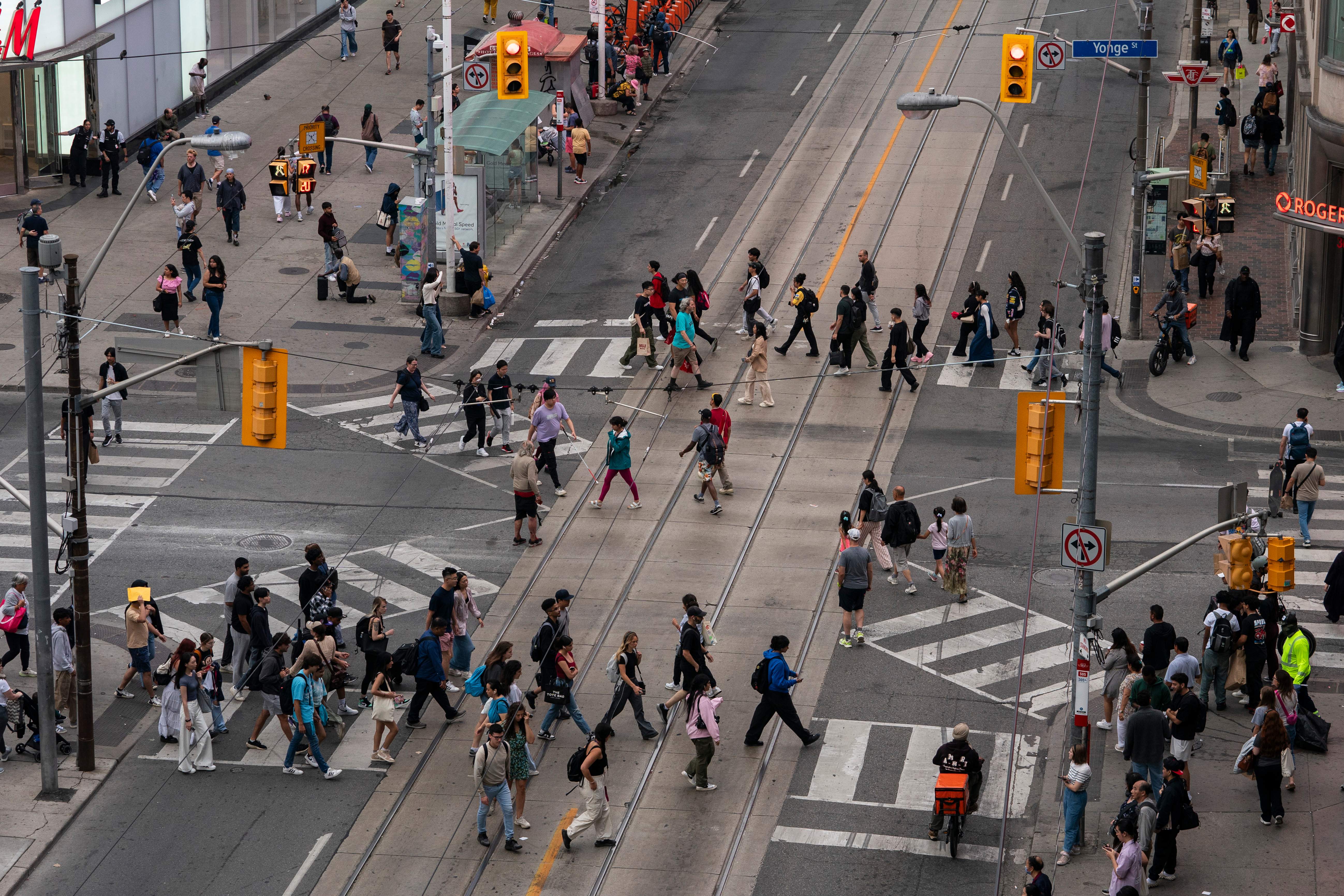
Walk through any suburban neighborhood in Southern Ontario or a quiet street in the West End of Vancouver at dusk. You will see the blue light of televisions flickering against living room walls. You will see cars tucked into driveways. But if you look closer, at the data flowing out of the concrete offices of Statistics Canada, you will see something that feels like a glitch in the Canadian dream. For the second consecutive quarter as 2025 came to a close, the lights are staying off in more rooms than before. Canada is shrinking.
We have spent decades conditioned to believe in an infinite upward curve. More people, more houses, more density, more everything. Growth was the heartbeat of the national identity. Yet, the latest figures from the end of 2025 confirm a chilling trend: the population has dropped again. It isn't a freefall, but it is a definitive step backward. A retreat.
To understand what this means, forget the spreadsheets. Think of a man named Elias.
Elias is a hypothetical composite of the thousands of non-permanent residents who made up the backbone of the service economy three years ago. In 2022, Elias arrived with a work permit and a plan to build a life in a mid-sized city like London or Halifax. By late 2025, Elias is at a boarding gate at Pearson International. He isn’t leaving because he wants to. He is leaving because the math of Canada no longer adds up. The rent ate his savings. The path to permanent residency, once a wide-open door, has been narrowed to a needle's eye by federal policy shifts intended to cool an overheated housing market.
When Elias leaves, he takes more than a suitcase. He takes a taxable income, a pair of hands that filled a labor gap, and a dream that used to be the country's primary export. When thousands of Eliases leave simultaneously, the national tally begins to bleed.
The Great Recalibration
The numbers from Statistics Canada aren't just dry tallies of births and deaths. They are the scoreboard of a massive, unintentional experiment in social engineering. After years of record-breaking immigration that pushed the population past 41 million with dizzying speed, the brakes haven't just been tapped. They’ve been slammed.
The primary driver of this second straight quarterly drop is the exodus of non-permanent residents. For a long time, these individuals—students, temporary workers, asylum seekers—were treated as a variable that could be scaled indefinitely. But the infrastructure groaned. Hospitals reached a breaking point. The "Temporary" in their titles became a point of political contention.
Consider the mechanics of the decline. We are seeing a rare alignment of two forces. First, there is the deliberate federal cap on international student permits and the tightening of work visas. Second, there is the "quiet quitting" of the Canadian dream by those already here. When the cost of a basement suite in Brampton exceeds the take-home pay of a full-time worker, the exit door becomes the most attractive feature of the apartment.
This isn't just a policy success for those who argued that high immigration was fueling the housing crisis. It is a fundamental shift in the Canadian story. For the first time in generations, we are facing the reality of a "negative growth" environment. It sounds clinical. It feels like a ghost town in the making.
The Invisible Stakes of a Smaller Map
Why does it matter if the population drops by a few thousand people over six months?
The danger lies in the momentum. Economics is a game of expectations. When a population grows, businesses invest. They build new grocery stores because they expect more mouths to feed. They build new warehouses because they expect more packages to deliver. When the curve bends downward, that confidence evaporates.
Imagine a local school board in a rural township. For years, they struggled with overcrowding. Now, they look at the 2025 year-end data and see a trajectory that suggests fewer kindergarteners in five years. They don't build the new wing. They don't hire the three new teachers. The local economy loses those salaries. The hardware store loses the contract for the lumber. The ripple effect isn't a wave; it’s a receding tide that leaves everything on the shore dry and brittle.
There is also the matter of the "Grey Wave." Canada’s natural birth rate—the number of children born to people already living here—has been below replacement levels for a long time. We are an aging society. We rely on the influx of young, tax-paying bodies to fund the healthcare of the retirees. When the population drops, the ratio of workers to retirees worsens. The burden on the remaining few grows heavier.
The Emotional Core of the Exit
Behind the "2nd straight drop" headline is a profound sense of disillusionment. We are witnessing the end of Canadian exceptionalism regarding migration. We used to believe that everyone wanted to be here, and that we could manage the flow with surgical precision.
The reality of late 2025 is more chaotic. The drop is fueled by people who feel they were sold a version of Canada that no longer exists. A student from Punjab or a tech worker from Lagos looks at the price of a head of lettuce and the four-year wait for a family doctor and decides that perhaps Australia, or even staying home, is the better bet.
This is the vulnerability we rarely talk about. We assume Canada is a "must-have" destination. But the data suggests we are becoming a "maybe" destination. When the population drops, it is a vote of non-confidence from the world. It is a sign that the cost of entry has finally exceeded the value of the prize.
The Geometry of the New North
It is tempting to look at these statistics and feel a sense of relief. Less competition for apartments. Shorter lines at the clinic. A chance for the infrastructure to "catch up." But history suggests that infrastructure rarely catches up during a contraction. It usually decays.
Revenue for municipalities is tied to growth. Fewer people means a smaller tax base. A smaller tax base means less money for the very transit projects and housing developments that were supposed to solve the initial problem. We are at risk of entering a feedback loop where we shrink to save ourselves, only to find that we have become too small to afford the solutions we need.
The streets aren't empty yet. You can still find a crowd at a hockey game or a traffic jam on the 401. But the margins are thinning. The vibrant, chaotic energy that defined the early 2020s—the feeling of a country bursting at the seams—has been replaced by a cautious, hushed stillness.
The 2025 year-end report from Statistics Canada is a mirror. It shows a country that is tired. We are a nation that decided it couldn't handle the weight of its own growth, and in trying to shed that weight, we may have accidentally begun to shed our future.
The chair at the dinner table isn't just empty because someone forgot to sit down. It’s empty because they realized they couldn't afford the meal, and they've gone somewhere else to eat.
We are left standing in a house that is suddenly, quietly, getting larger because there are fewer people to fill it, while we wonder if we will ever feel the warmth of a crowd again.