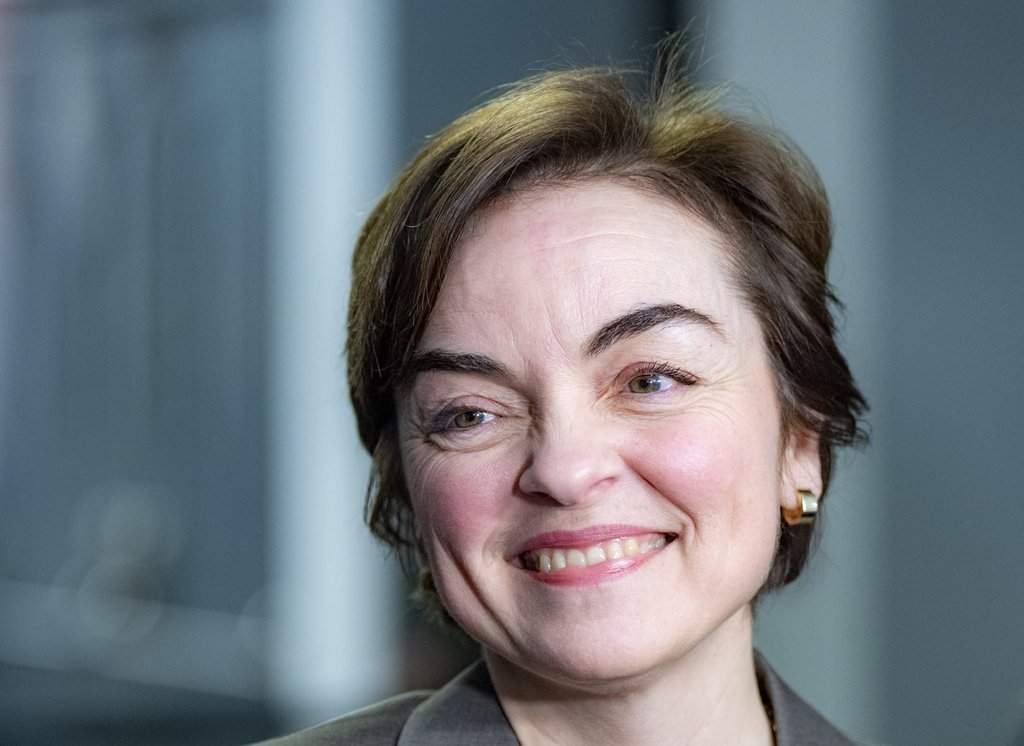
The Coalition Avenir Québec has officially moved past the François Legault era, crowning Christine Fréchette as the party’s new leader and Quebec’s premier. This transition was not a spontaneous democratic surge but a tightly choreographed handoff designed to save a government sliding in the polls. By choosing Fréchette, the CAQ is betting that a shift from populist bluster to technocratic precision can insulate the party from a surging Parti Québécois. She inherits a caucus weary of internal friction and a province demanding more than just identity politics.
Fréchette’s rise signals the end of the "grandfatherly" communication style that defined the CAQ’s early years. Where Legault relied on gut instinct and a perceived proximity to the average "mononc," Fréchette operates with the cool efficiency of the former Chamber of Commerce executive she is. The party isn't just changing a face. It is changing its entire operating system. Don't forget to check out our earlier coverage on this related article.
The Strategy of the Clean Break
Political parties in power for nearly a decade usually rot from the inside out. The CAQ was showing all the classic symptoms: arrogance in the face of labor disputes, a confused energy policy, and a base that felt the nationalist "autonomist" project had hit a ceiling. Fréchette was selected precisely because she represents a departure from the baggage of the Legault inner circle, despite having served within it.
The internal selection process functioned as a pressure valve. By rallying around Fréchette early, the party avoided a bruising public leadership race that would have exposed deep divisions between the economic right and the nationalist wing. This was a corporate merger masked as a political transition. The goal was stability at all costs. To read more about the history here, The Guardian provides an informative summary.
Wait-and-see approaches rarely work in the current Quebec political climate. The PQ, under Paul St-Pierre Plamondon, has successfully reclaimed the narrative of Quebec's future. Fréchette’s primary task is to pivot the conversation back to the economy and public management, areas where the CAQ believes it still holds a structural advantage over the sovereigntist opposition.
Economy First Identity Second
For years, the CAQ used language laws and secularism as a shield against criticism of its public service delivery. Fréchette appears ready to flip the script. Her background suggests a premier who will prioritize the "business of Quebec" over the "identity of Quebecers." This is a gamble. The CAQ base is built on nationalist sentiment, and if Fréchette moves too far toward a pure managerial style, she risks alienating the regions that gave Legault his massive majorities.
The Energy Crisis and the Northvolt Shadow
One of the most significant files on Fréchette’s desk is the massive, controversial investment in the Northvolt battery plant. This project is the centerpiece of the CAQ’s "green economy" plan, but it has become a lightning rod for criticism regarding environmental transparency and the use of public funds.
- The government has committed billions in subsidies.
- Energy surplus in Quebec has vanished, leading to tough questions about which industries get priority.
- Environmental groups remain skeptical of the fast-tracked approval processes.
Fréchette cannot simply parrot old talking points. She has to prove that the "Battery Valley" isn't a vanity project but a viable economic engine. If she fails to manage the Hydro-Québec supply issues, the very industrial base she comes from will turn on her.
Reshaping the Federal Relationship
Legault’s relationship with Ottawa was characterized by public sparring followed by quiet concessions. Fréchette, who handled the immigration portfolio with a firm but less inflammatory hand, is expected to change the optics of this friction. She understands that Quebec’s leverage in the federation depends on economic strength rather than just shouting about jurisdiction.
However, the immigration file remains a landmine. The pressure to reduce temporary residents is high, and the logistics of doing so without crippling the healthcare and construction sectors are daunting. Fréchette’s experience here is her greatest asset, but also her greatest liability. She owns the current numbers. She cannot blame her predecessor for a situation she helped manage as a minister.
A New Tone for Labor
The massive strikes that paralyzed the province in late 2023 left a bitter taste in the mouths of teachers and nurses. The CAQ’s popularity plummeted because the government appeared disconnected from the reality of the front lines. Fréchette must repair this. Her success depends on whether she can convince public sector workers that she views them as partners rather than costs to be minimized on a balance sheet.
The challenge is that the treasury is not bottomless. Quebec’s debt-to-GDP ratio remains a concern for the fiscal hawks within her party. Fréchette has to walk a tightrope between being the "Premier of Services" and the "Premier of Fiscal Responsibility."
The PQ Threat and the 2026 Horizon
The clock is ticking. An election looms in 2026, and the Parti Québécois is no longer a ghost of the past. They are a disciplined, focused threat. Fréchette’s appointment is a tactical maneuver to neutralize the PQ's momentum by presenting a modernized, competent alternative to sovereignty.
The CAQ’s internal polling likely showed that a "business-as-usual" approach under Legault would lead to a slaughter. Fréchette provides a "reset" button. She allows the party to claim it has listened to the public’s desire for change without actually moving to the opposition benches.
This isn't just a leadership change. It is a desperate attempt to professionalize nationalism. The era of the populist strongman is being replaced by the era of the high-level administrator. Whether the voters of Saguenay and Beauce will connect with a Montreal-centric technocrat remains the biggest unanswered question in Quebec politics.
Fréchette is a politician who speaks the language of spreadsheets and strategic plans. In a province that often votes on passion and "le cœur," she will have to find a way to project warmth without losing her reputation for competence. If she becomes too clinical, she will be seen as an elite outsider. If she tries too hard to be a populist, she will look like a fraud.
The Infrastructure Burden
Quebec's infrastructure is crumbling, and the costs of repair are ballooning. From the Louis-Hippolyte-La Fontaine bridge-tunnel to the crumbling schools in Montreal’s east end, the physical state of the province is a constant reminder of government inefficiency. Fréchette has hinted at a more aggressive oversight of public works.
This means taking on the powerful construction lobby and the unions simultaneously. It also means making hard choices about which projects to fund and which to mothball. The CAQ’s previous habit of promising "third links" and massive tunnels to win specific ridings has created a backlog of expectations that cannot be met.
Fréchette's administration will be defined by what it says "no" to. A premier who tries to please everyone usually ends up pleasing no one, a lesson Legault learned the hard way in his final year. By tightening the belt and focusing on execution over announcements, Fréchette hopes to rebuild the trust that was eroded by years of over-promising.
The Demographic Reality
Quebec is aging faster than almost any other jurisdiction in North America. This puts an unsustainable strain on the healthcare system and the tax base. The CAQ’s traditional stance on limiting immigration is in direct conflict with the economic need for more workers.
Fréchette has the unenviable task of reconciling the party’s nationalist rhetoric with the cold reality of the labor market. She knows that without a massive influx of talent, Quebec’s economy will stagnate. But she also knows that her base fears the "dilution" of the French language.
Her solution appears to be a hyper-focus on Francophone immigration, but the supply of French-speaking skilled workers is limited. She will have to look beyond the usual sources, potentially creating new tensions within her own cabinet. The "French first" policy is a non-negotiable pillar of the CAQ, but it is a pillar that is increasingly difficult to maintain in a globalized economy.
The transition to Christine Fréchette is the CAQ’s last chance to prove it is a party of governance rather than just a party of grievance. The novelty of the "third way" between sovereignty and federalism has worn off. Now, the province wants to know if the trains will run on time and if they will have a family doctor by the end of the decade.
The honeymoon will be short. The opposition parties are already sharpening their knives, painting Fréchette as a corporate puppet who is out of touch with the struggles of ordinary Quebecers. She doesn't have the luxury of a learning curve. She has to deliver immediate, visible wins in the healthcare and housing sectors if she wants to stop the bleeding.
This change in leadership is a cold-blooded calculation by a party that refuses to go quietly into the night. It is a bet that in an era of volatility, the public will choose the steady hand over the radical change. If Fréchette can master the mechanics of the state while maintaining the party’s nationalist soul, she might just pull off the greatest political comeback in Quebec history. If she fails, the CAQ will be remembered as a decade-long transition between two eras of the independence debate.
The boardroom is now the premier’s office. The spreadsheets are now the law of the land.