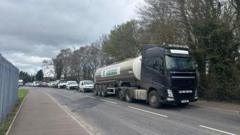
The image of trucks lined up at the border, drivers waving flags and shouting about "solidarity," makes for great television. It’s a classic David vs. Goliath narrative. On one side, the hardworking haulier; on the other, the faceless, soul-crushing tax machine of the state. But if you look past the high-vis vests and the emotional rhetoric of the recent Northern Ireland fuel protests, you’ll find a movement built on a foundation of economic illiteracy and a refusal to face the brutal reality of the global energy market.
"Solidarity" isn't a strategy. It's a coping mechanism for an industry that refuses to evolve.
The Tax Myth: Why Gutting the Treasury Won't Lower Your Costs
The lazy consensus among protesters in Belfast and Dublin is simple: "The government takes too much, so they should take less." It sounds logical until you actually look at how fuel pricing works. In the UK and Ireland, fuel duty is a fixed amount per litre. It doesn't fluctuate with the price of oil.
When the price of Brent Crude spikes due to geopolitical instability or OPEC+ production cuts, your pain at the pump has almost nothing to do with the taxman and everything to do with a global supply chain that doesn't care about your local logistics firm. If the government slashes duty by 10p tomorrow, history tells us exactly what happens: retailers and wholesalers absorb that margin within weeks. You don't get cheaper fuel; you get a brief dip followed by a price creep that restores the status quo, only now the state has a multi-billion-pound hole in its budget for roads and infrastructure.
I have spent twenty years watching industries lobby for tax breaks. It is the heroin of the corporate world. It provides a temporary high while the underlying disease—inefficiency—continues to rot the bones of the business.
The Productivity Trap
The Northern Ireland haulage sector is obsessed with the price of an input it cannot control. This is a massive failure of leadership.
Why are we talking about fuel duty instead of empty running? Roughly 30% of trucks on our roads are driving around with nothing in the back. That is the real scandal. If a business loses its margin because fuel goes up by 5%, that business was already on life support. It was a "zombie" firm, kept alive by low interest rates and cheap diesel.
Real industry titans don't stand on the side of the A1 with a placard. They invest in route optimization, aerodynamic fleet upgrades, and aggressive fuel-hedging strategies. They diversify. They move toward intermodal freight. The protesters aren't fighting for the "little guy"; they are fighting to keep a 1990s business model alive in a 2020s economy.
The Border Paradox
The "solidarity" between NI and ROI protesters is particularly rich given that for decades, the price differential across the border was a primary source of profit for many of these same operators. When fuel was cheaper in the South, Northern tanks were filled there. When the currency swung the other way, the flow reversed.
Now that the gap has narrowed due to harmonized carbon floor pricing and global volatility, the "unfairness" suddenly becomes a cross-border struggle. This isn't about fair competition; it's about a desperate grab for subsidies.
Let’s be blunt: The Irish government and the UK Treasury are currently staring down a massive transition toward electrification. They aren't going to lower fuel duty. They are going to raise it. They have to. Every penny cut from diesel duty is a penny taken away from the incentives needed to build a charging infrastructure that actually works. By demanding lower fuel taxes, protesters are actively lobbying to ensure their own obsolescence.
What No One Tells You About "Essential User" Rebates
One of the loudest demands is for an "essential user" rebate—a special lower rate for hauliers. On the surface, it seems fair. You need the fuel to run the economy; the Sunday driver doesn't.
But look at the mechanics.
- The Bureaucratic Nightmare: The cost of administering, auditing, and policing a tiered tax system is astronomical.
- The Fraud Factor: Remember "red diesel"? The moment you create two prices for the same product, you create a black market.
- The Competitive Distortion: A rebate favors the massive firms with the administrative capacity to claim it, while the small, independent driver—the very person these protests claim to represent—gets buried in paperwork or excluded by technicalities.
I've seen firms bank on these types of subsidies only to go bankrupt the moment the political winds shift. Basing your survival on the whim of a Finance Minister is not a business plan; it’s a suicide pact.
The Hard Truth: Prices Need to Be High
Here is the take that will get me banned from every haulage depot in County Antrim: High fuel prices are the only thing that will actually save the industry.
When fuel is cheap, we are lazy. We take inefficient routes. We ignore new technology. We over-rely on "just-in-time" delivery models that are fragile and environmentally disastrous. High prices force innovation. They force the consolidation of smaller, inefficient players into larger, more resilient networks. They accelerate the move toward hydrogen and electric heavy goods vehicles (HGVs).
Imagine a scenario where fuel stayed at 2015 prices forever. We would still be driving 15-year-old smoke-belchers, ignoring every advancement in logistics technology, and wondering why our margins are razor-thin. Pain is the only real catalyst for change in freight.
Stop Asking for Help and Start Cutting Weight
If you want to survive the next decade, stop looking at Westminster or the Dáil. They are not coming to save you. Their priorities are carbon targets and fiscal stability, neither of which involves making it cheaper for you to burn fossil fuels.
Instead of "standing in solidarity" on a cold motorway shoulder, start doing the math:
- Weight Reduction: Every kilogram of unnecessary equipment or poorly loaded cargo is money leaking out of your exhaust.
- Driver Training: The difference between your best driver and your worst driver is often 15% in fuel consumption. That’s a bigger margin than any tax cut you’ll ever get.
- Collaboration: Share loads with your competitors. It sounds like heresy, but "co-opetition" is the only way to kill the empty running that is actually starving your business.
The era of cheap, easy diesel is over. The protests aren't a sign of strength; they are a death rattle. You can either stand in the rain holding a sign, or you can go back to the office and figure out how to run a fleet that doesn't need a government handout to stay in the black.
Pick one. The market has already made its choice.



