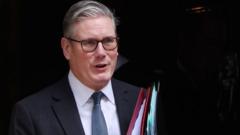
The Prime Minister is playing a dangerous game of fiscal chicken, and he’s using Iran as the ultimate bogeyman to justify it. By keeping fuel tax hikes "under review" due to Middle Eastern volatility, the government isn't protecting the working class. It is subsidizing a dying combustion era while handing a massive, unearned gift to the very regimes it claims to fear.
The "lazy consensus" suggests that raising fuel duty during a period of global instability is political suicide and an economic burden. That logic is prehistoric. In reality, the failure to hike fuel taxes is a slow-motion car crash for national infrastructure and a direct signal to oil-producing autocracies that Western policy remains their hostage.
The Iran Fallacy
Politicians love a good external crisis to hide internal cowardice. The narrative is simple: "We can’t raise taxes because Iran might close the Strait of Hormuz, driving prices up anyway."
This is backward.
If the supply chain is fragile because of a single chokepoint in the Persian Gulf, the solution is to aggressively reduce reliance on the commodity flowing through it. By freezing fuel duty, the government keeps the price at the pump artificially low, incentivizing continued high consumption of fossil fuels. We are effectively paying for our own vulnerability.
I have spent fifteen years analyzing energy markets. I have seen governments dump billions into "relief" packages that do nothing but pad the margins of refineries while the underlying infrastructure rots. When you suppress the price of a volatile asset, you don't create stability. You create a coiled spring.
The Subsidized Traffic Jam
We need to stop pretending that fuel duty is a "tax on the poor." While it’s true that rural commuters feel the pinch, the blanket freeze is an incredibly blunt and inefficient instrument.
Data from the Institute for Fiscal Studies (IFS) and various transport think tanks consistently shows that the wealthiest households benefit significantly more from fuel duty freezes because they drive more miles in heavier, less efficient vehicles. We are using the national ledger to pay for the fuel in a luxury SUV under the guise of helping a delivery driver in a transit van.
If the goal was truly to protect the vulnerable, we would hike the tax and use the $5 billion to $10 billion in annual revenue to provide targeted, means-tested rebates or to make public transit actually functional. Instead, we let the tax base erode. Since 2011, the freeze has cost the Treasury over £100 billion in cumulative revenue. Think about the state of the roads. Think about the rail network. That is where your "saved" tax went—it vanished into the potholes created by the very cars we are subsidizing.
The Inflation Boogeyman
The standard argument against a fuel tax hike is that it drives inflation. This is a half-truth that ignores the velocity of the energy transition.
Yes, fuel is an input cost for almost everything. But keeping it artificially cheap delays the "tipping point" for commercial fleet electrification. Logistics firms won't make the hard, capital-intensive pivot to electric heavy-duty vehicles or hydrogen fuel cells as long as the government promises to keep diesel cheap.
By refusing to raise the tax, the PM is effectively telling every logistics CEO in the country: "Don't bother innovating. We'll keep the old world on life support for you."
This creates a "productivity trap." While other nations use high carbon pricing to force efficiency and tech adoption, we are stagnating in a 20th-century loop. We aren't avoiding inflation; we are ensuring that when the next real oil shock hits—and it will—our economy will be the least prepared to handle it.
The Myth of "Under Review"
When a politician says something is "under review," they mean "I am waiting for the news cycle to change so I can do what is politically convenient rather than what is economically necessary."
The review process itself is a source of market instability. Businesses cannot plan ten-year cycles on "maybe." The automotive industry needs a clear, rising price signal to justify the massive R&D spend required for the next generation of transport.
Imagine a scenario where the government announced a guaranteed 5% annual increase in fuel duty for the next decade.
- Residual values for EVs would skyrocket because the total cost of ownership (TCO) becomes predictable.
- Investment in charging infrastructure would shift from "speculative" to "mandatory."
- The "Iran risk" would diminish every single year as the percentage of the GDP tied to oil prices drops.
Instead, we get a year-to-year shrug.
The Hidden Cost of "Cheap" Gas
There is no such thing as a free lunch, and there is certainly no such thing as cheap petrol. You pay for it somewhere else.
- The Health Bill: We pay in respiratory issues and healthcare costs associated with urban air quality.
- The Time Bill: We pay in the congestion that results from underfunded alternatives.
- The Sovereignty Bill: We pay by remaining tethered to the geopolitical whims of petrostates.
The PM’s hesitation isn't a "cautious approach." It is a surrender of agency. We are letting the fear of a 5p per liter jump dictate our national energy security.
Stop Asking if We Can Afford the Hike
The "People Also Ask" columns are filled with "How much will the fuel tax hike cost the average driver?"
That is the wrong question.
The right question is: "How much is the fuel tax freeze costing our ability to compete in a post-carbon global economy?"
The answer is: Everything. We are burning our future to stay warm in the glow of a burning past.
If we want to actually "review" the impact of Iran on our domestic policy, the conclusion should be immediate: Raise the tax. Decouple the economy. Build the infrastructure that doesn't rely on the stability of a region three thousand miles away.
Anything else is just cowardice dressed up as "economic sensitivity."
Stop looking at the price at the pump and start looking at the bill for the status quo. It’s far higher than a few pence on the gallon.
Rip the Band-Aid off. Raise the duty. Use the money to build a country that doesn't care what the oil price is in Tehran.