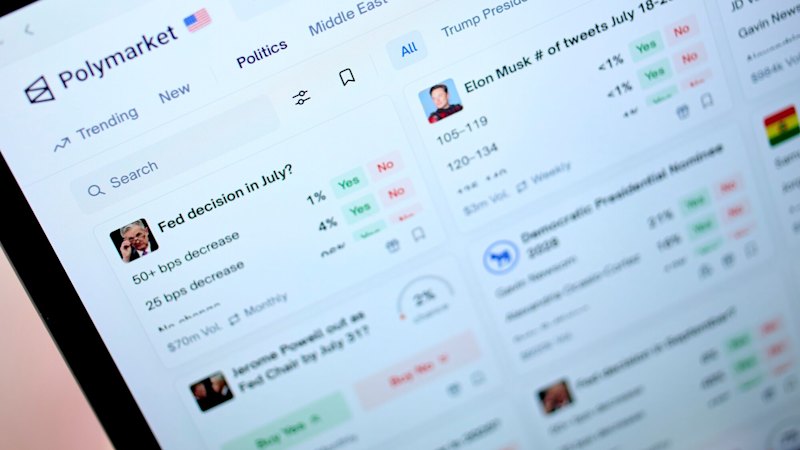
While most people watch the news to see what's happening, a growing group of traders is using their wallets to predict it. Over the last few days, the digital betting world has seen something unprecedented. As the military confrontation between the U.S., Israel, and Iran shifted from threats to active strikes, prediction markets didn't just react—they exploded.
On platforms like Polymarket, the volume for "world" and "geopolitics" contracts has hit levels that make previous records look like pocket change. We're talking about more than $500 million wagered on a single conflict. It’s a grim reality, but it’s also the most honest data we have. When people put real money on the line, the "noise" of political punditry disappears. What's left is a cold, hard calculation of probability.
The $529 Million Prediction
The scale of this surge is hard to wrap your head around if you haven't been following the rise of decentralized betting. One specific contract—"When will the U.S. strike Iran?"—has pulled in over $529 million in total volume since it opened late last year. On February 28, the day the strikes actually commenced, the daily volume alone was nearly $90 million.
Think about that. While traditional markets were closed for the weekend, thousands of people were trading the literal start of a war in real-time. This isn't just "gambling" in the traditional sense. It's the creation of a shadow intelligence agency fueled by the "wisdom of the crowd."
Bettors weren't just guessing if a strike would happen. They were pricing in the exact day. The odds for a February 28 strike hovered at a relatively low percentage for weeks, but as the "Epic Fury" operation drew near, the money started moving with suspicious precision.
Did Insiders Front Run the War
This is where things get messy. On-chain analytics firms like Bubblemaps have already flagged a handful of "fresh" wallets that seem a little too lucky. Six specific accounts were created and funded with hundreds of thousands of dollars just 24 hours before the missiles flew. These wallets bet exclusively on the "Yes" outcome for a February 28 strike.
One trader, going by the name "Curseaaaaaaa," reportedly cleared over $750,000 in profit on a single bet regarding the status of Iran's leadership. Another wallet turned about $61,000 into nearly half a million dollars in hours.
You don't need to be a conspiracy theorist to see the issue here. If you're a mid-level staffer with a tip or a contractor with eyes on a flight line, a decentralized, anonymous platform like Polymarket is a tempting place to "monetize" that info. It’s why we’re seeing a sudden, urgent push for the Public Integrity in Financial Prediction Markets Act of 2026 in Washington. Lawmakers are finally realizing that these markets might be the ultimate destination for "war-room" leaks.
What the Smart Money Is Pricing Now
If you want to know what's actually going to happen next, stop looking at the cable news tickers. Look at the "Ceasefire" and "Ground Invasion" contracts. As of March 3, 2026, here is how the crowd is pricing the immediate future:
- Ceasefire by March 6: Only a 15% chance. The market thinks this is just the beginning.
- Ceasefire by March 31: A much more optimistic 61%. This suggests bettors expect a short, high-intensity campaign rather than a multi-year slog.
- U.S. Ground Forces in Iran by March 7: Trading at 28%. This is a massive jump from the near-zero odds we saw in early February.
- Oil hitting $100: With the Strait of Hormuz effectively halted, the "supply shock" contracts are moving toward a 75% probability.
The market is essentially saying that while the initial "shock and awe" phase might be over, the regional disruption is far from settled.
Beyond the Betting Drones and Defense Stocks
While the "degens" on Polymarket are betting on the dates of explosions, Wall Street is doing its own version of geopolitical hedging. Defense giants like Lockheed Martin (LMT) and Northrop Grumman (NOC) are seeing heavy inflows. It’s the obvious play. Global defense spending is already projected to hit $2.6 trillion this year, and this conflict just put a floor under those valuations.
But keep an eye on the "intelligence" stocks. Palantir (PLTR) has jumped significantly, trading near $143. Why? Because in 2026, war is as much about data and AI-driven targeting as it is about hardware. Investors are betting that the U.S. will rely more on Palantir's "AIP" to manage the logistical nightmare of a Middle Eastern escalation than on traditional boots on the ground.
Gold is also behaving exactly how the textbooks say it should. It’s sitting near $5,400 per ounce, up over 2% since the weekend. If the conflict drags on and the Strait of Hormuz stays blocked, some analysts are calling for $6,300 by summer.
The Ethical Grey Area
I won't lie to you—there’s something inherently uncomfortable about watching a 24/7 ticker of people betting on the death of a head of state or the start of a bombing run. DraftKings actually drew a line in the sand this week, with their CEO stating they won't offer "blood money" bets on geopolitical deaths.
But the crypto-native platforms don't have those filters. They argue that by allowing these bets, they provide the world with the most accurate, unbiased forecast possible. It's a "truth machine" that doesn't care about optics. Whether you find it repulsive or revolutionary, the reality is that these markets are now a permanent fixture of how we understand global risk.
How to Navigate This Volatility
Don't let the headlines make you do something stupid with your portfolio. Geopolitical spikes are historically "buy the dip" opportunities, but this one feels different because of the energy component. If oil stays above $90, inflation won't just stay high—it'll accelerate.
- Watch the Strait: If tankers start moving again through the Strait of Hormuz, the "war premium" in oil will evaporate in 48 hours. If they don't, $100 oil is your new baseline.
- Hedge with Volatility: The VIX is sitting at its highest level of 2026 (around 23.6). It's expensive to buy insurance now, but holding some cash to deploy when the "panic" peaks is the smarter move.
- Audit Your Tech Exposure: High-growth tech hates high energy prices and high interest rates. If you're over-leveraged in software, you might want to rotate some of that into "hard" assets or defense.
The conflict in Iran isn't just a military event. It’s the first true "prediction market war," where the front lines are tracked in real-time by a global pool of capital. Stop waiting for the "official" word and start watching where the money is moving. It’s usually right.
Move your stop-losses up on your energy positions and keep an eye on the March 31 ceasefire odds. If those start to tank, we’re in for a very long spring.