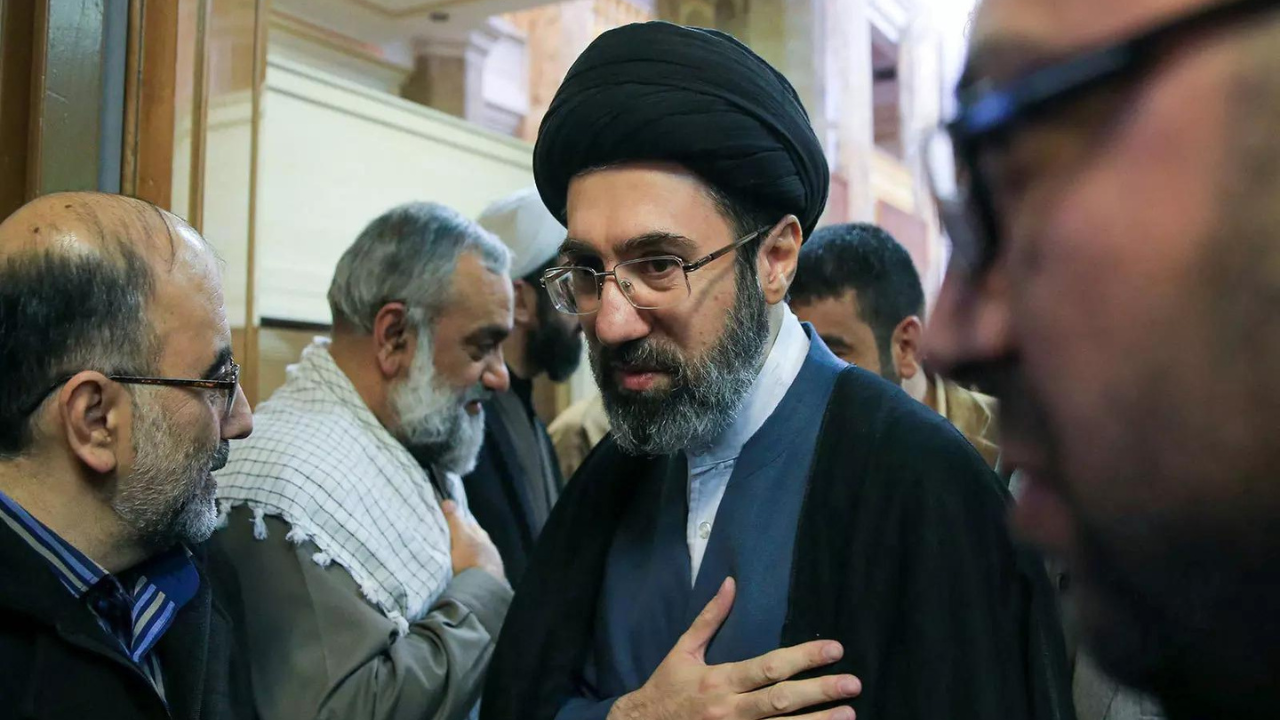
The recent assertions by Mojtaba Khamenei regarding a "defeat" of United States and Israeli interests in the Middle East are not mere rhetorical flourishes; they represent a calculated signaling mechanism designed to stabilize domestic power structures and validate the doctrine of "Strategic Patience." To analyze these claims with rigor, one must look past the binary of military win-loss records and instead examine the Iranian state's internal cost-benefit analysis and its definition of victory. In the context of the Islamic Republic’s current political evolution, "victory" is defined as the successful maintenance of the status quo against external revisionist pressure, rather than the physical displacement of adversary forces.
The Tripartite Framework of Iranian Victory Signals
Iranian strategic communication operates through three distinct channels, each serving a specific functional requirement for the regime's longevity.
- Domestic Legitimacy Reinforcement: Mojtaba Khamenei’s emergence as a vocal figure suggests a consolidation of the succession path. By claiming victory over "Global Arrogance," the state provides a psychological dividend to its core ideological base, compensating for the material hardships imposed by the Sanctions Architecture.
- Regional Deterrence signaling: These statements serve to reassure the "Axis of Resistance" that the central node (Tehran) remains committed to the long-term attrition strategy. It signals that the costs incurred—such as the degradation of proxy leadership or kinetic strikes on Iranian interests—are viewed by the leadership as acceptable overhead rather than systemic failures.
- Adversary Perception Management: By declaring the "enemy defeated," Tehran attempts to create a "fait accompli" narrative. This is intended to weary Western policymakers by suggesting that maximum pressure has reached a point of diminishing returns, thereby encouraging a pivot toward de-escalation or containment rather than confrontation.
The Attrition Constant and the Failure of Maximum Pressure
The core of the Iranian argument rests on the survival of its regional architecture despite years of intense economic and covert pressure. From a data-driven perspective, the "defeat" of the US and Israel is interpreted as the failure of these actors to achieve their primary stated objectives: the total cessation of Iran’s nuclear program and the dismantling of its regional influence.
The US strategy has historically relied on a linear escalation model: increase economic pain to force a change in political behavior. Iran, however, utilizes a non-linear response. For every unit of economic pressure applied, Iran increases its "Resistance Economy" measures and expands its gray-zone activities. The bottleneck for the West is the "Escalation Ceiling"—the point beyond which further pressure risks a regional conflagration that Western capitals are politically and economically unprepared to manage. Tehran identifies this ceiling and operates just beneath it, effectively neutralizing the efficacy of superior conventional power.
Institutionalizing Succession through Crisis Narrative
The involvement of Mojtaba Khamenei in delivering these proclamations is a significant data point in the study of Iranian elite physics. The transition of power in a theocratic system requires a candidate to demonstrate both ideological purity and a firm grasp of the security apparatus. By tethering his public persona to a "victory" over the state’s primary antagonists, Mojtaba is positioning himself as the custodian of the revolution’s survival.
This creates a self-reinforcing feedback loop. The more the state perceives itself as being under siege, the more it requires a leader who can claim to have navigated that siege successfully. The "victory" is not a destination but a continuous state of survival that justifies the concentration of power within a specific lineage or circle of the Islamic Revolutionary Guard Corps (IRGC).
The Mechanics of Asymmetric Persistence
To understand why Tehran views the current regional volatility as a win, one must evaluate the Cost of Entry vs. Cost of Denial.
- Cost of Entry: The United States and Israel incur massive financial and political costs to maintain a presence and deploy high-tech defense systems like the Iron Dome or carrier strike groups.
- Cost of Denial: Iran utilizes low-cost, high-impact assets—unmanned aerial vehicles (UAVs), cyber operations, and local militias—to deny its adversaries a stable environment.
When the cost for the adversary to maintain the status quo exceeds their long-term political will, the asymmetric actor claims victory. Mojtaba Khamenei's rhetoric indicates that Tehran believes it has reached this "will-parity" or even "will-superiority" over its opponents.
Assessing the Limits of the Victory Narrative
While the rhetoric serves domestic and regional purposes, it faces significant structural headwinds that could render the "victory" pyrrhic.
The first limitation is the Internal Economic Disconnect. There is a growing delta between the state’s claim of geopolitical triumph and the civilian population's experience of inflation and resource scarcity. If the "victory" does not translate into a relaxation of the economic siege, the legitimacy gain is confined only to the hardline loyalists, leaving the broader social fabric vulnerable to sudden shocks.
The second limitation is the Kinetic Reality. While Iran has maintained its regional "forward defense" posture, the technical and intelligence superiority of Israel has resulted in significant leadership attrition within the IRGC and its affiliates. Declaring victory while key operational commanders are being systematically eliminated creates a credibility gap that can only be bridged by increasing the intensity of the rhetoric or by a high-profile retaliatory success.
The Strategic Forecast for Regional Alignment
The projection of victory by the Khamenei circle suggests that Iran will not be seeking a comprehensive "Grand Bargain" in the near term. Instead, the strategy will shift toward Fragmented Normalization. This involves:
- Bilateral De-escalation with Gulf Neighbors: Using the perception of "US retreat" to draw regional Arab powers into security arrangements that exclude Western oversight.
- Solidifying the Eastward Pivot: Deepening the military and economic integration with Russia and China to provide an alternative to the Western-led financial system.
- Nuclear Latency as Permanent Leverage: Maintaining a threshold capability that is never fully weaponized (to avoid total war) but never abandoned (to maintain a permanent seat at the table of regional powers).
The proclamation of victory is a tactical maneuver within a much larger game of regional recalibration. It signals that the Iranian leadership has calculated that the worst of the external pressure has passed and that the future belongs to those who can endure the longest.
The immediate requirement for Western and regional intelligence services is to monitor the internal movement of IRGC assets following these statements. A declaration of victory is often the precursor to a pivot in operational focus. Analysts should anticipate a shift from defensive regional posturing to more aggressive "policing" of the internal economy and a tightening of the succession corridors within the Office of the Supreme Leader. The victory is not over a foreign army, but over the internal possibility of a different Iranian future.