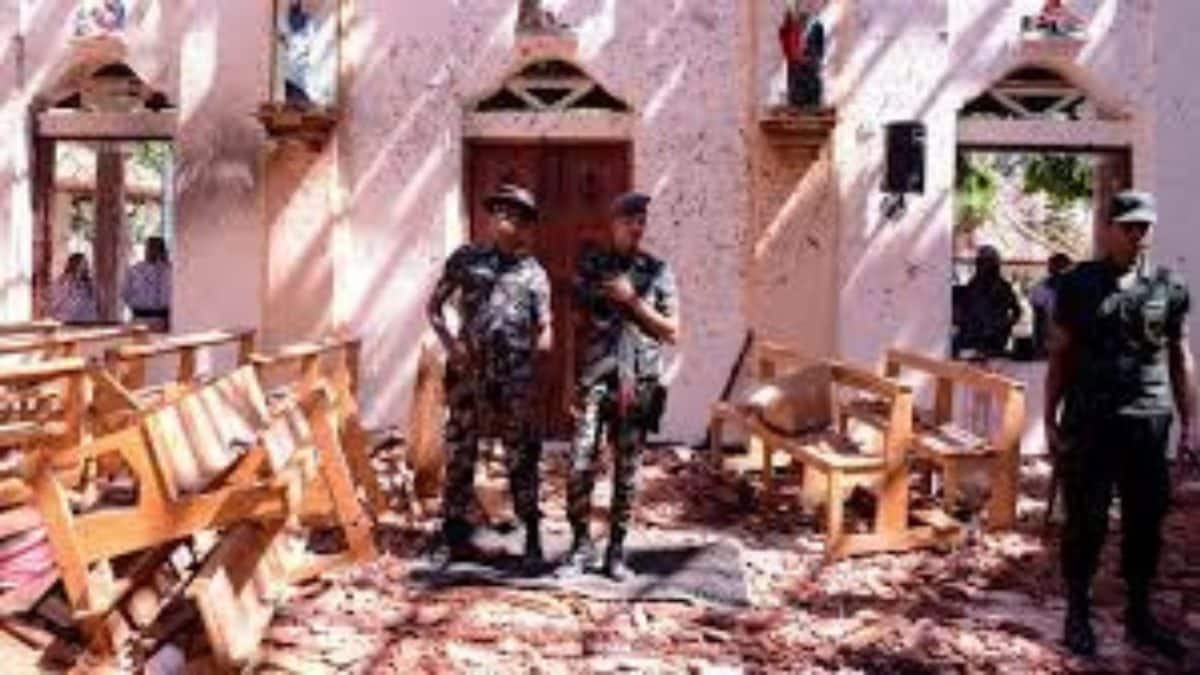
The salt air in Colombo usually carries the promise of respite, a cooling breeze that rolls off the Laccadive Sea to temper the humid weight of the city. But on Easter Sunday in 2019, the air tasted of sulfur and iron. It was a morning of white lace, church bells, and the clinking of breakfast porcelain in high-end hotels. Then, the world tore open.
Six coordinated explosions. Three churches. Three luxury hotels.
In the aftermath, the numbers were tallied with a cold, clinical precision that masks the true jagged edge of grief. Two hundred and sixty-nine lives were extinguished. Most were locals at prayer; others were travelers caught in the wrong timezone of history. For years, the official narrative was a closed book: a local extremist group, National Thowheeth Jama’ath, had pledged fealty to the Islamic State and unleashed hell.
But in Sri Lanka, the truth is rarely a straight line. It is a labyrinth.
The Architect of the Shadows
To understand why the recent arrest of a former military intelligence chief has sent tremors through the island, you have to look past the smoke of the blast sites. You have to look at the "deep state"—the invisible architecture of power that exists beneath the surface of any democracy.
Consider a hypothetical scenario, a metaphor for how intelligence is supposed to work. Imagine a lighthouse keeper who sees a storm brewing on the horizon. He has the maps. He has the radio. He sees the ships steering directly into the rocks. If that keeper stays silent, if he dims the light just as the hull strikes the reef, is he merely negligent? Or is he part of the storm?
For years, rumors swirled like monsoon winds. Allegations suggested that the men who wore the suits of state were not just blindsided by the attackers, but perhaps, in some dark corner of the board, were moving the pieces.
The man now at the center of this storm is Nilanthi Jayawardena. As the former head of the State Intelligence Service (SIS), he was the keeper of the maps. He was the man who received the warnings. And the warnings were not vague whispers. They were screams.
The Warning That Never Arrived
Weeks before the first vest was detonated, foreign intelligence agencies—specifically from India—provided granular, terrifyingly specific data. They had names. They had targets. They even had a date.
In the high-walled offices of Colombo’s elite, this information sat on desks. It traveled through memos. It was discussed in the sterile silence of briefing rooms. Yet, the police on the ground remained uninformed. The priests at St. Anthony’s Shrine continued to polish the pews. The families at the Shangri-La ordered their tea.
The arrest of the former spy chief isn't just a legal maneuver. It is a reckoning with the concept of "willful blindness."
In the immediate wake of the attacks, the political fallout was swift and opportunistic. The tragedy became a campaign slogan. The perceived incompetence of the sitting government paved a golden road for the return of the Rajapaksa dynasty, promising "strongman" security to a terrified populace. But as the years passed, the "security" they promised began to look more like a shroud.
Investigators and whistleblowers started to ask a more dangerous question: Did the intelligence apparatus allow the attacks to happen to create a political vacuum that only a specific kind of leader could fill?
The Human Weight of a Dossier
When we talk about "intelligence failures," we use a bloodless language. We talk about "silos" and "communication gaps."
We don't talk about the father in Negombo who spent three days searching for his daughter’s favorite earring in the rubble because it was the only piece of her he had left. We don't talk about the survivor whose ears still ring with a frequency that makes the sound of a closing door feel like a gunshot.
The arrest of a high-ranking official like Jayawardena suggests that the "gap" wasn't a mistake. It was a choice.
The legal case hinges on a devastating premise. Proving that an official failed to act is difficult. Proving that they chose not to act for a specific outcome is a descent into the darkest heart of political maneuvering. The Supreme Court of Sri Lanka had already ordered Jayawardena to pay millions in compensation to the victims out of his own pocket—a rare admission that his "negligence" crossed the line into a fundamental betrayal of public trust.
But money is a poor substitute for the truth.
The Long Memory of the Island
Sri Lanka is an island defined by its memories. It is a place where the ghosts of a thirty-year civil war still walk the streets of the north and south. For a brief moment after 2009, there was a hope that the cycle of blood had broken. The 2019 bombings didn't just kill people; they killed the illusion of safety.
The arrest of the former spy chief is a crack in the dam. For the first time, the investigators are looking upward, away from the foot soldiers of the Islamic State and toward the mahogany desks of the capital.
It is a terrifying process for a nation. To admit that the enemies are within the house is far more frightening than fearing a foreign threat. It means the very structures designed to protect the citizen—the badge, the dossier, the secret service—can be weaponized against them through the simple act of doing nothing.
Silence.
In the world of intelligence, silence is a weapon. By withholding a name, by stalling a phone call, a bureaucrat can change the course of a nation's history.
The Scales of Justice in a Fragile State
The current government, led by President Anura Kumara Dissanayake, is walking a razor's edge. He rose to power on a wave of anti-corruption sentiment, promising to finally give the victims the answers they have been denied for seven years.
But the "deep state" is not easily dismantled. It is a network of loyalties, debts, and shared secrets. To prosecute the former head of intelligence is to invite the ghosts to speak. And ghosts in Colombo have a habit of dragging others into the grave with them.
The evidence now surfacing includes allegations that the attackers were managed by intelligence assets—that the radicalization of these young men was watched, measured, and perhaps even nurtured for its strategic value.
Think of a forest fire. There are the men who drop the match. And then there are the men who see the smoke, look at the wind direction, and decide to let it burn because they want to build something new on the scorched earth.
The victims' families, led by the tireless advocacy of the Catholic Church in Sri Lanka, have refused to let the fire be forgotten. Cardinal Malcolm Ranjith has become a thorn in the side of every administration, demanding not just the arrest of the bombers, but the exposure of the conspiracy.
"We are not looking for revenge," one survivor told a local reporter. "We are looking for the reason. I want to know why my son is gone when the men in the offices knew his killer's name two weeks before he did it."
The Finality of the Evidence
This isn't a story about a simple failure. It is a story about the rot that occurs when the survival of a political class becomes more important than the lives of the people they serve.
The arrest of Nilanthi Jayawardena is the first time the "untouchables" have felt the cold steel of a handcuff. It signals to every operative and every politician that the "I was just following orders" or "I didn't think it was serious" defense is no longer a shield.
The stacks of paper—the hundreds of thousands of pages of testimony from the Presidential Commission of Inquiry—are finally being read with a different lens. No longer are they seen as a record of a tragedy. They are being read as an indictment.
Sri Lanka is trying to heal, but you cannot heal a wound that still has shrapnel inside it. You have to cut. You have to reach in and pull out the jagged pieces of the truth, no matter how much it bleeds.
As the sun sets over the Galle Face Green, the children fly kites in the same air where the smoke once rose. The city looks peaceful. But in the courtrooms and the prison cells, a different kind of storm is finally breaking. The keeper of the maps is no longer in the lighthouse. He is in the dock.
The bells of the churches will ring again this Easter. They will ring for the dead. But for the first time in years, they might also ring for a fragile, hard-won justice that refuses to be silenced by the shadows of the state.
The truth is a persistent thing; it waits in the dark until someone is brave enough to turn on the light.