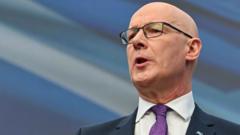
The rain in Perth doesn't just fall; it colonizes. It soaks through the heavy wool of overcoats and clings to the stone facade of the concert hall where the air usually smells of damp pavement and anticipation. Inside, John Swinney stands at a lectern, a man who has spent more than half his life in the engine room of Scottish politics. He is not a firebrand by nature. He is a mathematician of the soul, a man of spreadsheets and soft-spoken certainties. Yet, the words he is uttering carry the weight of a high-stakes wager: the SNP is not just surviving; it is winning.
He predicts a majority. Not a "strong showing." Not a "coalition-ready plurality." A full, 65-seat, outright mandate in a voting system specifically designed by its architects in the 1990s to make such a feat mathematically impossible.
To understand the audacity of this claim, you have to look past the polling data and into the kitchens of places like Kirkcaldy or the rain-slicked streets of Dundee. Consider a hypothetical voter named Elspeth. She is sixty-four, a retired teacher who remembers the 2014 independence referendum not as a political event, but as a season of her life. Back then, the energy was electric. Today, she looks at her heating bill, then at the news, then back at the bill. For Elspeth, and thousands like her, the promise of a majority isn't about constitutional theory. It is a question of whether the machinery of government still has the fuel to move.
The Architecture of the Impossible
When the Scottish Parliament was established, the "Additional Member System" was baked into its DNA. It was a safety valve. The goal was to ensure that no single party could ever govern alone, forcing a culture of consensus and compromise. It worked, until 2011, when Alex Salmond broke the physics of the building by securing 69 seats. Since then, that number—65—has become a ghost that haunts every First Minister. It is the threshold of total control.
Swinney’s confidence is a calculated gambit. By planting the flag at the 65-seat mark, he is attempting to bypass the fatigue that has begun to settle over the independence movement. He knows that voters are tired. They are tired of the cost of living, tired of the back-and-forth over the ferry contracts, and tired of the internal friction that has flickered through his party ranks like a persistent fever.
But a majority changes the conversation. It shifts the narrative from "defending the status quo" to "seizing the initiative." It is a psychological play. If you tell a crowd they might win, they might show up. If you tell them they are about to make history, they will run through the rain to get to the ballot box.
The Human Friction of the Doorstep
Politics at this level is often discussed in terms of "swings" and "target seats," but the reality is much more granular. It’s found in the friction of the doorstep.
Imagine a young activist named Callum. He’s twenty-two, wearing a yellow badge that has lost its luster in the drizzle. He knocks on a door in a housing estate outside Glasgow. The man who answers doesn't want to talk about the Treaty of Union. He wants to talk about why his son had to wait fourteen hours in an A&E department.
This is where Swinney’s prediction meets the hard pavement of reality. To get to sixty-five, the SNP has to bridge the gap between the grand constitutional vision and the immediate, visceral needs of the person holding the door open. Swinney’s argument is that only a majority government has the "muscle" to protect the Scottish budget from the decisions made in Westminster. It is a shield-and-sword strategy: the majority is the shield against austerity, and the sword that carves out a path to a different future.
But the sword is heavy.
Critics point to the polls, which suggest a tightening race with a resurgent Scottish Labour. They see the 65-seat prediction as a desperate bluff. They argue that the "nationalist tide" has gone out, leaving behind a shoreline of broken promises and stalled legislation. Yet, Swinney remains the calmest man in the room. He has seen the tide go out before. He has also seen it come back with a vengeance.
The Invisible Stakes
What is actually at stake here? It isn't just a tally of MSPs. It is the very definition of what Scotland wants to be in the middle of the 2020s.
If Swinney is right, and the SNP defies the gravity of the electoral system once again, it validates a decade of governance. It tells the world that the appetite for a break from the UK hasn't just survived the turmoil; it has been hardened by it. A majority provides a mandate that is difficult for any Prime Minister in London to ignore without looking like they are suppressing a clear democratic will.
If he is wrong, however, the consequences are existential. A minority government, or a loss of power to a unionist coalition, would represent more than just a change in management. It would be the closing of a chapter. The "independence generation" would have to reckon with the fact that their momentum had hit a ceiling.
The tension lies in the "grey voters"—the ones like Elspeth who are caught between a long-held dream and a sudden, sharp anxiety about the present. They are the ones who will decide if 65 is a number or a miracle.
The Math of Hope
There is a specific kind of silence that follows a bold prediction. It is the silence of people doing the mental arithmetic of their own lives. Swinney is banking on the idea that, when push comes to shove, the Scottish electorate prefers the "known quantity" of his leadership over the "uncertain change" offered by his rivals.
He is betting that the desire for self-determination is not a passing fad, but a structural shift in the Scottish psyche. He is betting that the internal scars of the party are less important to the voter than the external pressures of the UK economy.
But math is an unforgiving mistress. Every seat beyond sixty requires a level of turnout that borders on the miraculous in an "off-cycle" year. It requires the SNP to sweep the constituencies and pick up enough list seats to offset the built-in penalties of the voting system. It is like trying to win a race while wearing lead weights.
The air in the concert hall is warm, a sharp contrast to the biting cold outside. Swinney finishes his speech, the applause rises, and for a moment, the ghost of sixty-five feels almost tangible. It feels like something that can be touched, something that can be achieved through sheer force of will and organized effort.
Then the doors open. The cold air rushes in. The reality of a divided nation, a struggling health service, and a skeptical public waits on the other side of the threshold.
The mathematician has made his calculation. Now, the people have to decide if the variables match their own lives. They will walk back to their cars, turn on their heaters, and weigh the promise of a majority against the price of their groceries. The gamble has been placed. The wheel is spinning.
In the end, sixty-five is just a number, but in the damp, grey light of a Scottish morning, it represents the difference between a dream deferred and a nation redefined.
The rain continues to fall, indifferent to the predictions of men, washing over the streets where the real decision will be made, one door, one conversation, and one vote at a time.