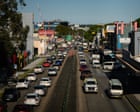
The M5 East is usually a grinding symphony of frustration. If you live in Sydney’s southwest, you know the sound: the low hum of thousands of idling engines, the rhythmic clicking of indicators, and the occasional sharp burst of a horn echoing through the tunnels. It is a place where time goes to die. But lately, something feels off. The roar has softened into a whisper. The bitumen is visible again.
For the first time in years, the ghost of a clear run has returned to the arterial veins of our biggest cities. In Melbourne, the Monash Freeway—a road that typically functions as a linear parking lot—is moving. It’s eerie. It’s quiet. For a more detailed analysis into this area, we suggest: this related article.
It’s also an omen.
The data tells a clinical story. Traffic volume across Sydney and Melbourne’s major toll roads and motorways has dipped significantly over the last quarter. Analysts point to the fuel crisis, a global surge in crude prices, and the relentless pressure of inflation. They call it "demand destruction." To a spreadsheet, it’s just a downward-sloping line. To the people behind the steering wheels, it’s a desperate recalculation of what their lives are actually worth in dollars per liter. For further details on the matter, extensive reporting can be read on Reuters.
The Kitchen Table Audit
Consider a hypothetical commuter named Sarah. She lives in Penrith and works in the city. For a decade, the eighty-kilometer round trip was an immutable fact of her existence, as certain as the sunrise. But last Tuesday, Sarah sat at her kitchen table with a calculator and a stack of receipts.
The numbers didn't just add up; they attacked.
When fuel sat comfortably at $1.50, the commute was a chore. At $2.20, it became a debt. By the time Sarah factored in the tolls—those digital vampires that drain your E-Toll account every time you pass under a metal gantry—the cost of simply showing up to work was rivaling her daily take-home pay after childcare.
She isn't alone. This isn't a "trend" in the way fashion or social media apps are trends. This is a structural retreat. Australians are retreating from their own infrastructure because the cost of entry has become a barrier to entry. We are seeing a quiet, suburban secession from the road.
The Invisible Toll of the Open Road
We often talk about the economy as if it’s a giant, sentient beast that lives in Canberra or New York. We forget that the economy is actually just a trillion small decisions made in aisles and on driveways.
When a family in Melbourne’s outer suburbs decides to skip the weekend trip to see grandparents because the "petrol light is on," that is the economy. When a tradesman in Sydney decides to stop quoting for jobs across the bridge because the bridge costs too much to cross, that is the economy.
The drop in traffic isn't a sign that we’ve suddenly embraced a slower pace of life or discovered a collective love for the environment. It is a sign of a squeeze so tight that it has begun to restrict our literal movement. Freedom in Australia has always been tied to the car. The vastness of our geography demands it. To lose the ability to move freely is to lose a piece of the Australian identity.
The ripple effects are everywhere.
Small businesses in the CBDs are noticing that the "incidental" customer—the person who drove in for a specific errand and stayed for a coffee—is vanishing. The friction of the journey has outweighed the reward of the destination. We are becoming a nation of localists, not by choice, but by necessity. We are shrinking our worlds to fit our fuel tanks.
The Math of the Modern Commute
Let’s look at the cold, hard mechanics of the crisis. Australia’s fuel prices are pegged to the Singapore benchmark, influenced by a weak Australian dollar and a global supply chain that remains as fragile as a house of cards. When a refinery closes in Asia or a pipeline is threatened in Eastern Europe, a mother in Frankston pays for it at the pump forty-eight hours later.
The average Australian vehicle consumes about 11 liters of fuel per 100 kilometers. In a city like Sydney, where stop-start traffic is the norm, that number climbs. If you are commuting 40 kilometers a day, you are burning through nearly 25 liters a week just to get to the office and back. At current prices, that’s $55 a week on fuel alone. Add $80 in tolls.
That is $7,000 a year. After tax.
For many, that $7,000 is the difference between a holiday and a staycation. It’s the difference between private health insurance and the public waiting list. It is a massive, unlegislated tax on distance.
The Psychological Shift
There is a specific kind of exhaustion that comes from calculating the cost of every kilometer. It changes the way you view your city. The city used to be a playground; now, it’s an obstacle course.
The "death of the office" was predicted during the pandemic, but the fuel crisis is the one actually delivering the killing blow. Employers who insisted on a "return to base" are finding their mandates hitting a wall of fiscal reality. When an employee realizes they can "earn" a $100-a-week raise simply by staying home and using Zoom, the shiny office perks of free fruit and a ping-pong table lose their luster.
This isn't just about the money, though. It’s about the stress of the uncertainty. Fuel prices in our major cities operate on a "cycle" that feels less like economics and more like a game of Three-card Monte. You wake up on Tuesday and it's $1.85. By Wednesday afternoon, it’s $2.25. There is no other essential commodity—not milk, not bread, not electricity—that fluctuates by 20 percent in twenty-four hours.
That volatility breeds a specific kind of anxiety. It makes people hesitant. It makes them stay put.
The Great Sorting
What we are witnessing is a "Great Sorting."
Those who can afford to live close to the city, or those whose jobs allow them to work from a spare bedroom, are largely insulated. They see the empty roads as a convenience—a silver lining to a dark cloud. But for the essential workers, the cleaners, the nurses, the construction crews, and the teachers who have been priced out of the inner rings, the empty roads are a mockery.
They are the ones who must drive. They are the ones who cannot "pivot" to a digital workflow. For them, the thinning traffic isn't a relief; it’s a signal that their peers have reached a breaking point that they themselves cannot yet afford to reach.
The "invisible stakes" here involve the very social fabric of our cities. If we reach a point where only the wealthy can afford to move through the city with ease, we are no longer living in a unified community. We are living in a series of disconnected islands, separated by expensive strips of asphalt that most people can only afford to look at, not use.
The Toll Road Paradox
Then there are the toll operators. Companies like Transurban have built empires on the assumption of perpetual growth. Their contracts with state governments are often iron-clad, featuring guaranteed price increases linked to inflation.
But there is a flaw in the logic of the toll road. It relies on a "value proposition" of time saved versus money spent. When the cost of the fuel becomes so high that the time saved is no longer worth the financial hit, the model begins to crack.
If the M7 or the CityLink becomes 10 percent quieter, the revenue doesn't just dip—the entire justification for these massive private-public partnerships begins to wobble. We are seeing a rare moment where the consumer is finally pushing back, not through protests or petitions, but through the simple act of putting the car keys back on the hook.
A New Geography of Living
So, what happens when the cars don't come back?
Historically, Australians have always been willing to trade time for space. We took the "quarter-acre block" at the end of a long highway because the commute was the price we paid for the dream. That trade is being renegotiated in real-time.
We are seeing a surge in interest in "satellite cities" and regional hubs where the commute is ten minutes instead of ninety. We are seeing a desperate, overdue investment in public transport, though the tracks can’t be laid fast enough to catch the falling demand for driving.
The silence on the M5 and the Monash isn't a fluke. It’s the sound of a country changing its mind.
We are learning to live smaller. We are visiting the local park instead of the distant beach. We are ordering in instead of driving out. We are discovering that the "convenience" of the car was always a fragile luxury, predicated on the idea that the world would always provide cheap energy to move two tons of metal to fetch a liter of milk.
That era is ending.
The Weight of the Ghost Road
Next time you find yourself on a major motorway at 5:30 PM and notice that you’re actually hitting the speed limit, don't just celebrate the clear run. Look at the empty lanes. Think about the thousands of people who aren't there because they simply couldn't afford to be.
Think about Sarah at her kitchen table.
The ghost roads of Sydney and Melbourne are a testament to our resilience, but they are also a warning. They tell us that the way we built our lives—on a foundation of endless movement and cheap fuel—is no longer sustainable.
We are standing still, and for the first time in a generation, we are forced to look around and ask if where we ended up is actually where we wanted to be. The engine has been cut. The car is cooling in the driveway.
Now, we have to figure out how to walk.


