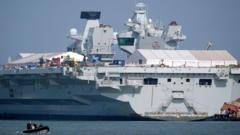
The British public keeps asking the same question every time a Houthi drone targets a merchant ship. Where are the carriers? It's a fair point. We spent billions on these floating airbases. Seeing the HMS Prince of Wales docked in Portsmouth while the Middle East smolders feels like owning a Ferrari but taking the bus to work because you’re worried about the tires. But the reality of naval power in 2026 is messier than a recruitment poster suggests.
Despite the headlines and the social media chatter, the HMS Prince of Wales isn't heading to the Red Sea. It’s not because of a lack of will. It’s a cold, hard calculation of logistics, manpower, and the sheer risk of putting a £3 billion asset in a literal "drone alley." Recently making waves in this space: Finland Is Not Keeping Calm And The West Is Misreading The Silence.
The logistics of a ghost deployment
Moving a Queen Elizabeth-class carrier isn't like sending a destroyer. You don’t just turn the key and go. A carrier is a system. It needs a "tail" of support ships that the Royal Navy is currently struggling to provide. To send the Prince of Wales into a combat zone, you need the Solid Support Ships to keep it fed and armed. Right now, the RFA (Royal Fleet Auxiliary) is stretched thin.
Strikes, maintenance backlogs, and a shortage of specialized sailors mean the support network is frayed. If you send the carrier without its grocery store and its magazine, it becomes a very expensive target. I’ve talked to former officers who say the same thing. You don't gamble with a national icon just for a "show of force" if you can't sustain it for more than a few weeks. Additional information on this are covered by The New York Times.
The F-35 problem nobody wants to admit
A carrier without its full complement of jets is just a very large, very slow helicopter landing pad. The UK's F-35B fleet is growing, but it’s still not where it needs to be for a sustained, high-intensity conflict in the Middle East. We have enough jets for training and "peacetime" patrols. We don't have enough to lose them in a war of attrition against cheap Iranian-made drones.
The math doesn't work. A Houthi drone costs maybe $20,000. An F-35B costs over $100 million. Using a fifth-generation stealth fighter to swat a lawnmower with wings out of the sky is a tactical nightmare. The US Navy is currently learning this lesson the hard way with the Eisenhower strike group. They are burning through expensive missiles and airframe hours at an unsustainable rate. The Ministry of Defence knows this. They’d rather keep the Prince of Wales for its primary NATO obligations in the North Atlantic.
NATO comes first for the Prince of Wales
We often forget that the UK has massive commitments closer to home. With tensions in Eastern Europe and the High North remaining at a boiling point, the Prince of Wales is the centerpiece of NATO’s maritime response. Taking our only available carrier—since the HMS Queen Elizabeth has had her own share of mechanical "gremlins"—and sending it to the Red Sea leaves a massive hole in Northern European defense.
It’s about priorities. The Red Sea is a global problem. The North Atlantic is a British problem. The Royal Navy is choosing to play the long game. They’re focusing on "Steadfast Defender" style exercises and showing Russia that the GIUK gap (Greenland, Iceland, and the United Kingdom) is secure. It's less flashy than launching strikes on Yemen, but it’s arguably more important for national security.
Why destroyers are better for this job anyway
If you want to stop drones and missiles, you don't need a carrier. You need a Type 45 destroyer like HMS Diamond or HMS Richmond. These ships are built for one thing: air defense. Their Sea Viper missiles are specifically designed to track and kill multiple high-speed targets.
A carrier is an offensive weapon. It’s designed to project power deep inland. But in the Red Sea, the mission is defensive. It’s about escorting tankers. Using a carrier for escort duty is like using a sledgehammer to crack a nut. It's overkill, and it puts too many eggs in one basket. If a lucky Houthi strike hits a destroyer, it’s a tragedy. If it hits the Prince of Wales, it’s a national crisis that could end a government.
The shadow of past mechanical failures
Let's be honest about the elephant in the room. The HMS Prince of Wales has a reputation. From propeller shaft issues to flooded engine rooms, the ship has spent more time in the headlines for repairs than for deployments. While the MoD insists those days are over, there’s a lingering hesitation.
Imagine the PR disaster if the ship sailed for the Middle East and broke down in the middle of the Suez Canal. It would be a gift to every adversary we have. The Navy needs the ship to have a "clean" run of successful NATO missions before they risk it in a high-threat environment. They need to prove the platform is reliable before they test it in the heat of the Red Sea.
The reality of 2026 naval warfare
The world has changed since these carriers were designed. The rise of cheap, autonomous weapons has shifted the balance. Carriers are still relevant, but they are no longer the invulnerable fortresses they once were. To deploy one today, you need a level of electronic warfare protection and "layered" defense that requires every part of the fleet to be working in perfect harmony.
Right now, that harmony isn't there. We are short on sailors, short on support ships, and short on the political appetite for a long-term Middle Eastern entanglement. The Prince of Wales will stay in cooler waters. It’s the safer bet, the smarter bet, and frankly, the only bet the UK can afford to make right now.
If you’re tracking the movements of the fleet, don't look at the Red Sea. Look at the Arctic Circle and the North Sea. That’s where the Prince of Wales will be earning its keep. Keep an eye on the RFA recruitment numbers and the delivery schedule of the new Type 26 frigates. Until those numbers go up, our carriers will likely remain a local force rather than a global one. The "Global Britain" dream is hitting the brick wall of naval reality.