The polished floors of city halls in London and the velvet-roped ballrooms of New York are currently hosting a masterclass in performative diplomacy. As the moon marks the end of Ramadan, the traditional "Eid reception" has morphed from a genuine community gesture into a high-stakes political shield. While mayors and ministers distribute baklava and offer practiced greetings, the air in these rooms is heavy with a specific, unspoken tension. The celebratory lights do little to mask the friction between the Western political establishment and a global Muslim population currently mourning a humanitarian catastrophe in Gaza.
This year, the festivities are not about bridge-building. They are about damage control.
The discrepancy between the rhetoric of "inclusion" inside these galas and the reality of foreign policy outside them has reached a breaking point. For decades, the Eid circuit served as a soft-power tool for Western leaders to signal pluralism. Today, that tool is blunted. Leaders who once viewed these events as easy photo opportunities now face empty chairs and public boycotts from the very community leaders they intended to court. The shift is not just a temporary reaction to a single conflict; it represents a fundamental breakdown in the social contract between the state and its minority constituents.
The Architecture of the Empty Chair
In Washington and London, the invitation lists for official Eid celebrations are being rewritten in real-time. It is no longer a matter of who is invited, but who refuses to show up.
When a prominent imam or a community organizer rejects an invitation to 10 Downing Street or the White House, it is a calculated political act. These leaders are no longer willing to provide the "interfaith" backdrop for administrations that they perceive as complicit in the suffering of their coreligionists abroad. This is the boycott of optics. By refusing the dates and the tea, these figures are stripping the state of its ability to claim a mandate of harmony.
The strategy is clear. If the government cannot offer substantive policy shifts regarding the Middle East, the community will not offer the aesthetic of approval. This creates a vacuum. Instead of a vibrant cross-section of society, these official events are increasingly populated by "safe" figures—often individuals with financial ties to the state or those whose influence within the actual community is negligible. The result is a sterile, hollowed-out version of a religious festival that serves only the internal PR needs of the hosting office.
The London Pivot
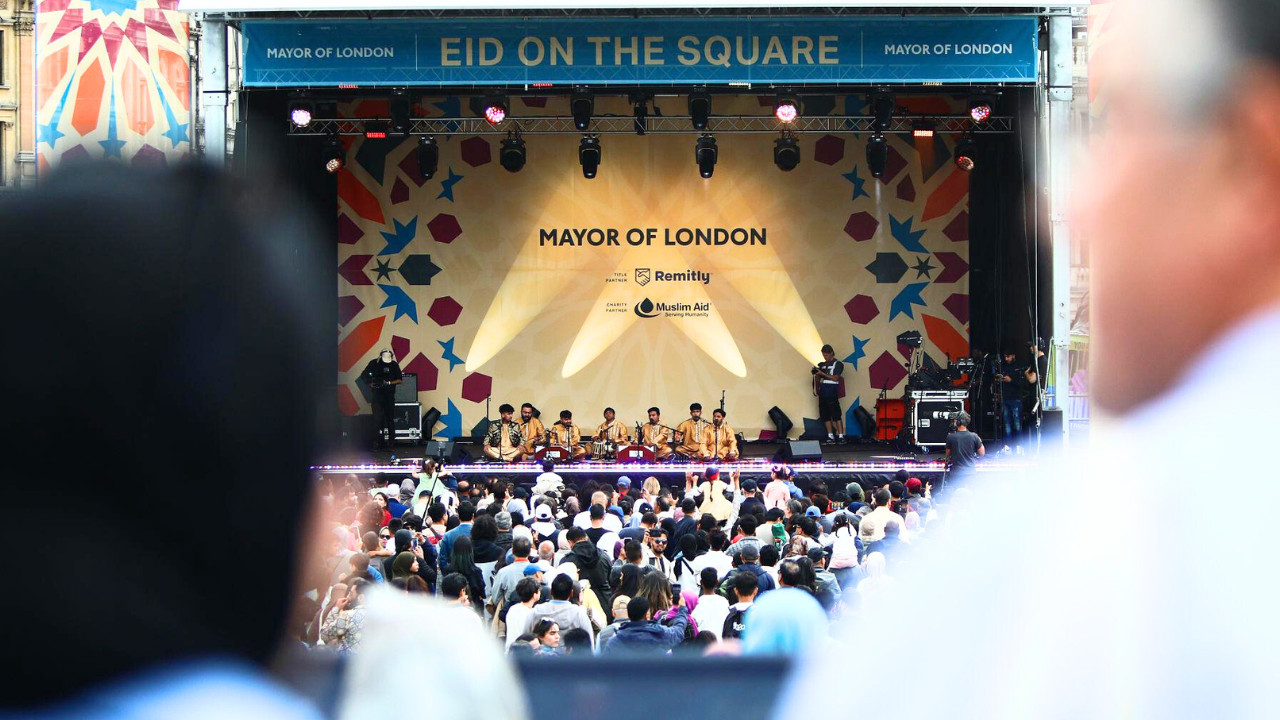
In London, the Mayor’s office has historically used "Eid in the Square" as a flagship event for the city’s brand. But the branding is failing. The 2026 climate is significantly different from the post-2012 Olympic era of "Cool Britannia" multiculturalism.
The modern London Muslim is younger, more politically engaged, and less impressed by a politician wearing a green tie. They see the Metropolitan Police’s handling of protests and the government’s restrictive rhetoric on migration. To this demographic, an official Eid celebration feels less like an embrace and more like a distraction.
The tension manifests in the security perimeter. To hold an "inclusive" celebration in Trafalgar Square, the state now requires a massive police presence to separate the celebrants from the protesters. This irony is not lost on anyone. A festival meant to celebrate the breaking of bread is now conducted behind steel barriers and bag checks. It is a celebration of peace held under the shadow of heavy enforcement.
New York and the Corporate Crossover
Across the Atlantic, the New York scene adds a layer of corporate interests to the mix. In Manhattan, Eid is increasingly a "Business Networking" opportunity. High-end hotels host events where the goal is less about spiritual reflection and more about the "halal dollar."
The commercialization of Eid in the West has created a strange paradox. While the political class struggles with the ethics of the holiday, the corporate class has leaned in. Luxury brands now release "Eid Collections," and tech giants host "Iftar mixers." This creates a secondary layer of tension. The grass-roots community often feels that their faith is being strip-mined for value while their political concerns are ignored.
The "New York Eid" is a microcosm of this struggle. On one block, you have a community center struggling to provide for refugees. On the next, you have a $200-a-plate "Leadership Gala" where the talk is of investment portfolios and venture capital. The disconnect is jarring. The political leaders who attend these high-end galas are insulated from the raw anger of the street. They are talking to the 1%, assuming they are talking to the community. They are wrong.
The Failure of Soft Power
Soft power only works when there is a baseline of trust. Without it, the "soft" elements of diplomacy—the cultural festivals, the holiday greetings, the shared meals—come across as manipulative.
Historically, Western governments used Eid as a way to project an image of "Liberal Islam" to the rest of the world. It was a way to say, "Look how well we integrate our citizens." This was a powerful narrative during the heights of the War on Terror, used to contrast Western "tolerance" against "extremism."
That narrative has collapsed. The global South, and the Muslim world in particular, is no longer looking at how many Muslims are in a Western cabinet or how many Eid cards a Prime Minister sends. They are looking at voting records at the United Nations. They are looking at arms sales. They are looking at the double standards applied to human rights across different borders.
When the UK government issues a statement of "Eid Mubarak" while simultaneously debating the legality of peaceful protest, the message is garbled. The community hears the silence on Gaza louder than the greeting for Eid.
The Rise of the Alternative Space
Because the official channels are clogged with hypocrisy, the real energy has shifted to "Alternative Eid."
Throughout 2026, we are seeing a surge in decentralized, community-led events that explicitly reject state or corporate sponsorship. These are held in parks, community halls, and backyards. They do not feature speeches from MPs. They do not have corporate logos on the banners.
In these spaces, the "global tensions" mentioned by mainstream media are not just background noise; they are the central theme. The sermons are political. The fundraising is directed toward emergency relief. This is a return to the roots of the holiday—a focus on justice and communal responsibility rather than a focus on being "seen" by the establishment.
This shift should worry the political class. When a significant portion of the population decides that the state’s recognition of their most important holiday is not only unnecessary but unwanted, the state has lost its grip on social cohesion.
The Security State Shadow
We must also address the "Security Eid." In many Western cities, the increase in Islamophobic attacks has forced mosques to spend significant portions of their budgets on private security.
It is a grim reality that while a leader might be giving a speech about "our shared values," the people listening are wondering if their windows will be smashed that night. The state’s failure to provide basic safety for its citizens makes the festive rhetoric feel like a cruel joke.
The policy of "Prevent" in the UK and similar surveillance programs in the US have created a climate of suspicion. Many Muslims feel that the state only interacts with them through the lens of security or through the lens of a holiday greeting. There is no middle ground. There is no consistent, everyday engagement that treats the community as an integral part of the nation rather than a "problem to be managed" or a "vote to be secured."
The Broken Bridge
The attempt to "celebrate Eid amid tensions" is failing because the tensions are not external. They are internal. They are the result of a direct conflict between the values the West claims to uphold—human rights, democracy, equality—and the policies it pursues on the global stage.
A holiday cannot fix a fractured foreign policy. A piece of baklava cannot sweeten the reality of a bombed-out hospital.
Leaders in New York and London continue to go through the motions because they don't know what else to do. They are trapped in a cycle of outdated diplomacy, using 20th-century tools to try and manage 21st-century anger. They want the optics of the "Good Muslim" who comes to the party and stays quiet. They are finding that that person no longer exists.
The "world leaders" mentioned in the headlines are not leading; they are reacting. They are trying to hold onto a facade of pluralism that is cracking under the weight of their own decisions. Until the policy matches the prose, these celebrations will remain what they are: expensive, well-catered exercises in irrelevance.
The real celebration is happening elsewhere, far from the cameras, among people who have realized they don't need an official invite to belong. Stop looking at the ballrooms and start looking at the streets.