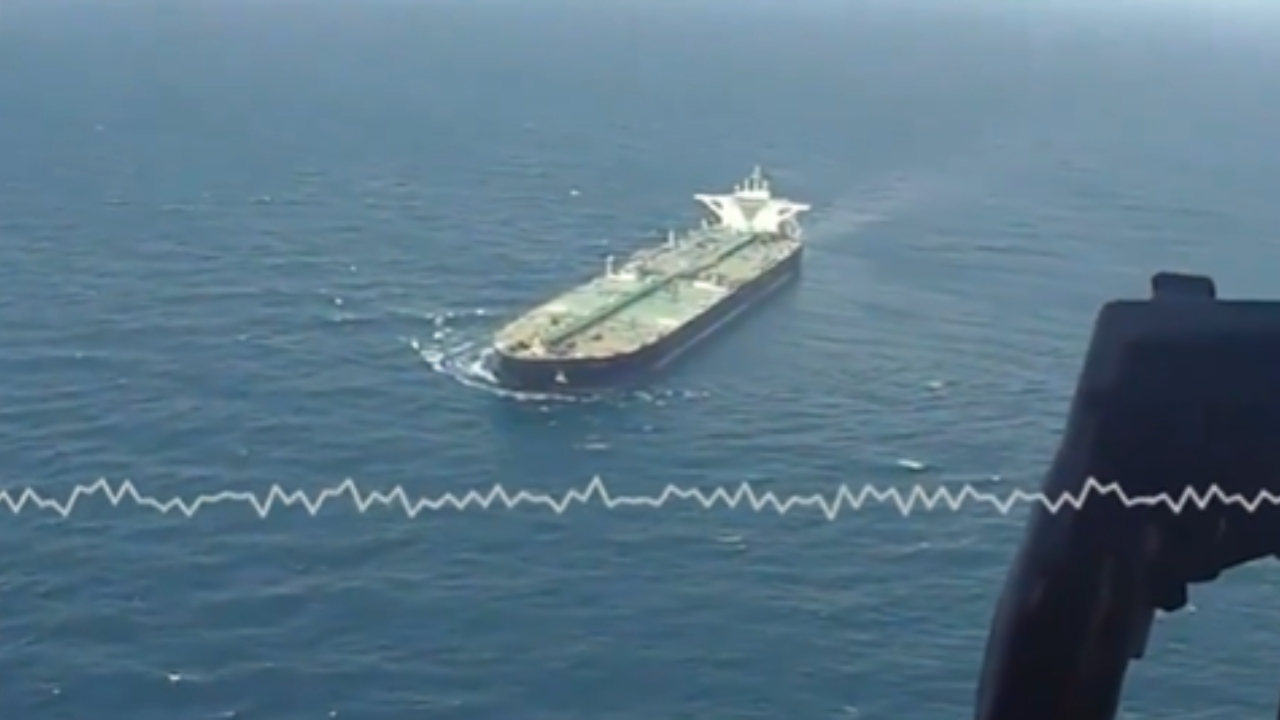
The Strait of Hormuz is not a "chokepoint." It is a psychological trigger. While mainstream media outlets obsess over maps showing the US Navy "enforcing a blockade" or "breaking a deadlock," they are operating on a naval doctrine that died in 1945. The narrative is simple: Iran threatens to shut the gates, and the US Fifth Fleet arrives to keep them open. It’s a comfortable, cinematic story of a global policeman protecting the world’s oil.
It is also fundamentally wrong.
The idea that the US Navy can—or even would—enforce a traditional blockade in the modern Strait of Hormuz ignores the physics of 21st-century littoral warfare. We aren't looking at a deadlock. We are looking at an obsolete strategy meeting a terrifyingly cheap reality.
The Myth of the "Symmetric" Blockade
Most analysts treat the Strait of Hormuz as a hallway where the biggest kid on the block stands guard. They talk about "tonnage," "carrier strike groups," and "freedom of navigation." This is 20th-century thinking applied to a drone-saturated environment.
A "blockade" implies a controlled environment where one side dictates who passes. In the Strait, which is barely 21 miles wide at its narrowest point, there is no "control." There is only "contestation."
The US Navy doesn't "enforce" a blockade against Iran; it survives in a kill zone. The Iranian strategy isn't to win a naval battle—it's to make the cost of transit high enough that insurance markets do the work for them. When Lloyd’s of London raises premiums because a $2,000 "suicide" drone hit a $200 million tanker, the "blockade" has already succeeded, regardless of where the USS Nimitz is parked.
The Geography of Failure
Look at the bathymetry. The Strait is shallow. It’s cluttered. It’s a nightmare for nuclear-powered submarines and deep-draft carriers.
- The Shoreline Advantage: Iran holds the high ground. Their coastline is a jagged maze of hidden missile silos and fast-attack craft bases.
- The Asymmetric Math: A single Harpoon missile costs about $1.5 million. An Iranian-made Shahed drone costs less than a used Honda Civic.
- The Sensor Saturation: In the 1980s "Tanker War," you could hide. Today, with commercial satellite imagery and persistent UAV surveillance, nothing stays hidden.
If the US Navy attempts to "force" the Strait during an active conflict, they aren't just fighting ships. They are fighting an entire coastline that functions as an unsinkable aircraft carrier. The "deadlock" isn't between two navies; it's between a high-tech legacy force and a low-tech, high-volume swarm.
Why Oil Flows (And Why It Isn't Thanks to the Navy)
The "People Also Ask" sections of the internet are filled with queries like "Will the US Navy protect oil prices?"
The answer is a brutal no.
The Navy protects the physical passage of ships, but they cannot protect the market. The moment a single shot is fired in the Strait, the price of Brent Crude spikes. It doesn't matter if the Navy sinks every Iranian vessel in thirty minutes. The psychological shock to the global supply chain is instantaneous.
I’ve talked to logistics officers who have seen the simulations. In almost every scenario, the "protection" offered by a naval escort is more about optics than operational security. You can't intercept 500 incoming projectiles with 100% certainty. And in the oil business, a 99% success rate is a 1% catastrophe that triggers a global recession.
The status quo remains not because the US Navy is "enforcing" anything, but because Iran knows that actually closing the Strait is a suicide pact. They lose their own ability to export. The "deadlock" is a mutual economic hostage situation, not a military victory.
The Carrier Problem: A $13 Billion Target
We need to stop pretending that a Carrier Strike Group (CSG) is the right tool for this job.
Deploying a Ford-class carrier into the Persian Gulf to "enforce a blockade" is like bringing a sniper rifle to a knife fight in a phone booth. You can't use the rifle’s range, and the knife is going to find a gap in your armor eventually.
The US Navy’s insistence on using these massive platforms in littoral (near-shore) waters is a refusal to admit that the paradigm has shifted.
- The Cost of Defense: Every time an Aegis destroyer fires an SM-2 missile to intercept a cheap drone, the US loses the economic war.
- The Proximity Issue: Within the Strait, the "OODA loop" (Observe, Orient, Decide, Act) is compressed to seconds. There is no reaction time.
Imagine a scenario where 50 fast-attack boats, each armed with C-802 anti-ship missiles, swarm a lone destroyer. Even with the best automated defense systems, the sheer volume of targets creates a "saturation point." Once you’re past that point, the billion-dollar ship is a reef.
Stop Asking if the Navy Can and Ask if They Should
The "lazy consensus" says the US must be the guarantor of the Strait.
Why?
The US is now a net exporter of energy. The countries most dependent on Hormuz are China, India, Japan, and South Korea. Yet, it is American taxpayers who fund the "blockade enforcement" that keeps the lights on in Shanghai.
The real disruption here isn't military; it's geopolitical. By continuing to play the role of the Hormuz Enforcer, the US provides a massive subsidy to its primary economic competitors. If the US Navy pulled back and said, "The Strait is an international waterway; protect your own tankers," the power dynamic would flip overnight.
Suddenly, China would have to negotiate with Iran. India would have to deploy its own fleet. The "deadlock" would become someone else's problem.
The Infrastructure Blind Spot
While we focus on ships, we ignore the pipes.
The true "blockade breaker" isn't a destroyer; it's the Abu Dhabi Crude Oil Pipeline and the East-West Pipeline in Saudi Arabia. These land-based routes bypass the Strait entirely.
If you want to understand the future of the Hormuz deadlock, stop looking at naval deployments. Look at the capacity of these pipelines. The moment the overland capacity exceeds the Strait’s daily volume, the Strait of Hormuz becomes a tactical footnote.
We are obsessed with the drama of the sea because it makes for better television. We like the "Top Gun" aesthetic of jets launching from decks. But a concrete pipe buried in the sand is a far more effective tool for regional stability than a carrier group that is essentially a sitting duck for hypersonic missiles.
The Hard Truth About Naval Power
The US Navy is currently a "fleet in being"—it exerts influence just by existing. But the second you try to use that fleet to "enforce" a blockade in a narrow, land-locked sea against a sophisticated asymmetric power, the illusion of invincibility vanishes.
The military-industrial complex loves the Hormuz narrative because it justifies the construction of more $13 billion ships. But in a world of $20,000 loitering munitions and $5 million anti-ship ballistic missiles (like the DF-21D), the math doesn't work.
We are not "enforcing" anything. We are performing a high-stakes piece of theater.
If a real conflict breaks out, the Strait will close. It won't matter how many ships we have there. The mines will be laid, the drones will be launched, and the tankers will stop coming. The US Navy’s "blockade enforcement" is a plan for a war that no longer exists, using tools that are too expensive to lose and too clumsy to win.
Stop looking for the Navy to save the global economy. Start looking for a way to make the Strait irrelevant. Until we do, we are just waiting for a cheap drone to prove that the Emperor has no clothes—and no fleet.
The deadlock isn't in the water. It's in the minds of the Pentagon planners who refuse to accept that the age of the battleship—and the carrier—is over in the narrow seas.