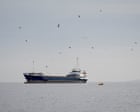
The two-week ceasefire between Washington and Tehran, brokered in the frantic hallways of Islamabad, is currently dissolving into the salt water of the Persian Gulf. By Sunday afternoon, the Islamic Revolutionary Guard Corps (IRGC) issued a cold ultimatum: any military vessel approaching the Strait of Hormuz will be treated as a direct breach of the truce and met with "severe force." This was not an idle threat. It was a direct response to President Donald Trump’s declaration that the U.S. Navy would begin a full-scale blockade to stop what he termed "world extortion."
For the global economy, the stakes have moved beyond mere price fluctuations. We are witnessing the functional death of the "just-in-time" energy model. Since the initial strikes on February 28, 2026, which took out the top of Iran's leadership, the Strait has become a graveyard for the old rules of maritime law. Iran has turned the 21-mile-wide waterway into a proprietary toll booth, demanding payment in Chinese yuan and enforcing "smart management" that looks increasingly like a permanent siege.
The Infrastructure of a Stalemate
The current crisis is not just about ships sitting in a line. It is a technological and tactical deadlock that the U.S. military is finding difficult to break without sparking a full-scale regional conflagration. Iran has deployed a layered defense system that bypasses traditional naval engagements.
- Smart Mining: Iran has seeded the channel with sophisticated bottom-dwelling mines. These aren't the rusted spheres of the 1980s. These sensors-heavy devices can distinguish between a neutral commercial hull and a military destroyer.
- Electronic Fog: Reports of widespread GNSS jamming and satellite spoofing in the region have made navigation a nightmare. Commercial captains are refusing to enter the Gulf not because they are physically blocked, but because their insurance premiums have surged by 400% as their navigation systems blink into the dark.
- Asymmetric Swarms: The IRGC "deadly vortex" involves hundreds of small, fast-attack craft and Unmanned Surface Vessels (USVs) that can overwhelm a carrier strike group’s point defenses in the confined spaces of the Strait.
Washington’s counter-move—a naval blockade of Iranian ports—is an attempt to starve the IRGC of the revenue they are now generating through illegal tolls. Trump’s directive to interdict any vessel that has paid a toll to Tehran effectively turns every tanker in the Gulf into a potential target for one side or the other. It is a pincer movement with the world’s energy supply caught in the middle.
The Toll Booth Economy
What the initial reports missed was the sheer scale of the financial infrastructure Iran has built in the ruins of the conflict. By demanding payments in yuan and bypass-ing the SWIFT system, Tehran is attempting to create a "sanction-proof" corridor. This isn't just about survival; it’s an attempt to force a new financial reality on the Gulf.
QatarEnergy’s declaration of force majeure on all LNG exports last month was the first domino. Now, we are seeing the "Fertilizer-LNG Paradox." Because the Strait is choked, the production of urea and other petroleum-based fertilizers has halted. This is hitting Asian agriculture during the critical 2026 sowing season. The price of food in the Gulf Cooperation Council (GCC) states has already spiked by 120%. People in Bahrain and Kuwait are not just worried about the price of gas; they are worried about the price of bread.
The U.S. Navy destroyers that entered the Strait this weekend were ostensibly there for "mine clearance" and "freedom of navigation." However, the IRGC claims they forced an American vessel to turn back. This conflicting narrative highlights the reality on the water: nobody is truly in control. The U.S. can project power, but it cannot guarantee safety. Without safety, there is no trade.
The Legal Fiction of Transit Passage
International law, specifically the UN Convention on the Law of the Sea (UNCLOS), dictates that the Strait of Hormuz is an international waterway where "transit passage" cannot be suspended. But laws only matter if someone is willing to enforce them without burning the neighborhood down. Iran’s position is that the ceasefire terms required a cessation of all "hostile acts," and they define a U.S. naval presence as a hostile act.
The U.S. argues that a blockade is a legitimate response to "piracy" and "extortion." It is a legal circle that leads nowhere. The reality is that the Strait has been functionally closed since early March, with traffic dropping by 70%. The 150 ships currently anchored outside the Strait are a silent monument to the failure of 21st-century diplomacy.
A Systemic Collapse of the Gulf Model
For decades, the Arab states of the Gulf operated on a simple premise: the U.S. guarantees the security of the water, and the oil flows. That premise is gone. Saudi Arabia and the UAE have limited alternative pipelines, but they cannot handle the volume required to stabilize global markets. Brent crude at $120 is the new baseline.
The "Islamabad Talks" failed because they attempted to solve a 50-year-old nuclear dispute in a 20-hour window while the world's most vital artery was being squeezed. Vice President JD Vance’s "final and best offer" was rejected because Tehran currently holds the most valuable leverage in the history of modern warfare. They don't need to win a naval battle; they just need to keep the Strait "too dangerous" for Lloyd’s of London to insure a tanker.
The U.S. Navy's next move—clearing mines while under the threat of IRGC missile batteries—will determine if this ceasefire is a footnote or a turning point. If the blockade begins in earnest at 10am ET as scheduled, the "two-week truce" will have lasted exactly six days. The global economy is not prepared for what happens on day seven.