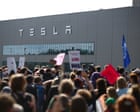
The power struggle at Tesla’s Grünheide plant is not a mere labor dispute; it is a structural collision between the Silicon Valley "Blitzscaling" Model and the German Co-determination System. While media narratives focus on personality clashes between Elon Musk and IG Metall leadership, the underlying reality is a technical conflict over the governance of industrial output. IG Metall’s attempt to secure a majority on the works council (Betriebsrat) represents a strategic move to internalize the plant’s operational pacing within the broader German industrial collective bargaining framework.
The Structural Architecture of German Labor Law
To analyze this friction, one must define the legal apparatus governing German manufacturing. Unlike US labor relations, which often operate on an adversarial "zero-sum" negotiation model, Germany utilizes a dual system of representation.
- The Works Council (Betriebsrat): A plant-level body elected by all employees. They hold "co-determination rights" over social matters, personell planning, and technical monitoring of performance.
- The Trade Union (IG Metall): An external organization that negotiates regional wage agreements (Tarifverträge).
Tesla’s Giga Berlin currently operates without a binding union wage agreement. This allows the company to maintain a fluid, "First Principles" approach to labor allocation. By infiltrating the works council, IG Metall seeks to transform a decentralized, internal body into a proxy for centralized union power.
The Pillar of Operational Control: Pacing and Ergonomics
The primary technical point of contention is the Line Speed vs. Human Capacity function. In a traditional Tesla environment, production targets are dynamic, responding to real-time data and OTA (Over-the-Air) software updates that may alter the manufacturing sequence.
IG Metall’s platform centers on "health and safety," which is the legal lever used to regulate line speed. Under the German Works Constitution Act (Betriebsverfassungsgesetz), the council has a say in the "design of jobs, operations, and the working environment." If a union-aligned council can prove that the current "Tesla Speed" exceeds ergonomic thresholds, they can legally force a deceleration of the assembly line.
This creates a Cost-to-Output Bottleneck. If the council mandates longer break cycles or slower takt times (the cycle time needed to match customer demand), Tesla’s capital efficiency per square meter of factory floor drops. For a company whose valuation depends on hyper-growth and industry-leading margins, this is a direct threat to its financial architecture.
The Conflict of Incentive Alignment
Tesla utilizes a compensation structure heavily weighted toward Stock Based Compensation (SBC) and performance milestones. This aligns the worker's financial upside with the company’s share price and production volume.
The IG Metall model seeks to replace this variable, high-upside model with a Standardized Wage Lattice.
- The Tesla Model: High variance, potential for high-reward equity, rapid internal promotion based on meritocratic "hardcore" output.
- The Union Model: Compressed wage gaps, seniority-based progression, and fixed hourly rates regardless of individual plant performance.
The "Gigafactory" philosophy relies on a workforce that accepts short-term volatility for long-term equity gains. IG Metall’s entry signals a shift toward the "de-risking" of labor, which inherently attracts a different psychological profile of employee—one prioritized on stability rather than the high-intensity growth required by Tesla’s mission.
Identifying the Strategic Asymmetry
Tesla’s management currently leverages a "Yellow Union" or "Pro-Tesla" faction within the works council (often organized under the banner "Gigavoice"). This group argues that internal collaboration is more efficient than external interference. The strategic asymmetry lies in the Information Gap.
Management possesses the data on global production requirements and battery cell supply chains. IG Metall possesses the data on industry-wide German labor standards. The battle for the works council is a battle for which data set dictates the daily reality of the shop floor.
When IG Metall claims that injury rates are higher at Grünheide than at Volkswagen or BMW, they are attempting to move the goalposts from Production Innovation to Regulatory Compliance. Tesla’s defense has been to point toward the creation of 12,000 jobs in a region that was economically stagnant, utilizing "Job Creation" as a shield against "Labor Quality" critiques.
The Risk of Institutional Ossification
The second limitation of the union-heavy model is the impact on Iterative Engineering. Tesla is famous for making hundreds of small hardware changes to its vehicles every week. In a unionized environment, every change to a workstation or a tool can trigger a requirement for council "consultation."
This creates a Latent Iteration Tax. If every adjustment to a robotic arm’s pathing requires a week of committee review to ensure it doesn't "increase worker stress," the cumulative delay across thousands of iterations destroys the speed advantage Tesla holds over legacy OEMs (Original Equipment Manufacturers).
Quantifying the Electoral Mechanics
The election of the works council uses a proportional representation system. Employees vote for "lists" (slates of candidates).
- If IG Metall secures a simple majority (>50%), they control the chair and the agenda.
- If they secure a plurality but not a majority, they must form a "coalition" with independent lists, leading to a fragmented and potentially gridlocked governance structure.
The current tension is exacerbated by the Workforce Composition. A significant percentage of Giga Berlin employees are international or non-German speakers who may not have a historical affinity for the German "Social Partnership" model. IG Metall’s struggle is as much a cultural integration challenge as it is a political one.
The Geopolitical and Macroeconomic Context
Tesla’s German operations do not exist in a vacuum. They are the frontline of the European Union’s attempt to retain automotive relevance in the age of the Electric Vehicle (EV). The German government is caught in a Policy Paradox:
- They need Tesla to succeed to prove that Germany is a viable location for high-tech manufacturing despite high energy costs.
- They cannot allow Tesla to bypass the labor protections that are the foundation of German social stability.
If IG Metall successfully "seizes" the council and forces a traditional collective bargaining agreement, Giga Berlin becomes just another German car plant. Its cost structure will harmonize with VW’s Wolfsburg or BMW’s Munich. For the investor, this removes the "Tesla Alpha"—the unique efficiency that justifies its premium valuation.
Tactical Projection and the "Master Contract" Maneuver
The most probable path forward is not a total victory for either side, but a Bifurcated Labor Strategy.
Tesla will likely concede on certain "Quality of Life" metrics—such as shuttle bus reliability or canteen quality—to sap the momentum of the union's more radical structural demands. Simultaneously, IG Metall will use the Grünheide council as a "living lab" to develop new strategies for unionizing "New Tech" manufacturing, potentially expanding their reach to battery startups and AI hardware firms.
The ultimate strategic play for Tesla is the Automation Counter-Offensive. Any labor-induced increase in the "Cost of Human Capital" at Giga Berlin will be met with an accelerated deployment of the Optimus (Tesla Bot) program or increased robotic density. If the human element becomes too regulated, the engineering goal shifts from "managing labor" to "eliminating the labor dependency."
The works council election is a lagging indicator of a broader shift. The real metric to watch is the Capex-per-Employee ratio. If Tesla increases capital expenditure on automation in response to union gains, it signals that the German Co-determination model is successfully being bypassed by technological displacement.
Monitor the "Labor Cost as a Percentage of Revenue" specifically for the Berlin-produced Model Y. If this figure rises above 15% due to union-mandated shifts, expect a radical restructuring of the plant's automation architecture. The union may win the council, but in doing so, they may inadvertently accelerate the obsolescence of the very roles they seek to protect.