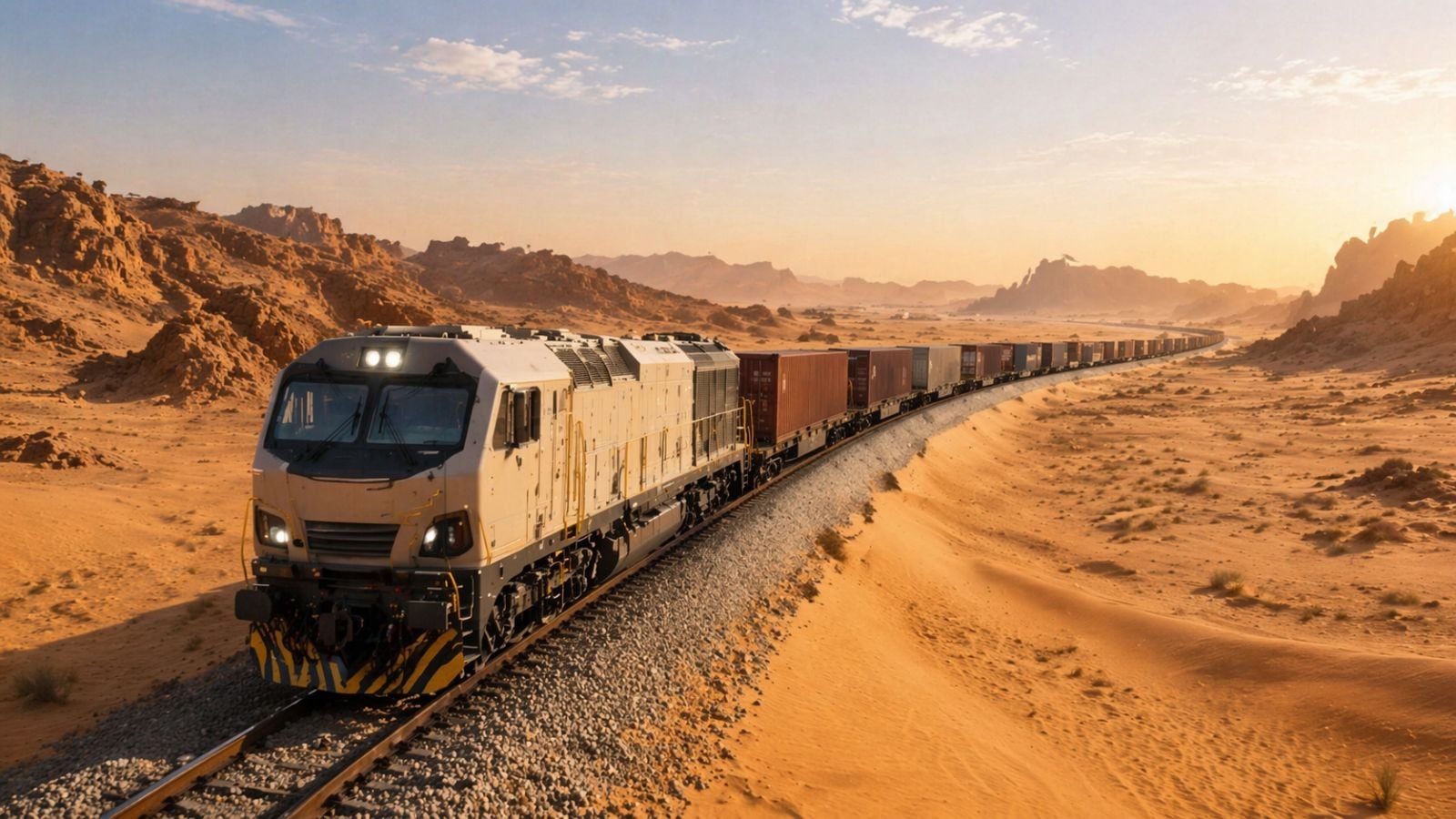
The press releases are glowing. They speak of "strategic milestones" and "regional integration." UAE and Jordan just inked a $2.3 billion deal to build a 360km railway connecting the phosphate and potash mines of southern Jordan to the Port of Aqaba. On paper, it looks like a masterstroke of logistics. In reality, it is a massive capital expenditure on an analog solution for a world that is rapidly moving toward digital and decentralized supply chains.
We are watching a 19th-century solution try to fix 21st-century economic stagnation.
The consensus is that rail is the ultimate "enabler" of trade. Politicians love big infrastructure because it is visible, it uses a lot of concrete, and it makes for great ribbon-cutting ceremonies. But if you look at the unit economics of heavy rail in the Middle East, the narrative starts to fracture. This isn't just a train; it’s a $2.3 billion gamble that global demand for raw phosphate and potash will remain static enough to justify a multi-decade payoff period.
The Myth of the "Logistics Backbone"
Every logistics consultant with a PowerPoint presentation will tell you that rail lowers costs per ton-mile. That is true in a vacuum. It is not necessarily true when you factor in the debt service on a $2.3 billion project in a high-interest-rate environment.
Jordan isn't building this to move people or high-value goods. This is a dedicated industrial line. It is a "pipe" for minerals. By locking themselves into this specific infrastructure, Jordan is doubling down on an extraction-based economy at exactly the moment they should be pivoting toward value-added processing and high-tech manufacturing.
When you build a massive rail line for raw ore, you are signaling to the world that you are content being a quarry.
Why Flexible Logistics Beat Static Rails
The world of logistics is currently being eaten by two things: automation and modularity. While Jordan lays down fixed steel tracks that cannot be moved, the rest of the world is experimenting with autonomous electric trucking fleets that offer a level of flexibility rail can never match.
Imagine a scenario where the global market for raw phosphate dips—perhaps because of a breakthrough in synthetic fertilizers or a shift in agricultural tech. A fleet of autonomous trucks can be sold, rerouted, or repurposed. A $2.3 billion railway becomes a very expensive monument to a dead commodity.
Fixed infrastructure is a liability in a volatile market. The "efficiency" of rail is a trap if the cargo it carries loses its luster.
The Geography of Miscalculation
The corridor from Ashidiya and Ghor as-Safi to Aqaba is rugged. It’s harsh. Maintaining high-speed heavy-haul rail in desert conditions isn't just about laying tracks; it’s an endless war against thermal expansion, sand encroachment, and specialized maintenance.
The "lazy consensus" ignores the OpEx. They look at the $2.3 billion sticker price and assume that’s the cost. It isn't. The real cost is the decade of maintenance and the opportunity cost of not spending that capital on Jordan’s chronically underfunded water infrastructure or its burgeoning tech sector.
Following the Money: The UAE’s Real Angle
Etihad Rail and the UAE investment firms aren't doing this out of the goodness of their hearts. This is a geopolitical hedge. For the UAE, this is about controlling the flow of essential commodities across the region. It’s about soft power and securing supply chains for their own food security initiatives.
For Jordan, however, the math is different. They are taking on the risk of the physical asset while the UAE takes the strategic upside. If the project fails to hit its tonnage targets, Jordan is the one left with a rusting track in the desert.
The Potash Paradox
Jordan’s Arab Potash Company (APC) and Jordan Phosphate Mines Company (JPMC) are the lifeblood of this project. They are successful, profitable entities. But they are also legacy entities.
The "pro-rail" crowd argues that this project will "boost exports." Will it? Or will it just make the current exports slightly more profitable for the shareholders while the taxpayer-backed infrastructure debt lingers? True economic "boosts" come from increasing the complexity of what you export, not just the volume of rocks you pull out of the ground.
If Jordan wanted to disrupt the status quo, they wouldn't spend $2.3 billion to move phosphate to a port. They would spend it to build the world’s most advanced fertilizer refineries at the mine site, exporting finished, high-value chemicals via existing roads or smaller, more agile transport systems.
The AI and Automation Gap
We are currently seeing a massive shift in how heavy industry operates. We are moving toward "Small-Scale, Everywhere" manufacturing. 3D printing, localized chemical processing, and decentralized energy are making the "Big Mine to Big Port" model look increasingly archaic.
By the time this railway is fully operational—likely several years from now—the global trade landscape will be dominated by carbon-adjusted border taxes and a desperate scramble for "green" minerals. Does this rail project include a plan for total electrification? Does it use hydrogen-powered locomotives? If not, Jordan is building a carbon-heavy legacy system in a world that is penalizing exactly that.
Addressing the "People Also Ask" Delusions
People ask: "Will the Jordan-UAE railway create jobs?"
Yes, in the short term. Construction jobs are great for a few years. But once the tracks are laid, heavy rail is one of the least labor-intensive industries on earth. It’s designed to be automated. It won't solve Jordan’s youth unemployment crisis.
People ask: "Is this the start of a regional rail network?"
This is the most dangerous myth of all. The "Middle East Rail" dream has been talked about for fifty years. Every country has different gauges, different standards, and—most importantly—different political agendas. Building a 360km "stub" in southern Jordan does not magically make a regional network appear. It just makes a 360km stub.
The Hard Truth About Infrastructure
I have seen developing economies get strangled by "prestige" infrastructure. They build the shiny thing because it looks like progress. But true progress is invisible. It’s in the regulatory frameworks, the education systems, and the digital pipes.
This $2.3 billion would have been better spent turning Aqaba into a world-class semiconductor packaging hub or a green hydrogen leader. Instead, it’s being spent to move rocks faster.
Rail is a 19th-century technology that worked because the alternatives were horses. Today, the alternatives are autonomous drones, AI-optimized trucking, and local production. Choosing rail today is an admission that you don't believe in the technological leapfrog.
The Opportunity Cost is the Real Killer
Every dollar spent on this railway is a dollar not spent on Jordan’s catastrophic water scarcity. You can move all the phosphate you want, but if your cities are dry, the economy will not grow.
The UAE is brilliant for diversifying their portfolio with Jordanian assets. They are buying tangible, "hard" reality. Jordan, meanwhile, is selling its future flexibility for a static, heavy-metal solution to a problem that was solved decades ago.
If you want to understand the future of the Middle East, don't look at the ribbon-cutting ceremonies. Look at the debt-to-GDP ratios and the maintenance schedules of the projects being built today.
Stop celebrating the "Logistics Backbone." It’s actually a "Logistics Anchor," and it’s going to hold Jordan exactly where it is for the next fifty years.
Build for the world that is coming, not the world that is leaving. Move the molecules, or better yet, move the data. Don't just move the rocks.