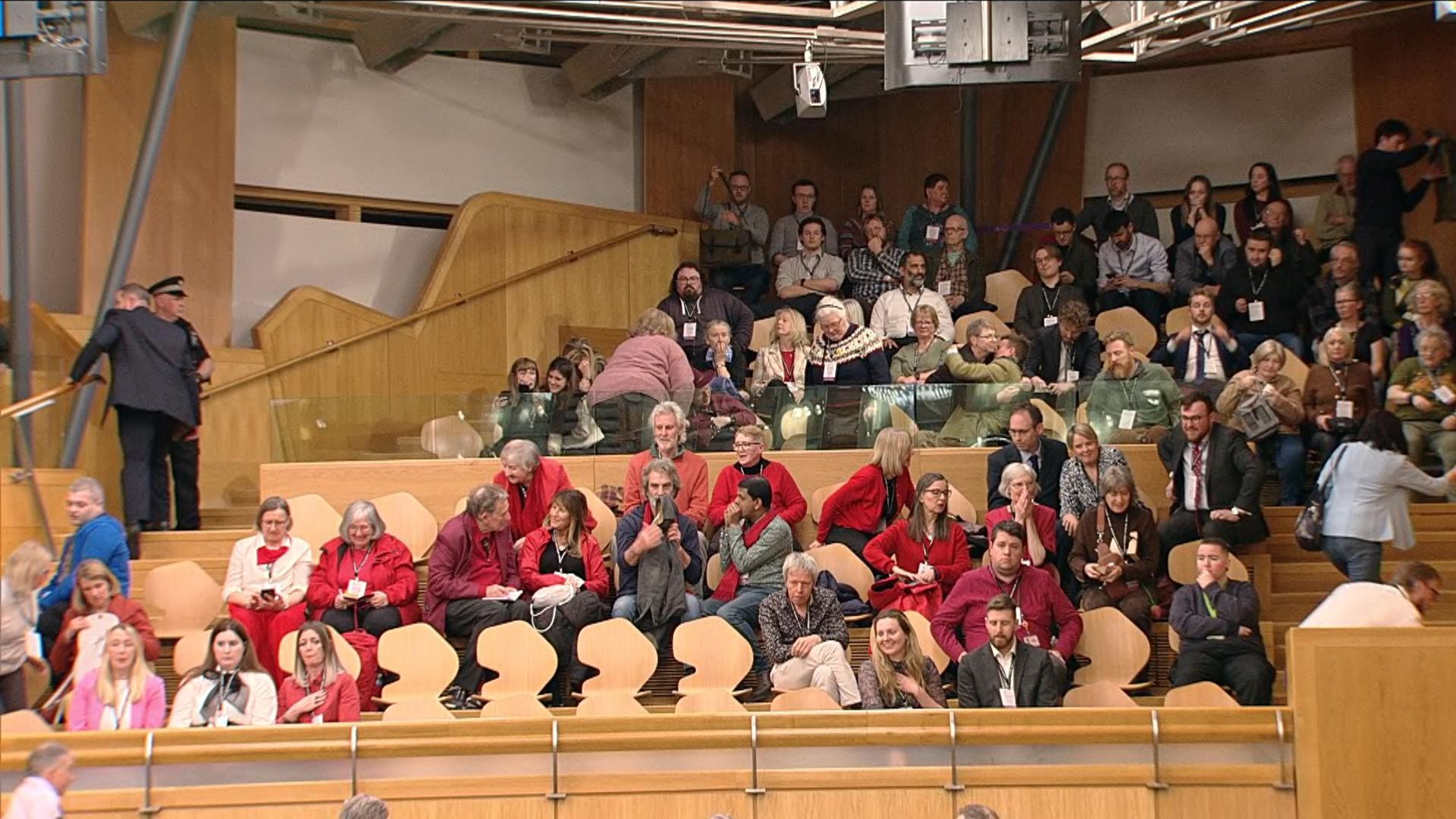
The rejection of the Assisted Dying for Terminally Ill Adults (Scotland) Bill by the Scottish Parliament represents a profound intersection of medical ethics, legislative risk management, and shifting public sentiment. While the media often frames such events through the lens of individual tragedy or partisan friction, the failure of the bill is more accurately diagnosed as a collision between three rigid institutional frameworks: the Clinical Safety Mandate, the Jurisdictional Boundary Constraint, and the Implementation Friction of Safeguards.
To understand why a bill with significant public support failed to reach the statute books, one must move beyond the emotional rhetoric and examine the structural logic that governs parliamentary decision-making in the United Kingdom.
The Triad of Institutional Resistance
The legislative process in Scotland operates under a set of internal and external pressures that create a high threshold for transformative social policy. In the case of assisted dying, these pressures manifested in three distinct categories.
1. The Clinical Safety Mandate
The primary obstacle to the bill was the medical establishment’s inability to reconcile "assisted dying" with the traditional Hippocratic framework. Critics of the bill argued that the proposed legislation did not provide a sufficient mechanism to differentiate between a "rational" request for death and a symptom of clinical depression or coercive influence.
In clinical terms, this creates a Diagnostic Uncertainty Gap. If a physician cannot guarantee 100% accuracy in predicting a six-month terminal prognosis—a timeframe frequently cited in such bills—the legal risk to the practitioner becomes untenable. Studies in prognostic accuracy often show that clinician estimates of life expectancy are frequently over-optimistic or significantly inaccurate, creating a statistical variance that legislators found impossible to ignore.
2. Jurisdictional Boundary Constraints
The Scottish Parliament (Holyrood) operates within a devolved framework, meaning it shares power with the UK Parliament (Westminster). This creates a unique legal bottleneck. While health is a devolved matter, many of the substances used in physician-assisted dying are regulated under the Misuse of Drugs Act 1971, which is a reserved matter for Westminster.
This jurisdictional overlap creates a Legal Compatibility Conflict. MSPs (Members of the Scottish Parliament) were tasked with passing a bill that might be unenforceable or subject to a Supreme Court challenge if it were found to step into reserved territory. The risk of passing "symbolic" legislation that fails in court is a significant deterrent for a legislature seeking to maintain credibility.
3. Implementation Friction of Safeguards
The bill’s proponents introduced a series of safeguards designed to prevent the "slippery slope" scenario. However, in the eyes of the opposition and skeptical MSPs, these safeguards created an Operational Paradox.
- The Assessment Burden: For the safeguards to be effective, they required multiple independent medical assessments and a waiting period.
- The Resource Constraint: In an overstretched National Health Service (NHS), the administrative and clinical overhead required to verify "mental capacity" and "absence of coercion" was viewed as a new, unfunded mandate.
- The Vulnerability Variable: Legislators struggled with the definition of "vulnerability." If the law cannot perfectly filter out those acting under subtle societal or familial pressure, the entire safety framework is deemed structurally unsound.
Quantitative Divergence: Public Opinion vs. Legislative Risk
A critical failure in the strategy of the bill's supporters was the over-reliance on raw polling data. While polls consistently showed that roughly 70% to 75% of the Scottish public supported the principle of assisted dying, these numbers do not translate directly into legislative momentum.
The disconnect exists because public opinion measures Moral Approval, whereas MSPs are evaluated on Systemic Risk.
Public approval is often a "low-stakes" metric; the respondent does not bear the legal or ethical liability for the outcome. Conversely, a legislator must account for the "Black Swan" event—the single high-profile case of abuse or wrongful death that could dismantle a career or trigger a massive civil lawsuit against the state. When the perceived risk of a "system failure" (a wrongful death) outweighs the perceived benefit of "system modernization" (autonomy for the terminally ill), the rational legislative actor will default to the status quo.
The Logic of Medical Neutrality
The role of the British Medical Association (BMA) and the Royal College of General Practitioners (RCGP) cannot be overstated. By shifting from "opposition" to "neutrality," the BMA moved the needle slightly, but "neutrality" in a high-stakes legislative environment often functions as a Passive Veto.
Without an active mandate from the medical community—those who would be required to facilitate the law—the legislature lacks the "Operational Permission" to proceed. The medical community’s concerns centered on the Normalization of Non-Curative Intervention. If the state-funded healthcare system begins to offer death as a service, the economic incentive structure of end-of-life care changes.
The concern is not necessarily one of direct malice, but of Resource Reallocation. In a budget-constrained environment, there is a latent fear that the availability of assisted dying could lead to a decrease in the quality or availability of palliative care. This is a classic "Substitution Effect" where a lower-cost option (assisted dying) inadvertently crowds out a higher-cost, more complex option (hospice and palliative management).
Comparative Policy Failure: International Benchmarks
The Scottish bill attempted to mirror models seen in Oregon (USA) and Canada (MAiD). However, the "Canadian Model" increasingly served as a cautionary tale rather than a blueprint.
Initially, Canada’s legislation was limited to those whose death was "reasonably foreseeable." Subsequent judicial rulings expanded this to include those with chronic illnesses and, more controversially, mental health conditions. This Scope Creep provided the opposition with a powerful empirical argument: once the binary threshold of "terminal" is crossed, there is no logical or legal firewall to prevent the expansion of the criteria.
The Scottish Parliament’s rejection was, in part, a rejection of this "Expansionary Velocity." MSPs viewed the Oregon model as too permissive regarding the lack of oversight during the final act, and the Canadian model as too expansive regarding the eligible population. Without a "Goldilocks" model that could prove its own stability over a 20-year horizon, the bill was seen as an unstable asset.
The Psychological Weight of the Palliative Care Lobby
The palliative care sector in Scotland is highly developed and carries significant moral authority. Their argument against the bill was rooted in the Holistic Comfort Framework. They argued that "unbearable suffering" is often a failure of existing palliative provision rather than an inherent quality of terminal illness.
By framing the bill as a "failure of imagination" in end-of-life care, the palliative lobby successfully shifted the burden of proof. Proponents had to prove not only that assisted dying was a right, but that it was a necessity that could not be solved through better pain management and psychological support.
This created an Evidentiary Barrier. Since "pain" and "suffering" are subjective, and since palliative medicine is constantly evolving, it is impossible to prove that a patient’s suffering is truly "unsolvable." This ambiguity served as the final nail in the legislative coffin.
Structural Requirements for Future Success
For any future iteration of assisted dying legislation to succeed in a devolved parliament, it must move beyond the "Right to Die" narrative and address the Mechanical Deficiencies of the previous attempts.
First, the legislation must include a Fixed-Cost Funding Model for palliative care, ensuring that the two systems are not in competition for the same pool of resources. This breaks the Substitution Effect.
Second, the bill requires a Binary Eligibility Filter that is tied to objective biological markers rather than subjective "suffering" or "prognosis" alone. This reduces the Diagnostic Uncertainty Gap.
Third, the legal framework must be pre-negotiated with the UK Home Office to ensure that the necessary pharmaceutical protocols do not trigger a constitutional crisis.
The rejection by MSPs was not a vote against compassion; it was a vote against an under-engineered system. Until a bill can demonstrate a failure rate of near-zero—specifically regarding the protection of the non-terminal vulnerable—the institutional inertia of the Scottish Parliament will continue to favor the status quo.
The strategic path forward for proponents lies in the data-heavy refinement of "vulnerability screening" and the formalization of "conscientious objection" for institutions, not just individuals. Until the medical and legal risks are quantified and mitigated to an acceptable variance, the legislative appetite for such a shift remains nonexistent. The focus must shift from changing minds to fixing the implementation architecture.
Any organization or advocacy group seeking to revive this policy must first commission an independent audit of the "Palliative Care Gap" to strip the opposition of their primary argument. By identifying exactly where current end-of-life care fails, the proponents can position assisted dying not as a competitor to palliative care, but as a specialized fail-safe for the statistically significant minority for whom clinical intervention is insufficient. Only then will the legislative risk profile become manageable for a cautious parliament.