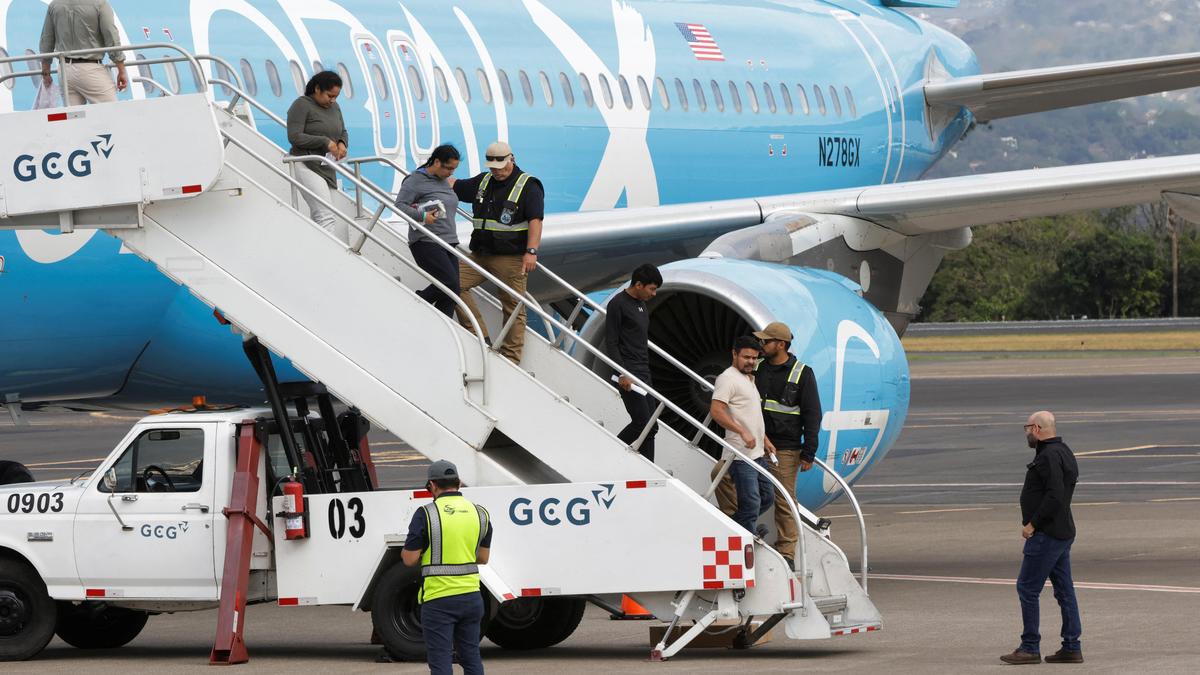
The tarmac in San José doesn't care about your dreams. It is a flat, gray expanse of indifference, radiating the kind of heat that makes the horizon shimmer until the world looks like it’s melting. When the wheels of the charter flight touched down this week, they carried more than just passengers. They carried the heavy, suffocating weight of a journey that ended exactly where no one intended it to.
Among the crowd stepping off the plane—the second such group in a new, clinical cycle of enforcement—was a man from India. He stood out, perhaps, for the sheer distance he had covered to reach this moment of failure. He wasn't just miles from home; he was a whole world away from the life he had gambled everything to build.
Behind every "deportee" is a ledger of debt and a heart full of terror.
The Geography of Desperation
To understand how a citizen of India ends up on a deportation flight from the United States to Costa Rica, you have to stop looking at maps and start looking at shadows. The path is never linear. It is a jagged, expensive, and often lethal zig-zag across continents. It begins with a sold plot of land in a village, a life savings handed over to a "travel agent" in a dim office, and a promise of a golden door that usually turns out to be a trapdoor.
The U.S. government’s latest strategy isn't just about moving people; it’s about shifting the geography of responsibility. By sending migrants to Costa Rica—a nation that has increasingly become a reluctant waiting room for the world’s displaced—the machinery of border control attempts to solve a math problem. If the numbers don't add up at the Rio Grande, move the variables further south.
But people are not variables.
Consider a hypothetical traveler named Arjun. Arjun didn't leave home because he wanted an adventure. He left because the local economy was a ghost, or because a dispute over family land made his life tenable only in the past tense. He flew to South America, trekked through the Darien Gap—that lawless, muddy hell where the jungle swallows the weak—and moved north with nothing but a phone number and a prayer.
When Arjun is finally detained and placed on a plane to San José, he isn't just being "returned." He is being cast into a vacuum.
The Invisible Architecture of the Accord
The logistics are handled with a terrifying efficiency. This isn't the chaotic scramble of a border crossing; it is the sterile, organized process of international diplomacy. The United States and Costa Rica have entered into a rhythm of cooperation that seeks to manage the "flow." It is a word bureaucrats love. Flow. It suggests water. It suggests something that can be dammed, diverted, or drained.
For the migrants on that second flight, the reality was less like a fluid movement and more like a car crash in slow motion.
The agreement relies on the "Safe Mobility Offices" and regional processing centers. The idea is simple: stop the march toward the U.S. border by offering a middle ground. But for the Indian national among the group, the middle ground feels like a desert. He doesn't speak the language. He has no roots in the Central American soil. He is a ghost in a foreign bureaucracy, caught between a home he cannot return to and a destination that has slammed the door.
Costa Rica, known for its "Pura Vida" soul and lush rainforests, is finding its hospitality stretched to a breaking point. The country is a bridge. But even the strongest bridges crack when too many people are standing on them, waiting for a signal that may never come. The arrival of non-Latino migrants—those from India, China, or African nations—adds a layer of complexity that the system wasn't designed to handle.
The Arithmetic of Loss
Let's talk about the money. Not the billions spent on border tech, but the thousands spent by the man on the plane.
To get from Punjab or Gujarat to the U.S. border costs roughly $20,000 to $50,000. That is a fortune. It represents the collective hopes of an entire extended family. It represents decades of labor. When that man is deported to Costa Rica, he isn't just losing his freedom; he is facing a financial ruin that spans generations.
The shame is often worse than the poverty. To return—or to be sent to a third country—is to admit that the gamble failed. It is to face the aunts, uncles, and neighbors who contributed to the "travel fund."
So, they stay in the shadows of San José. They wait. They look for a way back into the "flow."
The policy-makers argue that these flights are a deterrent. They believe that if the word gets back to the villages, the "flow" will stop. They assume that migration is a choice based on logic. It isn't. Migration is an act of survival. You cannot deter a man who believes he is already dying.
The Silence After the Engines Stop
The plane emptied. The paperwork was signed. The officials moved with the practiced boredom of people doing a job they’ve done a thousand times before.
The Indian migrant walked into the terminal, a small bag in his hand and a void in his chest. He represents a new era of global displacement where the borders are no longer just lines on a map, but moving targets. He is a testament to the fact that you can fly a man across the ocean, but you cannot strip him of the reason he ran in the first place.
The sun began to set over the mountains surrounding the valley. The sky turned a bruised purple. In the city, life went on. People drank coffee, tourists booked zip-line tours, and the wheels of commerce turned.
Somewhere in a crowded shelter or a cheap hostel, a man sits on the edge of a bed. He pulls out a phone with a cracked screen. He looks at a photo of a family thousands of miles away. He wonders how to tell them that he is in a place called Costa Rica, a place he never wanted to see, and that the road has finally run out.
The silence in that room is louder than the jet engines that brought him there. It is the sound of a human life being rewritten in the margins of a geopolitical treaty. It is the sound of the world moving on, leaving behind those who tried to leap and found the gap was wider than they were told.
The tarmac is dry again. The plane is fueling up for the next trip. The "flow" continues, indifferent to the souls it carries or the shores where it breaks.
A man stands by a window, watching a strange horizon, realizing that the hardest part of the journey isn't the walking. It’s the standing still when you have nowhere left to go.