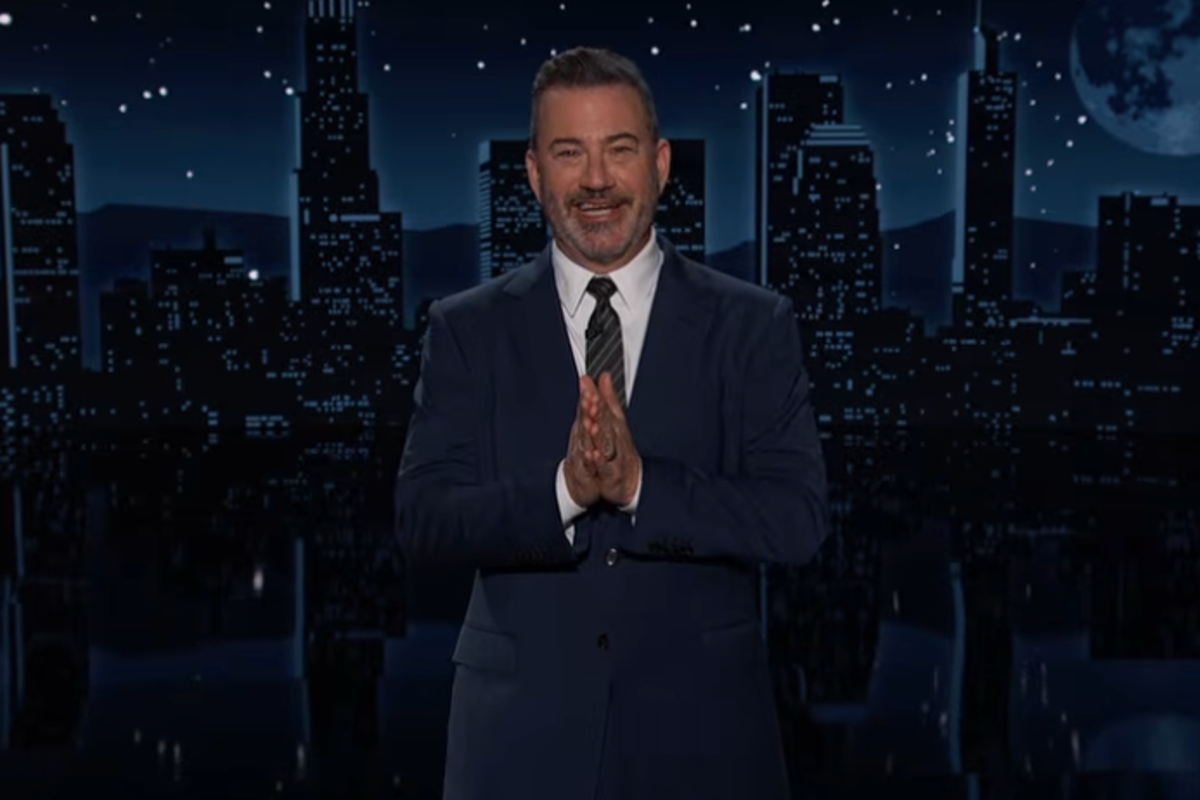
The conflict between late-night television commentary and political communication strategies reveals a fundamental breakdown in the shared definition of satire. When Jimmy Kimmel addresses JD Vance’s defense of Donald Trump’s social media posts regarding religious iconography, the interaction is not merely a celebrity spat; it is a collision of two distinct rhetorical frameworks: performative irony and literalist accountability. Vance attempts to use irony as a defensive shield, categorizing controversial statements as jokes to neutralize criticism. Kimmel, conversely, employs a "literalist deconstruction" to strip away the comedic defense, forcing the audience to confront the underlying ideological claim.
The Irony Defense Framework
The core of the Vance-Trump communication strategy rests on the Irony Defense Framework. This tactic functions by operating in a state of "Schrödinger’s Intent," where a statement is simultaneously serious to the base and a joke to the critics. This creates a rhetorical paradox that serves three primary functions:
- Plausible Deniability: By labeling a post as a "joke," the speaker avoids the burden of proof required for factual claims.
- Targeted Engagement: The intended audience (the "in-group") understands the underlying message, while the "out-group" is mocked for taking it literally.
- Resource Exhaustion: Critics spend significant time debating the intent of the statement rather than its impact, effectively stalling the news cycle.
Vance’s claim that Trump’s "Jesus post" was a joke relies on the assumption that the medium (social media) and the persona (Trump) grant automatic immunity from literal interpretation. However, this defense collapses when the critic—in this case, Kimmel—refuses to engage with the irony and instead applies a standard of Cognitive Consistency.
Kimmel’s Logical Counter-Strike
Kimmel’s response utilizes a method of Analytical Reductio ad Absurdum. Instead of debating whether the post was funny, he evaluates the internal logic of Vance’s defense. The "Epic Punch" referenced in media headlines is actually the identification of a Logical Discontinuity.
If the post is a joke, what is the punchline? If the post is serious, what is the theological or political utility? By framing the post against Vance’s own public-facing persona as a serious intellectual and defender of traditional values, Kimmel highlights a Values-Persona Mismatch. The conflict is categorized by three distinct vectors:
- The Theological Vector: Trump’s comparison of himself to religious figures creates a friction point for Vance’s evangelical and Catholic base. Kimmel exploits this by highlighting the sacrilegious nature of the "joke."
- The Intellectual Vector: Vance’s background as a Yale Law graduate and author suggests a high degree of rhetorical precision. Kimmel’s critique suggests that Vance is "dumbing down" his analysis to accommodate Trump, which creates a perception of intellectual dishonesty.
- The Media Vector: Late-night comedy acts as a mirror to political comedy. When a politician claims they are joking, they are entering the comedian’s domain. Kimmel, as a professional satirist, exerts "Domain Authority" to declare the politician’s joke invalid or poorly executed.
The Cost Function of Satire as Policy
When irony becomes a central pillar of political communication, it incurs a specific set of costs that traditional analysis often ignores. The Satire-Policy Cost Function ($C_s$) can be expressed as the sum of Credibility Erosion ($E_c$), Information Noise ($N_i$), and Base Alienation ($A_b$).
$$C_s = E_c + N_i + A_b$$
The second limitation of Vance’s approach is the Elasticity of Interpretation. When a leader’s statements are perpetually "jokes," the ability to communicate urgent, literal truths is diminished. If the public cannot distinguish between a joke about religious identity and a literal policy proposal, the signal-to-noise ratio in the political ecosystem drops to near-zero.
This creates a bottleneck in governance. If a representative is constantly clarifying that the principal was "just kidding," they are effectively serving as a Rhetorical Janitor rather than a strategic advisor. Kimmel’s monologue functions as a public audit of this role, quantifying the labor Vance must perform to maintain the Irony Defense.
Structural Asymmetry in Late-Night Critique
The effectiveness of Kimmel’s critique stems from an inherent Structural Asymmetry. Kimmel is a comedian who uses seriousness as a tool for humor, while Vance is a politician who uses humor as a tool for seriousness.
- Kimmel’s Advantage: He is not bound by the requirements of objective journalism or the constraints of diplomatic decorum. He can use visceral language and emotional appeals to highlight logical fallacies.
- Vance’s Constraint: As a Vice Presidential candidate, every attempt to be "one of the guys" or "just joking" must still pass the threshold of "presidential" viability.
This asymmetry means that when Kimmel "punches," he is hitting a stationary target. Vance cannot punch back with the same comedic freedom without risking further damage to his serious political persona. The result is a Rhetorical Trap: if Vance ignores the critique, he looks weak; if he responds, he validates the comedian’s role as a serious political arbiter.
The Displacement of Traditional Fact-Checking
We are witnessing a shift where traditional fact-checking is being displaced by Narrative Auditing. Kimmel is not checking the "facts" of the Jesus post; he is auditing the authenticity of the defense.
The mechanism of this audit follows a specific sequence:
- Isolation: The specific claim (the post was a joke) is isolated from the surrounding political noise.
- Contextual Mapping: The claim is compared against the speaker’s historical record and stated values.
- Pressure Testing: The comedian applies "social pressure" by inviting a mass audience to laugh at the absurdity of the contradiction.
This process is more damaging than a standard "Pinocchio" rating from a newspaper because it utilizes Social Proof. When thousands of people laugh at a logical fallacy, the fallacy becomes socially expensive to maintain. Vance is forced to choose between the approval of the Trump base and the respect of the broader, moderate electorate that finds the "joke" defense increasingly thin.
Cognitive Dissonance in the Electorate
The interaction between Kimmel and Vance serves as a micro-study in Induced Cognitive Dissonance. The audience is presented with two conflicting ideas:
- Idea A: JD Vance is a serious, faith-based conservative leader.
- Idea B: JD Vance is defending a post that mocks the central figure of his own faith for the sake of political expediency.
Kimmel’s role is to ensure that these two ideas cannot coexist comfortably. By highlighting the "epic punch," the media is signaling that the dissonance has reached a breaking point. The "punch" is the moment of clarity where the irony fails to cover the contradiction.
The primary vulnerability in Vance’s strategy is the Assumption of Universal Irony. He assumes that all observers will recognize the "joke" as he does. However, in a fragmented media environment, irony does not scale. What is a "joke" on Truth Social is a "blasphemy" or "evidence of instability" on a late-night broadcast. This lack of Contextual Scalability is the flaw that Kimmel exploits.
Strategic Recommendation for Political Communication
To mitigate the damage of the "Late-Night Audit," political strategists must move away from the Irony Defense and toward Controlled Sincerity. The reliance on "it was just a joke" is a declining asset. As the public becomes more saturated with ironical content, the "shock value" diminishes, leaving only the structural damage to the candidate’s brand.
Future engagement must prioritize Thematic Anchoring. If a controversial statement is made, the defense should be based on the statement’s alignment with a core policy theme rather than its status as humor. This prevents comedians from using Domain Authority to invalidate the message. The goal is to move the conflict from the "Comedic Arena"—where the politician will always lose to the professional satirist—to the "Policy Arena," where the politician holds the advantage of technical expertise.
The Vance-Kimmel exchange marks the end of the "Post-Irony" era of political campaigning. The "Epic Punch" was not a singular event but a demonstration that the Irony Defense has reached its point of Diminishing Rhetorical Returns. Strategists should prepare for a return to literalist accountability, where the ability to defend a statement on its merits will outweigh the ability to deflect it with a smirk.