The coffee in the finjan was still steaming when the first shockwave rattled the windows of Mar Elias. In Beirut, sound is a geography. You learn to map the city by the timbre of its tragedies. A low rumble is often the sea or a distant quarry. A sharp, metallic crack is a sonic boom. But this was different. This was a heavy, earth-eating thud that vibrated through the soles of the feet before it ever reached the ears.
For decades, the violence between Hezbollah and Israel had a predictable, if bloody, choreography. It stayed in the south. It haunted the border. It visited the sprawling suburbs of Dahiyeh. Central Beirut, with its narrow alleys, its historic churches, and its scent of roasting nuts and salt air, was supposed to be the sanctuary. It was the neutral ground where the Lebanese could pretend, even for an hour, that the world wasn't tearing itself apart.
That illusion died on a Tuesday.
The Geography of a Target
When the missiles struck the Bachoura district, they didn't just hit a building. They punctured a psychological dam. Bachoura sits a stone’s throw from the Parliament building and the upscale shops of downtown. It is the connective tissue of the city.
Consider a man named Elias. He isn't a politician or a fighter. He is a baker whose family has lived in the shadow of the Saint George Cathedral for three generations. For Elias, the expansion of the conflict into the city center isn't a headline in a foreign newspaper. It is the realization that the "red lines" everyone talked about were actually written in disappearing ink.
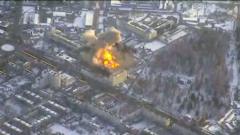
The military objective was clear enough in the sterile language of briefings: targeting Hezbollah’s command infrastructure or financial hubs. But in the crowded streets of a Mediterranean capital, there is no such thing as a surgical strike that doesn't leave scars on the neighbors. When the dust settled in Bachoura, the air wasn't just filled with pulverized concrete. It was heavy with the smell of sulfur and the collective gasp of a million people realizing that nowhere was safe anymore.
The Sound of Shifting Fronts
The conflict has mutated. What began as a cross-border exchange of fire following the events in Gaza has escalated into a full-scale atmospheric shift. Israel’s strategy has pivoted from containment to a systematic dismantling of Hezbollah's presence, moving deeper into the urban fabric of Lebanon.
Hezbollah, meanwhile, has doubled down. Their rockets, once infrequent visitors to central Israel, now arc toward Tel Aviv with grim regularity. It is a pendulum of escalation. Each side believes the next strike will buy them leverage. Instead, it only buys more funerals.
The numbers tell one story—thousands displaced, hundreds dead, billions in infrastructure evaporated. But the eyes of the people in the displacement centers tell another. In the public schools and parks of central Beirut, families who fled the south now find themselves in the crosshairs again. They are running out of map.
Imagine the logistics of fear. You pack a bag with the essentials: passports, milk for the baby, a handful of family photos. You drive north, dodging the craters in the highway, thinking you’ve reached the "safe" zone. Then, at 2:00 AM, the building three blocks away vanishes in a fireball. The "safe" zone was just a temporary reprieve.
The Invisible Stakes
We often talk about these wars in terms of territory. We look at maps with red and blue arrows. We discuss the Litani River as if it were a magical barrier that, if crossed, would solve the riddle of Levantine peace.
The real stakes are far more fragile. They are the social contracts of a multi-faith, multi-ethnic city. Beirut has always been a miracle of improbable coexistence. In the cafes of Hamra, you find the secular, the devout, the poet, and the profiteer sharing the same cramped table.
When the fighting spreads to the center, it threatens to ignite the old sectarian fault lines that the Lebanese have spent thirty years trying to bury. If one neighborhood feels targeted and another feels spared, the resentment builds. The fear isn't just of the missiles from above; it’s of the neighbor across the street. This is the invisible goal of urban warfare: the erosion of trust.
The Arithmetic of Survival
There is a specific kind of exhaustion that settles over a city under siege. It isn’t the tiredness of a long day’s work. It is a systemic depletion.
In the wake of the central Beirut strikes, the economy didn't just stumble; it gasped. The small shops that had survived the 2020 port explosion and the subsequent hyperinflation finally shuttered their doors. Who buys a new shirt or a book when the sky might fall before dinner?
The logistical reality of the fighting is a series of impossible choices. Do you stay in your apartment because it’s everything you own, or do you sleep in your car because it’s easier to flee from? Do you keep your children home from school because of the drones, or do you send them because they need a shred of normalcy?
The conflict is no longer a "clash" or an "exchange." It is an environment. It is the weather. People check the news apps before they check the clouds.
A City of Ghosts and Neon
Walking through the streets after a strike is a surreal experience. One block is a charred skeleton of rebar and ash, where civil defense workers pick through the rubble with a desperate, practiced efficiency. The next block over, a generator hums to life, and a neon sign for a pharmacy flickers on, casting a garish pink glow over the shattered glass on the sidewalk.
Beirut is a city that refuses to stay down, but even the strongest heart can only take so many shocks. The strikes in the city center represent a crossing of the Rubicon. It signaled to the world—and more importantly, to the residents—that the old rules of engagement have been discarded.
The diplomacy continues in hushed rooms in Paris and Washington, filled with talk of UN resolutions and maritime borders. But those words feel hollow when you are standing in a square where the air still tastes like burnt rubber. The gap between the political "solution" and the human "reality" has never been wider.
There is a woman who sits on a plastic chair outside her damaged apartment in Gemmayzeh. She doesn't cry. She doesn't scream. She simply sweeps the glass from her doorstep, over and over, into a neat little pile. When asked why, she says nothing. She just looks up at the sky, waiting for the next sound to tell her where she fits on the map of the new Beirut.
The pile of glass is small, but it is sharp, and it catches the light of the setting sun like a thousand tiny diamonds. It is a beautiful, terrible reminder that in this city, even the debris has a story to tell.
The sun dips below the Mediterranean, turning the smoke on the horizon a bruised purple. The city waits. It doesn't sleep; it merely holds its breath, listening for the next thud in the dark.