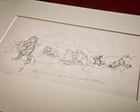
Finding the soul of a literary icon usually requires digging through layers of marketing and soft-focus nostalgia. For Winnie the Pooh, that soul isn't found in the bright red shirt of the Disney era. It's found in the thin, graphite lines of Ernest Howard Shepard’s original pencil sketches. Recently, a rare collection of these preparatory drawings has come to light, offering a look at the "Bear of Very Little Brain" before he became a global brand.
These aren't just doodles. They're the blueprint for childhood. For a different view, consider: this related article.
When you look at a finished ink drawing in the 1926 classic, you see a masterpiece of minimalism. But the pencil sketches tell a different story. They show the hesitation, the movement, and the literal weight of a stuffed bear trying to climb a tree or stuck in a rabbit hole. Most people think Shepard just followed A.A. Milne’s lead. He didn't. He practically built the Hundred Acre Wood from the ground up, using his own son’s toys and the actual landscape of Ashdown Forest in East Sussex as his primary sources.
Why These Pencil Sketches Change Everything
Most readers only know the clean, black-and-white ink versions that made it into the books. Those are great, sure, but they're polished. They're the "final take." The pencil sketches are the rehearsal. You can see where Shepard lightened his touch to show the fluffiness of Pooh’s fur or where he pressed down hard to give Piglet a sense of genuine anxiety. Related reporting regarding this has been published by ELLE.
Graphite allows for a range of motion that ink simply can't capture. In these newly shared sketches, there’s a sense of "becoming." You see Shepard trying to figure out how a stuffed animal’s joints would actually work. Since Pooh is a "bear of stuffed bits," his movement shouldn't be fluid like a real grizzly. It should be slightly stiff, slightly clumsy. Shepard nailed that in the pencil stage.
The Ashdown Forest Connection
Shepard didn't just sit in a studio in London and imagine trees. He went to the source. He spent days in Ashdown Forest, sketching the specific shapes of the beech and pine trees. If you visit the forest today, you can find the exact spots—the "Poohsticks" bridge, the sandy pit where Roo plays, and the dark thickets where Eeyore might mope.
The pencil sketches show his obsession with light and shadow in the woods. He used the grain of the paper to mimic the texture of the forest floor. It’s this grounded reality that makes the stories feel so permanent. You aren't in a dreamworld; you're in a real place in England, just seen through the eyes of a child’s imagination.
The Secret Evolution of Pooh Bear
It’s a common misconception that Pooh always looked like Pooh. In the early sketches, Shepard was still finding the silhouette. You can see him playing with the proportions. Should the belly be larger? How short should the legs be?
Actually, the "real" Winnie—the stuffed toy owned by Christopher Robin Milne—looked a bit different from Shepard's drawings. Shepard actually used his own son's teddy bear, "Growler," as the primary model. Growler was a bit more portly and had a more classic "Steiff" bear look. This decision by Shepard was huge. It gave Pooh a unique visual identity that separated him from the actual toy in the Milne household.
Working With Milne was no Picnic
A.A. Milne was a precise, sometimes difficult man. He knew exactly what he wanted the "vibe" of the book to be. Shepard had to translate Milne’s dry, British wit into something visual. These pencil drafts show the back-and-forth process. You can almost see the moments where Shepard realized that a simple tilt of the head could convey more emotion than a thousand words of dialogue.
He used a technique called "economy of line." He didn't overdraw. He knew that in a pencil sketch, what you leave out is just as important as what you put in. That’s why Piglet often looks so small and vulnerable—it’s the vast amount of white space Shepard left around him.
The Market for Shepard Original Art
If you think these sketches are just for museum walls, check the auction prices. Original Shepard pieces have fetched hundreds of thousands of dollars at Sotheby’s. In 2014, an ink drawing of Pooh, Christopher Robin, and Piglet playing Poohsticks sold for nearly $500,000.
Collectors value the pencil sketches because they're unique. An ink drawing is often traced or refined from a pencil original, but the pencil sketch is the first time that specific image ever existed in the physical world. It’s the "alpha" version.
Preservation Challenges
Pencil is fragile. Graphite can smudge, and paper yellows. The fact that these sketches have survived for a century is a miracle of archival science. They’ve been kept in climate-controlled environments, away from the UV rays that would eat the paper alive. Seeing them shared now is a rare win for the public, as most of these belong to private estates or deep within the archives of the Victoria and Albert Museum.
How to Look at a Shepard Sketch
When you’re looking at these newly released images, don't just look at the characters. Look at the background.
- The Grass: Shepard used quick, flicking motions to show wind.
- The Eyes: A single dot of graphite. It’s insane how much expression he got out of a literal speck of carbon.
- The Gravity: Notice how Pooh sits. He doesn't sit like a person; he sits like a sack of beans. Shepard understood the physics of toys.
Most people overlook the technical skill because the subject matter is so "cute." That's a mistake. Shepard was a world-class political cartoonist for Punch magazine before he ever touched Pooh. He brought a satirical, sharp eye to the Hundred Acre Wood. He wasn't drawing a cartoon; he was documenting a series of very serious events in the lives of some very serious stuffed animals.
Why We Still Care a Century Later
Pooh is a multibillion-dollar industry now, but these sketches strip all that away. They remind us that it started with a guy, a pencil, and a piece of paper. There’s something deeply human about seeing the eraser marks and the faint "ghost lines" where Shepard changed his mind.
It makes the magic feel attainable. It’s a reminder that even the most famous characters in history started as messy, graphite blurs on a page.
If you want to appreciate the artistry, stop looking at the polished merchandise. Go back to the sketches. Look at the way the pencil catches the tooth of the paper. That’s where the real Pooh lives. He’s not a corporate icon there; he’s just a bear, waiting for his friend to come out and play.
Go find a high-resolution scan of the "Poohsticks" pencil draft. Compare it to the final version. You’ll see the energy in the pencil lines that the ink version—as perfect as it is—just can't quite replicate. That raw energy is the reason Pooh hasn't faded into obscurity.
If you're an artist or just a fan, grab a 2B pencil and try to mimic Shepard's line work. You'll quickly realize that "simple" is the hardest thing in the world to pull off.