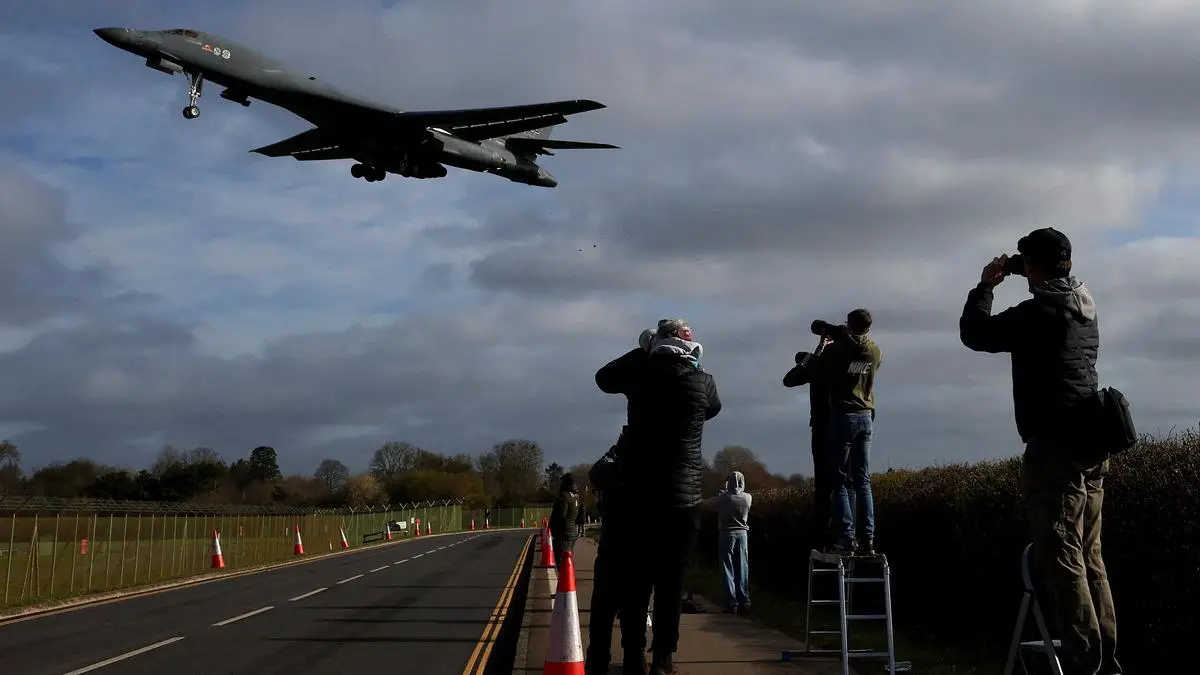
The coffee in the mess hall at RAF Lakenheath or Mildenhall doesn't taste like diplomacy. It tastes like wet earth and burnt beans. But the men and women stirring sugar into those ceramic mugs are currently standing at the epicenter of a geopolitical shift that has nothing to do with the rolling hills of Suffolk and everything to do with the scorched deserts of the Middle East. For decades, these bases have been a polite fiction—sovereign British soil hosting American steel. Now, that fiction has sharpened into a bayonet.
London has given Washington the green light. The United States can now use British bases to launch strikes against Iranian missile sites. It sounds like a headline. It feels like a tremor.
To understand why this matters, you have to look past the press releases and into the cockpit of a Reaper drone or the belly of an F-15E Strike Eagle. When a plane takes off from a runway in East Anglia, it isn't just burning fuel. It is burning through years of British hesitation. Historically, the UK has been the wary partner, the one pulling at the sleeve of the American giant, whispering about de-escalation and the sanctity of international law. That whisper has died down.
The Geography of a Strike
Imagine a technician in a dimly lit room, miles from the nearest ocean. They aren't looking at a map of England. They are looking at a digital rendering of the Iranian plateau—specifically, the hardened silos and mobile launchers that house the "Fattah" or "Shahab" missile series. These are not mere abstract threats. They are the kinetic reality of a region on the brink.
The logistical math is brutal. Flying from the continental United States to the Persian Gulf is an endurance test that strains both airframes and human sanity. But the "Special Relationship" provides a shortcut. By using bases like Akrotiri in Cyprus or the interconnected web of facilities in the UK, the US military shrinks the world. The distance between a policy decision in the Situation Room and a precision-guided bomb hitting a GPS coordinate in Isfahan just became significantly shorter.
Why now? Because the invisible stakes have become visible. Iran’s missile program is no longer a localized concern for Israel or Saudi Arabia. It has become a global currency of instability. When those missiles fly, insurance premiums for oil tankers in the Strait of Hormuz skyrocket. Global supply chains, already fragile, begin to fray. Your morning commute, your heating bill, and the price of the grain in your bread are all tethered to the stability of those Iranian launch pads.
The Calculus of Risk
There is a specific kind of silence that falls over a village like Lakenheath when the afterburners kick in at three in the morning. The locals know the sound. They’ve lived with it since the Cold War. But during the Cold War, the enemy was a monolith—the Soviet Union. Today, the enemy is fluid, decentralized, and capable of asymmetric retaliation.
By allowing these strikes to originate or be supported from its soil, the UK is effectively stepping out from behind the shield. It is an admission that the era of "balanced" diplomacy is over. You cannot be a neutral observer when you are providing the launchpad. This is the human cost of the agreement: the weight of responsibility shifted onto the shoulders of the British public, who now find their quiet countryside inextricably linked to the heat of a Middle Eastern missile exchange.
Consider the hypothetical case of a logistics officer at RAF Brize Norton. Their job is to ensure that the tankers—the flying gas stations that keep the strike fighters airborne—are ready. In the old world, that officer was part of a peacekeeping apparatus. In this new world, they are a vital cog in an offensive machine. There is a psychological toll to that shift. It’s the realization that "support" is just a polite word for "participation."
The Technological Shadow
The weapons involved are marvels of terrifying precision. We are talking about the integration of satellite intelligence, real-time cyber-warfare, and kinetic impact.
- The Intelligence Phase: Before a wheel leaves the tarmac, GCHQ and the NSA have already mapped the electronic signature of the target.
- The Kinetic Phase: The physical strike, designed to penetrate dozens of feet of reinforced concrete.
- The Assessment Phase: Drones linger in the stratosphere, sending back high-resolution proof of destruction.
The UK isn't just providing a runway; it’s providing the "brain" of the operation. The British contribution to signals intelligence is world-class. When the US strikes, they are often using eyes and ears that belong to the Crown. This agreement formalizes that synergy, removing the bureaucratic speed bumps that used to slow down the process of "request and approval."
The Ghost in the Room
The elephant in the room is, as always, escalation. Every action has a reaction, and in the world of high-stakes missile defense, the reactions are measured in seconds. If the US uses a British base to take out a site in Iran, does Iran see that as an American act or a British one? The distinction is becoming increasingly irrelevant.
We are moving into a period where the lines between nations are blurring in favor of "capability blocks." You are either inside the tent or you are a target. By opening the gates, the UK has decided that the danger of a nuclear-capable or missile-dominant Iran outweighs the danger of being a target themselves. It is a cold, hard calculation made by people in expensive suits who will never have to hear the sirens.
The reality of modern warfare is that it is rarely a sudden explosion. It is a series of quiet permissions. It is a signature on a document in a basement in Whitehall. It is a nod of the head between a Prime Minister and a President. It is the sound of a gate opening at a high-security fence in the middle of a forest in Gloucestershire.
The missiles in Iran are fueled and pointed. The planes in England are fueled and ready. The distance between them has never been shorter, and the air has never been thinner. Somewhere in the North Sea, the wind is picking up, carrying the scent of salt and the distant, low hum of a jet engine that refuses to stay on the ground.
The permission has been given. The silence is over.