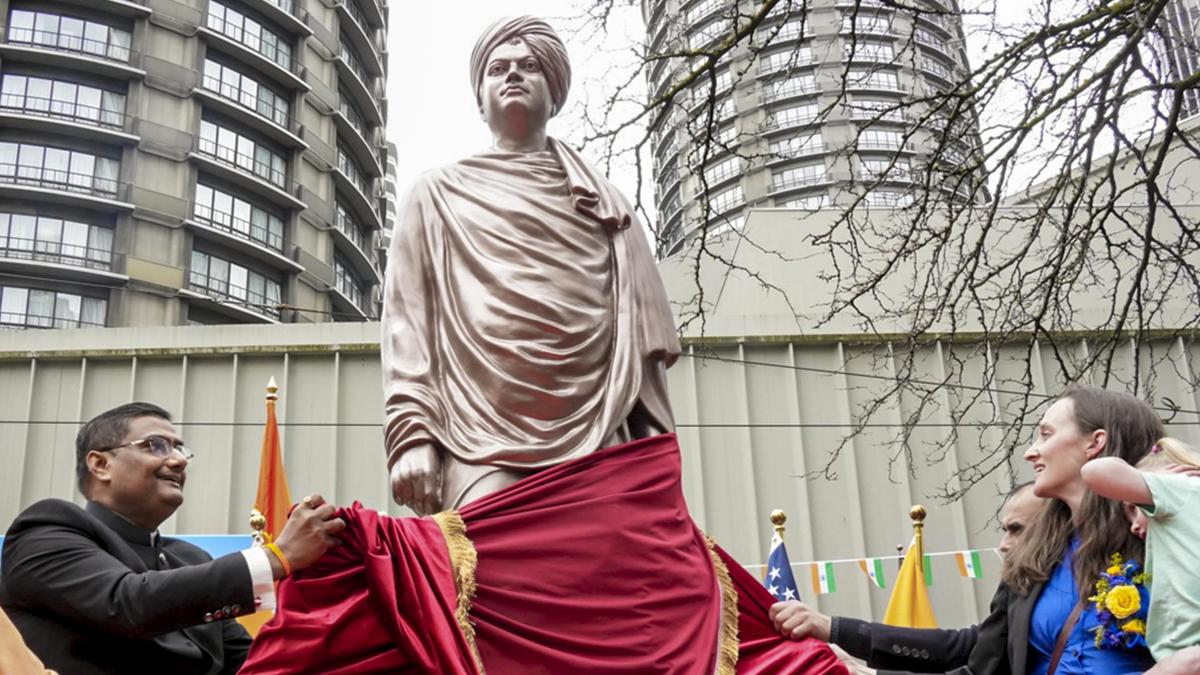
The recent unveiling of a life-size bronze statue of Swami Vivekananda at the Hindu Temple and Cultural Center in Bothell, Washington, represents more than a local milestone. It is the first time the 19th-century philosopher-monk has been cast in such a scale in the United States, marking a definitive shift in how the Indian diaspora asserts its cultural footprint in the Pacific Northwest. While headline-skimming reports focus on the aesthetics of the ten-foot monument, the real story lies in the timing of its arrival and the specific strain of intellectual influence it seeks to cement within the tech-heavy corridor of Seattle.
Vivekananda is not merely a religious figure; he is the architect of modern global Hinduism. By bringing this physical manifestation to the outskirts of Seattle, the local community is signaling a transition from quiet assimilation to a proactive projection of heritage. This isn't just about a statue. It is about a permanent claim to the philosophical high ground in a region defined by rapid innovation and a shifting demographic balance.
The Strategy of Bronze and Granite
Statues are political acts. They are attempts to freeze a specific narrative in time and space. The decision to install a life-size Vivekananda in the Seattle metropolitan area is a calculated move by the Hindu Temple and Cultural Center (HTCC) to bridge the gap between historical Vedantic philosophy and the modern, secular pressure of the American West.
The project, which took years of planning and significant private funding, was not an accidental occurrence. It was a response to a growing demand for a "civilizational anchor." As Seattle has grown into a global hub for software and aerospace, the Indian community—comprising a massive chunk of the high-skill workforce—has looked for ways to move beyond the temporary nature of H-1B visas and rental culture. This statue is the foundation stone of that permanence.
Historically, the American view of Indian philosophy has been filtered through the lens of the 1960s counterculture or modern wellness trends. By placing a traditional, scholarly representation of Vivekananda center stage, the organizers are reclaiming the narrative from the "yoga-studio" version of Eastern thought. They are pointing back to the 1893 World’s Parliament of Religions in Chicago, where Vivekananda first challenged Western audiences to view the East not as a mystical curiosity, but as a sophisticated intellectual peer.
Why Seattle and Why Now
The location is significant. Bothell sits at the intersection of the region’s massive tech expansion. The people funding these initiatives are often the same individuals driving innovation at Microsoft, Amazon, and Boeing. There is a specific tension at play here: the struggle to maintain a cultural identity while operating within a hyper-capitalist, Western framework.
Vivekananda serves as the perfect bridge for this demographic. He famously advocated for a "marriage" between Western material science and Eastern spiritual depth. For a software engineer in Redmond or a data scientist in Bellevue, that message resonates with a specific kind of practical intensity. It justifies their professional success while providing a framework for personal meaning.
The Financial and Logistics Reality
The procurement of the statue involved intricate craftsmanship and international logistics. High-quality bronze casting of this scale is a dying art in many parts of the world, often requiring specialized foundries in India that can maintain the "Dhyana Mudra" (meditative posture) with anatomical precision.
- Weight: Several hundred pounds of solid bronze.
- Scale: 10 feet tall, including the pedestal.
- Cost: Estimates suggest hundreds of thousands of dollars in donations, logistics, and site preparation.
The sheer capital required to execute this project speaks to the economic might of the local Indian-American community. This isn't a grassroots effort in the traditional sense; it is an elite-driven cultural project. The funding came from a mix of local entrepreneurs and long-standing temple members, reflecting a unified front across different economic tiers of the diaspora.
Reclaiming the 1893 Legacy
To understand the weight of this statue, one must look at the specific version of Vivekananda being presented. He is depicted in his signature turban and robe, the same attire he wore when he famously addressed "Sisters and Brothers of America." This choice is deliberate. It evokes a moment of historical triumph where an Indian man stood as an equal among Western theologians.
In the current American social climate, where debates over representation and identity are constant, the statue serves as a non-confrontational but firm assertion of presence. It says: "We have been here since 1893, and our ideas are part of the American fabric."
However, this assertion is not without its internal complexities. Within the Indian community, there are varying interpretations of Vivekananda’s work. Some view him as a universalist reformer, while others see him as a symbol of muscular nationalism. By choosing a traditional meditative pose for the Seattle statue, the HTCC has opted for the most inclusive, serene version of his persona. This minimizes friction and maximizes the statue’s role as a site for quiet reflection rather than political debate.
The Engineering of a Monument
Installing a life-size bronze statue is a nightmare of civil engineering and zoning laws. You cannot simply drop a ton of metal onto a lawn. The HTCC had to navigate the strict building codes of Bothell, which included seismic considerations—a necessity in the earthquake-prone Pacific Northwest.
The pedestal itself is a feat of stability, designed to ensure that the "monk who moved the world" doesn't literally move during a tremor. This technical backdrop is often ignored in the celebratory press releases, but it highlights the commitment required to make this vision a reality. Every bolt and every pound of reinforced concrete represents a community that is planning to stay for the next century.
Countering the Spiritual Vacuum
There is a broader sociological trend at work here. The Pacific Northwest is often cited as one of the most "unchurched" regions in the United States. In this relative spiritual vacuum, the introduction of a major religious and philosophical monument stands out. It provides a focal point in a landscape that is often criticized for being cold and transactional.
For the younger generation of Indian-Americans—the "Gen Z" and "Gen Alpha" cohorts—the statue acts as a visual touchstone. It is much harder to ignore your heritage when it is cast in ten feet of bronze in your neighborhood. This is cultural preservation through sheer physical presence. It is an attempt to fight the "melting pot" effect that often erodes distinct cultural identities over three generations.
The Unspoken Friction
While the unveiling was a moment of unity, the presence of such a prominent religious-cultural figure in a public-adjacent space always raises questions about the boundary between secularism and religious expression. In the U.S., temples are private property, but their outward-facing monuments are public statements.
Some critics of the "statue culture" argue that the funds could be better spent on direct social services. A hundred thousand dollars can buy a lot of food or fund many scholarships. However, the counter-argument from the HTCC leadership is that spiritual and cultural identity provides the "why" behind social service. Without the anchor of identity, the community loses its cohesion and its drive to give back. They aren't just building a statue; they are building a sense of "we."
A New Map of Influence
If you look at a map of Vivekananda statues globally, you see a trail of the Indian diaspora’s success. From Chicago to London, and now to the tech corridors of the West Coast, these monuments track the movement of Indian intellectual and economic capital.
The Seattle statue is the latest pin on that map. It represents the maturation of a community that no longer feels the need to hide its roots to fit into the corporate boardroom. It is an era of "unapologetic presence."
The statue’s eyes are set in a meditative gaze, looking out toward the horizon. This isn't just a nod to the past; it is a sentinel for the future of the region. As the tech industry continues to grapple with the ethics of AI and the human cost of rapid progress, the silent presence of a monk who preached the balance of "atoms and Atman" (science and soul) offers a constant, bronze-cast reminder of a different way to measure success.
The real test will be what happens after the ceremony ends and the dignitaries leave. Will the statue become a dusty relic, or will it serve as a catalyst for the "intellectual powerhouse" that Vivekananda envisioned? The answer won't be found in the bronze itself, but in the community that now walks in its shadow every day.
The Seattle monument is a permanent stake in the ground. It is an announcement that the philosophy which traveled from the banks of the Ganges to the shores of Lake Michigan in 1893 has finally found a permanent, life-size home in the heart of the digital revolution. The monk has arrived in Silicon Forest, and he isn't leaving.