The sky over the Arabian Peninsula doesn't just hold the heat. It holds a tension so thick you can almost hear it hum against the glass of the skyscrapers in Dubai and Abu Dhabi. For the millions of people living beneath that expanse—baristas from Manila, tech consultants from London, and families whose roots go back centuries—the horizon is usually a promise of commerce and sunset. But recently, that horizon has been crowded by something invisible to the naked eye.
War today isn't always a declaration. Sometimes, it is a mathematical problem solved in microseconds by a computer chip.
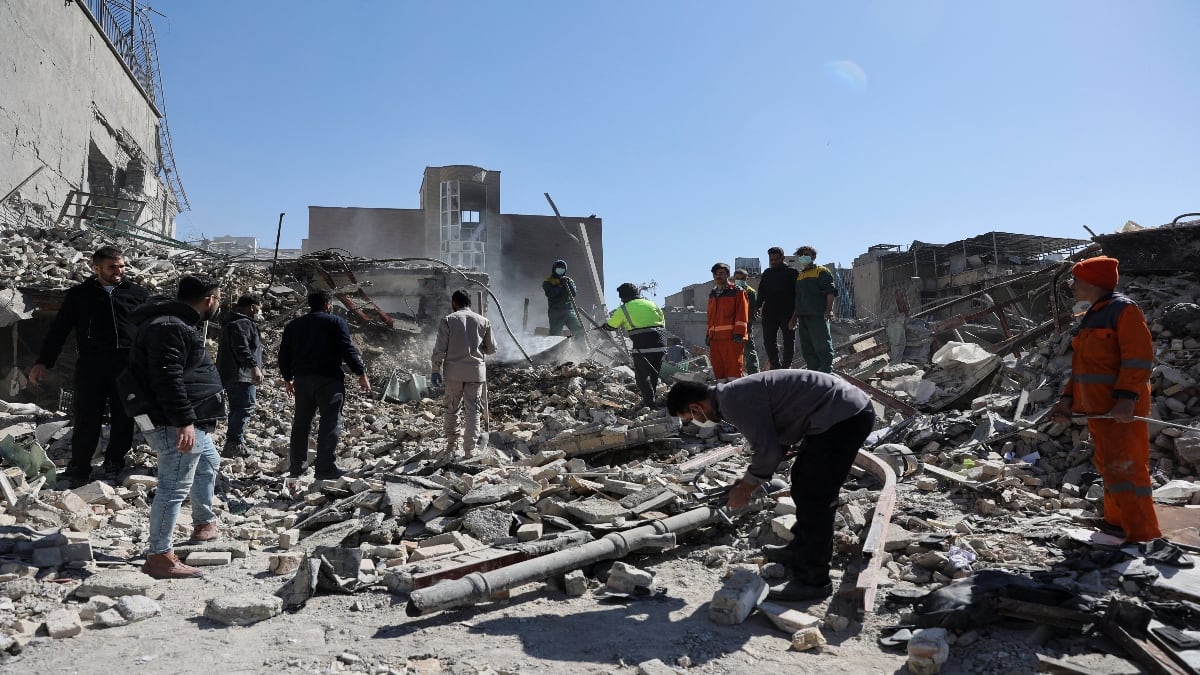
When the news broke that the United Arab Emirates had reaffirmed its position of neutrality while simultaneously acknowledging the interception of over 1,000 Iranian-linked attacks, the world saw a headline. They saw a dry tally of ballistic missiles, cruise missiles, and suicide drones. What they missed was the human heartbeat behind the data. They missed the terrifying split-second reality of what it means to live in a "neutral" zone that is, quite literally, under fire.
The Calculus of the Incoming
Imagine a young air defense officer sitting in a darkened room, the air conditioning struggling against the desert sun outside. We will call him Sultan. He isn't a politician. He doesn't write the white papers on regional "de-escalation" or "strategic autonomy." His world is a glowing screen.
On a Tuesday that looks like every other Tuesday, a blip appears. Then ten. Then fifty. These aren't birds. They aren't commercial flights deviated from their paths. These are metallic messengers of chaos, launched from hundreds of miles away, programmed to find a target—perhaps an oil refinery, perhaps a water desalination plant, or perhaps a crowded mall.
The UAE has spent decades building a fortress out of sand and silicon. It is one of the few places on Earth protected by a multi-layered shield that includes the Terminal High Altitude Area Defense (THAAD) and Patriot systems. When those 1,000 attacks were intercepted, it wasn't a single event. It was a thousand moments where Sultan, or someone like him, watched a computer calculate an intercept trajectory.
Every successful interception is a non-event for the public. A fireball in the upper atmosphere is just a streak of light that most people mistake for a shooting star. But for the men and women behind the consoles, it is a heavy, recurring debt paid to keep the peace.
The Myth of the Easy Choice
There is a persistent, tired narrative that countries must pick a side and stay there. In the West, neutrality is often viewed with suspicion, as if it were a form of cowardice or an attempt to play both ends against the middle.
The reality is far more grueling.
Maintaining neutrality while being targeted by over 1,000 aerial threats is not a passive act. It is an aggressive, daily commitment to balance. The UAE sits in a geographic vice. To its north, an assertive Iran; to its west and north, a complex web of proxies and shifting alliances. To remain neutral in this environment is to walk a high-wire during a hurricane.
Consider the economic stakes. The UAE is a global hub. If a single one of those 1,000 drones had struck the heart of Dubai International Airport, the ripples would have been felt in the stock exchanges of New York and Tokyo within minutes. Neutrality is the product the UAE sells to the world—the promise that "here, you are safe to do business, regardless of the chaos next door."
When the government reaffirms this stance, they aren't just talking to diplomats. They are talking to the markets. They are saying that their shield is strong enough to allow them the luxury of not being dragged into a century-old blood feud.
The Architecture of the Shield
To understand how 1,000 attacks are stopped, you have to look past the missiles and into the logic of the defense. It is a hierarchy of safety.
- Early Warning: Satellites and long-range radar detect the heat signature of a launch. The clock starts. You have minutes.
- Identification: Is this a drone hugging the terrain to avoid radar? Is it a ballistic missile arching into space? The system decides which "tool" to use.
- Engagement: A THAAD battery might reach out into the edge of space to crush a threat through kinetic energy—essentially hitting a bullet with another bullet.
Each of these steps costs millions of dollars. More importantly, each step requires a level of regional cooperation that rarely makes the evening news. To stop a thousand attacks, you need data from neighbors. You need a "tapestry"—if you’ll forgive the image—of sensors that don't care about borders.
Wait. Let’s be more direct. You need a net. And that net has holes. The 1,000 successful intercepts represent the holes that were closed just in time.
The Shadow of the 1,001st Attack
The psychological toll of this "quiet" defense is rarely discussed. For the residents of the UAE, there is a strange cognitive dissonance. You go to a Michelin-starred dinner while, sixty miles up, a sophisticated piece of Iranian technology is being vaporized by a multi-million dollar interceptor.
We live in an era of "Grey Zone" warfare. This isn't the total war of the 1940s. It’s a constant, low-level pulse of aggression designed to wear down the will of the defender. If you launch enough drones, eventually one gets through. If one gets through, the "neutrality" of the target is tested. Do they retaliate? Do they join the coalition they’ve been avoiding?
The UAE’s insistence on staying the course is a refusal to let the aggressor dictate the terms of their national identity. They are betting that technology can provide a third way—a way to be involved in the world without being consumed by its fires.
But technology is never neutral. The systems used to intercept these 1,000 attacks are often American-made. This creates a friction point. How do you remain a "neutral" bridge between East and West when your very survival depends on a specific set of Western gears and sensors?
The answer lies in the sheer volume of the threat. A thousand attacks change the math. It moves the conversation from "political alignment" to "basic survival." When someone is throwing stones at your house, you don't ask about the politics of the man who sold you the glass; you just make sure the glass is bulletproof.
The Invisible Cost of Peace
We often measure the cost of war in lives lost and buildings destroyed. We rarely measure the cost of the war that didn't happen.
The 1,000 intercepts represent 1,000 tragedies that were deleted from the timeline. They represent 1,000 headlines that were never written. But they also represent a staggering diversion of human ingenuity and capital. Imagine what a nation could build if it didn't have to spend its brilliance on the physics of interception.
The UAE’s reaffirmation of its stance is a plea for a return to a world where the sky is just the sky. It is a reminder that behind every diplomatic statement about "neutrality" and "de-escalation," there are thousands of hours of tension, thousands of miles of scanned airspace, and a shield that must be perfect every single time.
The aggressor only has to be lucky once. The defender has to be perfect forever.
As the sun sets over the Persian Gulf, the lights of the cities begin to flicker on. The cafes fill up. The traffic jams begin. The 1,000 attacks are a footnote in a news cycle. But the shield is still there, its hum lost in the noise of the city, its silicon heart beating in anticipation of the 1,001st blip on the screen.