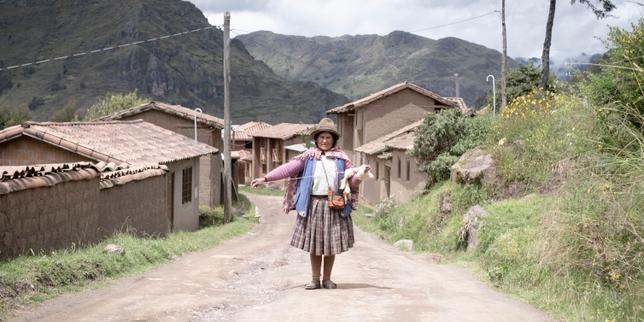
The international press has a fetish for the "forgotten" Andean village. You’ve seen the photos: a weathered grandmother in a felt hat, a child with rosy cheeks, and a backdrop of majestic, indifferent peaks. The text always follows a predictable script of "abandonment." It laments the lack of paved roads, the distance to the nearest hospital, and the failure of the central government in Lima to provide a safety net.
This narrative isn't just lazy; it’s a fundamental misunderstanding of geography and economic reality.
Calling the highlands "abandoned" assumes that the state is an omnipresent deity that failed its duty to terraform the impossible. It’s time we stop treating remote topography as a policy failure. The "neglect" cited by NGOs and journalists is actually the natural friction of the most complex terrain on the planet. By framing these communities as victims of apathy, we ignore the agency of the people living there and the sheer physics of their environment.
The Myth of the Universal Safety Net
Western observers and urban elites in Lima love to talk about the "social debt" owed to the Andes. They demand a hospital in every hamlet and a fiber-optic cable in every valley. But look at the math. The cost of maintaining high-standard infrastructure at an altitude of 4,000 meters—where the $O_2$ levels drop and the climate eats asphalt for breakfast—is astronomically higher than in the coastal plains.
When a journalist says a village is "abandoned" because it takes six hours to reach a clinic, they are ignoring the Density-Cost Paradox.
Imagine a scenario where a government spends $500 million to build a highway to a village of 200 people. That is not "equity." It is a catastrophic misallocation of capital that could have saved 10,000 lives in a high-density urban slum. The hard truth that nobody wants to admit is that geographic isolation is a choice or a circumstance, but it is not a right to unlimited state subsidies.
True expertise in regional development requires acknowledging that some places are simply not economically viable as modern hubs. In my years tracking regional investment flows, I’ve seen governments pour billions into "white elephant" projects in the highlands just to appease the "abandonment" narrative, only for those projects to crumble within five years because the maintenance costs exceed the entire region's GDP.
The Invisible Prosperity of the Informal Economy
The "poverty" reported in these Andean regions is often a statistical illusion created by an obsession with formal income. If you look at the official data, these villagers are "destitute." But if you look at their assets, the picture changes.
- Land Wealth: Unlike the urban poor in Lima’s pueblos jóvenes, Andean villagers often own their land. It is an illiquid but massive asset.
- Reciprocity Systems: The ayni (traditional communal work) handles labor needs that would cost a fortune in a formal economy.
- Mineral and Water Rights: The real tension isn't "abandonment"; it's the fight over who controls the resources under the soil.
The media paints the arrival of a mining company as the ultimate villain, but the locals are often more sophisticated than the activists who claim to speak for them. They aren't looking for "care." They are looking for a seat at the table in a $20 billion industry. When a community blocks a road, they aren't crying because they are forgotten; they are exercising leverage. It’s a business negotiation, not a plea for help.
Stop Trying to "Save" the Andes
The standard "People Also Ask" search result for Andean development focuses on how to bring more NGOs or state aid. This is the wrong question. The right question is: how do we facilitate the inevitable transition?
The historical trend for 500 years has been migration from the highlands to the coast. Trying to freeze these villages in time through subsidies is a form of cultural taxidermy. It keeps people trapped in subsistence lifestyles under the guise of "preserving heritage" while denying them the economic mobility that only density can provide.
If we actually cared about these "abandoned" people, we wouldn't build a failing school in a village of ten children. We would provide the scholarships and transit systems to get them to the best schools in Arequipa or Cusco.
The Trap of Victimhood
The "sentiment of abandonment" is a political tool, not an emotional reality. Local mayors and regional governors use this rhetoric to shake down the central government for "emergency funds" that conveniently disappear into administrative black holes.
I have watched local leaders decry the lack of "basic services" while sitting in offices built with mining royalties that remain unspent. In many Andean regions, the problem isn't a lack of money from Lima; it's an utter inability—or refusal—to execute a budget at the local level. The "abandonment" comes from within.
Logistics are Not a Human Right
We need to be brutally honest: you cannot have a 21st-century lifestyle with 15th-century logistics.
If you choose to live in a place where the geography actively resists human habitation, you are accepting a trade-off. The romanticization of high-altitude life by outsiders prevents a serious conversation about Managed Retreat. In the corporate world, if a branch office is losing money and impossible to reach, you close it. In social policy, we call that "cruel," but the alternative is lying to people, telling them that a paved road and a local surgeon are "just around the corner" when they are never coming.
The future of the Andes isn't in more "aid" or "visibility." It’s in integration. Stop viewing the mountain ranges as a series of isolated victims and start seeing them as a rugged, high-stakes economic zone where only the efficient survive.
The village isn't being abandoned by the state. The world is simply moving to where the people are. Stop building roads to nowhere and start building ladders for the people who want to climb out.