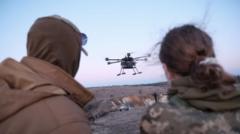
The delivery of the United Kingdom’s largest-ever drone shipment to Ukraine represents more than a logistical milestone; it signals a shift toward a mechanized attrition strategy. By flooding the theater with thousands of Unmanned Aerial Systems (UAS), the UK is attempting to solve a fundamental deficit in traditional artillery fires while simultaneously stressing Russian electronic warfare (EW) architectures. This influx functions as a force multiplier that decentralizes strike capabilities, shifting the burden of precision from expensive, centralized missile platforms to low-cost, expendable front-line assets.
The Three Pillars of Drone-Centric Defense
To understand the impact of this shipment, one must look past the raw numbers and examine the operational categories these systems fill. The delivery is not a homogenous mass of hardware but a stratified layers of capability:
- First-Person View (FPV) Strike Assets: These are high-speed, maneuverable units designed for terminal kinetic impact. They function as "precision-guided munitions for the masses," filling the gap left by shell shortages.
- Intelligence, Surveillance, and Reconnaissance (ISR) Platforms: High-endurance units that provide real-time targeting data. Without these, the FPVs lack the "eyes" to find high-value targets behind the zero line.
- Maritime and Heavy-Lift Variants: Specialized systems designed to disrupt naval logistics or deliver supplies to isolated units, expanding the conflict beyond the trenches.
The Cost Function of Modern Attrition
The economic logic of this drone shipment is rooted in the "Cost-Exchange Ratio." A standard FPV drone costs between $400 and $1,000 to produce. In contrast, a modern Main Battle Tank (MBT) or an Advanced Air Defense system can cost between $5 million and $150 million.
When the UK provides thousands of these units, they are effectively arming Ukraine with the ability to trade $1,000 for $10,000,000 repeatedly. This asymmetry is the core driver of the UK’s procurement strategy. Even with a 10% success rate—where nine out of ten drones are lost to EW or kinetic interception—the economic drain on the defender remains unsustainable. The UK is not just sending weapons; it is sending a tool for financial and industrial exhaustion.
Geometric Complexity in Electronic Warfare
The primary bottleneck for these drones is the Russian EW umbrella. The UK’s shipment addresses this through Frequency Agility and Quantity Saturation.
The logic of frequency agility involves hardware that can operate on non-standard radio bands, bypassing the "jamming bubbles" created by Russian Silok or Pole-21 systems. When a shipment reaches this scale, it allows Ukrainian operators to conduct "swarm-adjacent" tactics. This does not necessarily mean a sophisticated AI-linked swarm, but rather a high-volume saturation attack. By launching dozens of drones simultaneously at a single sector, the attackers force the EW systems into a state of "Target Overload," where the signal processors cannot suppress every incoming frequency at once.
The Architecture of the Supply Chain
This shipment highlights a transition from "Off-the-Shelf" procurement to a "Design-to-War" manufacturing model. The UK is increasingly integrating Ukrainian front-line feedback into the assembly lines within the British Midlands. This creates a tight OODA loop (Observe-Orient-Decide-Act):
- Front-line Observation: A new Russian jamming frequency is detected in the Donbas.
- Technical Orientation: Signal data is sent back to UK-based engineers.
- Strategic Decision: The next batch of 500 drones is fitted with new, shielded telemetry modules.
- Action: The upgraded drones arrive at the front within weeks.
This rapid iteration is a capability that traditional defense primes, used to decadal development cycles for fighter jets or frigates, have historically struggled to achieve. The UK is essentially treating drone production like software development—releasing "patches" in the form of hardware updates with every new shipment.
Logistical Friction and the Human Variable
Despite the massive influx of hardware, two critical constraints remain: pilot throughput and battery logistics.
A drone is only as effective as its operator. The UK’s commitment must include a parallel investment in training facilities, likely located in third-party nations or Western Ukraine. The cognitive load on an FPV pilot is immense; they must navigate 3D space under intense pressure while managing signal degradation.
Furthermore, the "Battery-to-Airtime" ratio creates a massive logistical tail. Lithium-polymer batteries are sensitive to temperature and require specialized charging infrastructure. Thousands of drones require tens of thousands of batteries, all of which must be transported safely to the front. If the UK provides the airframes but the power supply chain falters, the shipment becomes "static inventory" rather than active ordnance.
Strategic Divergence from Conventional Doctrine
This shipment signals a departure from NATO's traditional preference for high-end, multi-role platforms. By prioritizing quantity and "acceptable loss" (attrition-tolerant systems), the UK is acknowledging that in a high-intensity peer-to-peer conflict, survivability is a myth.
The strategy is now to prioritize "Distributed Lethality." Instead of one $100 million aircraft carrying 10 bombs, the UK is providing 10,000 drones that are the bombs. This creates a targeting dilemma for the adversary: Do you fire a $2 million S-300 missile to down a $500 drone? If you do, you lose the economic war. If you don't, you lose the asset on the ground.
The Data-Link Vulnerability
A significant risk in these shipments is the "Command and Control" (C2) vulnerability. Most low-cost drones rely on analog or unencrypted digital signals for low-latency video. This makes them susceptible to "Spoofing," where the enemy takes control of the drone, or "Direction Finding," where the enemy locates the pilot by tracing the radio signal. The UK's role in this shipment likely involves providing more sophisticated, encrypted data links that are typically reserved for higher-tier military hardware, attempting to shield Ukrainian pilots from counter-battery fire.
Operational Forecast
The arrival of this massive shipment will likely precede a localized Ukrainian counter-push or a "Active Defense" phase designed to stabilize the front. The sheer density of these assets will allow Ukraine to establish a "No-Man's Land" that extends 5 to 10 kilometers behind the Russian lines.
The strategic play here is to use the drones to achieve "Fire Superiority" without relying on traditional artillery tubes, which are prone to barrel wear and counter-battery detection. By using drones as the primary strike element, Ukraine can preserve its remaining 155mm shells for high-priority breakthroughs while the UK-supplied drones maintain a constant, grinding pressure on Russian infantry and logistics. The success of this shipment will be measured not by the territory gained in the first week, but by the measurable drop in Russian armored vehicle availability over the next quarter.
The UK is betting that a decentralized, high-volume drone force can offset the traditional advantages of a larger, more resource-rich military. The next phase of the conflict will determine if industrial-scale drone delivery can truly replace the heavy iron of 20th-century warfare.
Ukrainian commanders should immediately integrate these assets into "Combined Arms Drone Teams," where ISR units are permanently tethered to FPV strike cells at the company level. This removes the latency of requesting strikes from higher headquarters. The tactical priority must be the systematic destruction of Russian mobile EW platforms (such as the Leer-3 system) to clear the electromagnetic path for the bulk of the shipment to reach its maximum effective range.