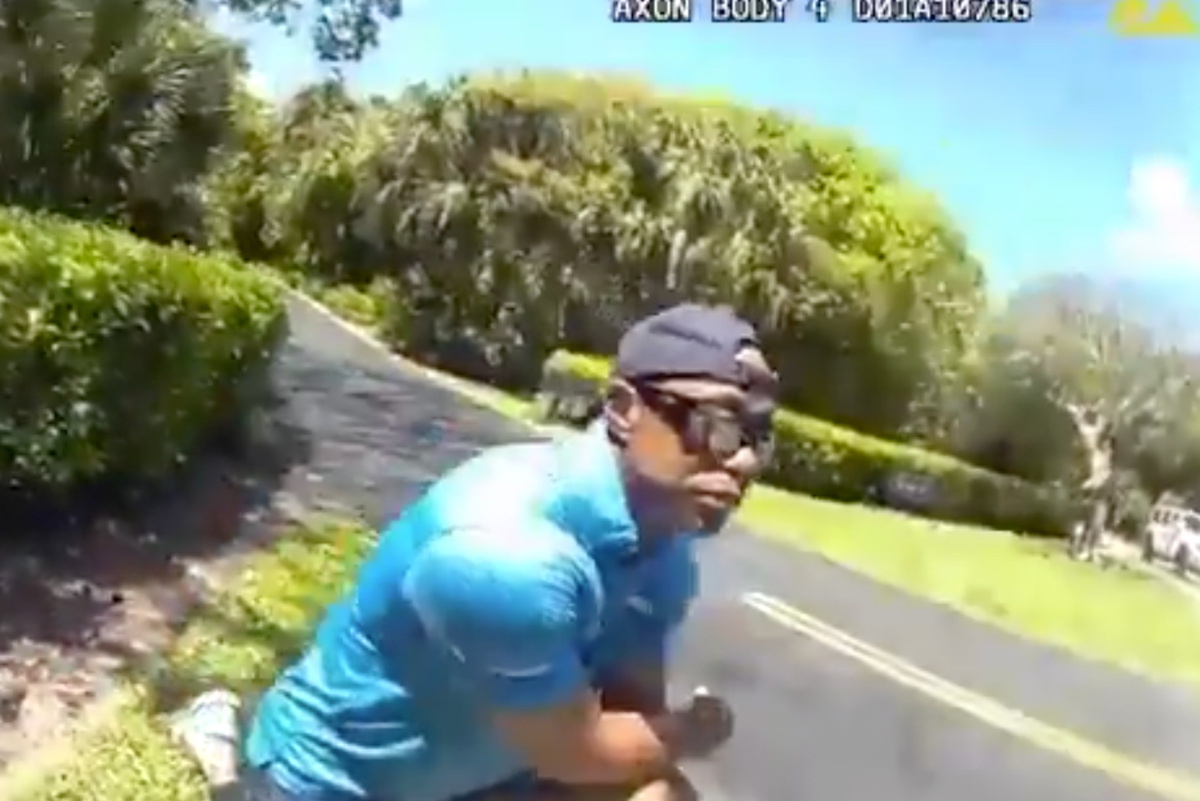
The February 23, 2021, high-speed rollover involving Tiger Woods serves as a definitive case study in the intersection of automotive safety engineering, kinetic energy dissipation, and the physiological limits of the human lower extremity. Analysis of the primary data—comprising the Los Angeles County Sheriff’s Department (LASD) investigative report, the vehicle’s Event Data Recorder (EDR) telemetry, and subsequent bodycam footage—reveals a failure of situational awareness followed by a series of mechanical interventions that prevented a fatal outcome. The event is best understood through the lens of structural deceleration: how a 5,300-pound Genesis GV80 managed the transition from 87 mph to a stationary position across a 400-foot debris field.
Kinetic Energy and Deceleration Dynamics
The fundamental physics of the crash dictated the severity of the injuries. Kinetic energy ($E_k$) is calculated as $\frac{1}{2}mv^2$. Because velocity is squared, the difference between the 45 mph speed limit and the estimated 84–87 mph entry speed represents nearly a fourfold increase in energy that the vehicle's frame had to absorb.
The vehicle struck a center median, crossed into oncoming lanes, hit a curb, and then a tree before rolling multiple times. The crash sequence followed a predictable chain of energy transfer:
- Primary Impact (The Median): The initial strike against the wooden "Welcome to Rolling Hills Estates" sign and the curb initiated the transition from linear travel to chaotic rotation.
- The Trip Mechanism: Rolling occurs when a vehicle’s lateral movement is suddenly interrupted by an object, creating a pivot point. The GV80’s high center of gravity compared to a sedan increased the "tripping" potential once it left the asphalt.
- Energy Dissipation: The fact that the vehicle rolled multiple times was, counterintuitively, a survival factor. Each roll and impact with the brush and soil served as a "brake," bleeding off kinetic energy gradually rather than the instantaneous, fatal deceleration associated with hitting a fixed concrete barrier.
The Structural Integrity of the Genesis GV80
The survival of the occupant was not a matter of luck but of rigid cabin architecture. The "safety cell" remained intact despite the vehicle’s exterior being shredded. Modern luxury SUV engineering focuses on three specific zones during a rollover:
- A and B Pillar Reinforcement: These vertical supports prevented the roof from collapsing under the vehicle's own weight during inversions.
- The Crumple Zone Buffer: The front-end engine compartment absorbed the initial tree impact, preventing the engine block from being pushed into the footwell—a common cause of death in high-speed collisions.
- Active Restraint Systems: The deployment of all 10 airbags, including the knee airbag, created a pressurized envelope. The bodycam footage shows a driver who is conscious but severely "stunned," a clinical state resulting from the rapid concussive force of airbag deployment and the vestibular disruption of multiple rolls.
Orthopedic Trauma and the Comminuted Fracture
The medical data confirms that the most significant injuries were concentrated in the right lower extremity. The impact resulted in comminuted open fractures to both the tibia and fibula. In medical terminology, "comminuted" indicates that the bone fragmented into several pieces, while "open" means the bone breached the skin, introducing a high risk of infection (osteomyelitis).
The mechanism of this injury is typically "pedal loading." At the moment of impact, the driver’s foot is often braced against the floorboard or brake pedal. The force is transmitted up the shaft of the bone. Because the ankle was stabilized by the footwell, the tibia became the primary load-bearing path for the remaining kinetic energy. The subsequent surgical intervention—the insertion of a rod into the tibia and the use of screws and pins for the foot and ankle—indicates a total reconstruction of the skeletal architecture.
LASD Investigative Findings and the Absence of Impairment Evidence
A critical point of public contention involved the lack of a blood draw or field sobriety test at the scene. The investigative logic relied on the "clinical observation" protocol. Sheriff’s deputies reported no smell of intoxicants and no "objective signs of impairment" such as slurred speech or glassy eyes.
However, the EDR data provided the most objective narrative of the driver's state. The data showed:
- 0% Braking: There was no record of the brake pedal being depressed throughout the crash sequence.
- 99% Acceleration: The throttle was depressed at the time of the first impact.
This suggests a "pedal misapplication" error, a known phenomenon in high-stress vehicular incidents where a driver, startled by a drift or a minor impact, intends to hit the brake but instead floors the accelerator. The lack of skid marks on the pavement supports the theory that the vehicle did not attempt to stop before leaving the roadway.
The Bodycam Footage: A Study in Post-Traumatic Shock
The released bodycam footage provides a raw look at the "golden hour" of trauma care. The driver’s initial interaction with Deputy Carlos Gonzalez highlights the body’s physiological response to massive trauma. The "stunned" appearance noted in media reports is a manifestation of distributive shock.
In this state, the sympathetic nervous system floods the body with adrenaline and cortisol, which can temporarily mask the pain of catastrophic bone fractures. This explains why Woods was able to engage in basic dialogue despite having a shattered leg. The decision by first responders to use a "halligan tool" and an axe rather than the "jaws of life" (hydraulic spreaders) indicates that while the driver was trapped, the metal was not so compressed as to require heavy machinery, further validating the GV80's structural performance.
Long-term Athletic Viability and Mechanical Constraints
The transition from a reconstructed limb to a professional golf swing involves a complex mechanical bottleneck. The golf swing requires significant internal and external rotation of the lead and trail legs.
- The Pivot Limitation: For a right-handed golfer, the right leg (the injured leg) acts as the "trail" leg. It must support the load during the backswing and then facilitate a powerful push-off during the downswing.
- Subtalar Joint Mobility: The screws and pins in the foot and ankle likely fused several small bones. This reduces the foot's ability to adapt to uneven lies on a golf course, making walking 72 holes a greater physical challenge than the swing itself.
- Proprioceptive Deficit: Nerve damage associated with open fractures often leads to a permanent loss of "feel" or proprioception—the body's ability to sense its position in space. For an elite athlete, a 1% shift in weight distribution can result in a significant deviation in ball flight.
Operational Conclusion for High-Performance Safety
The 2021 rollover proves that vehicle safety has reached a point where 80+ mph impacts are survivable, provided the safety cell remains uncompromised. The strategic takeaway for automotive manufacturers is the continued prioritization of knee and curtain airbags, which in this case prevented a traumatic brain injury (TBI) and fatal internal hemorrhaging. For the subject, the path forward remains a battle against the "biological clock" of bone healing versus the "mechanical clock" of professional sports.
The primary constraint for future performance is not the strength of the tibia—which, once healed with a titanium rod, is structurally sound—but the degradation of the surrounding soft tissue and vascular health. Chronic swelling (edema) and reduced blood flow to the lower extremities will dictate the duration of any future competitive windows. The focus shifts from "recovery" to "load management," treating the limb as a mechanical assembly with a finite number of high-stress cycles remaining.