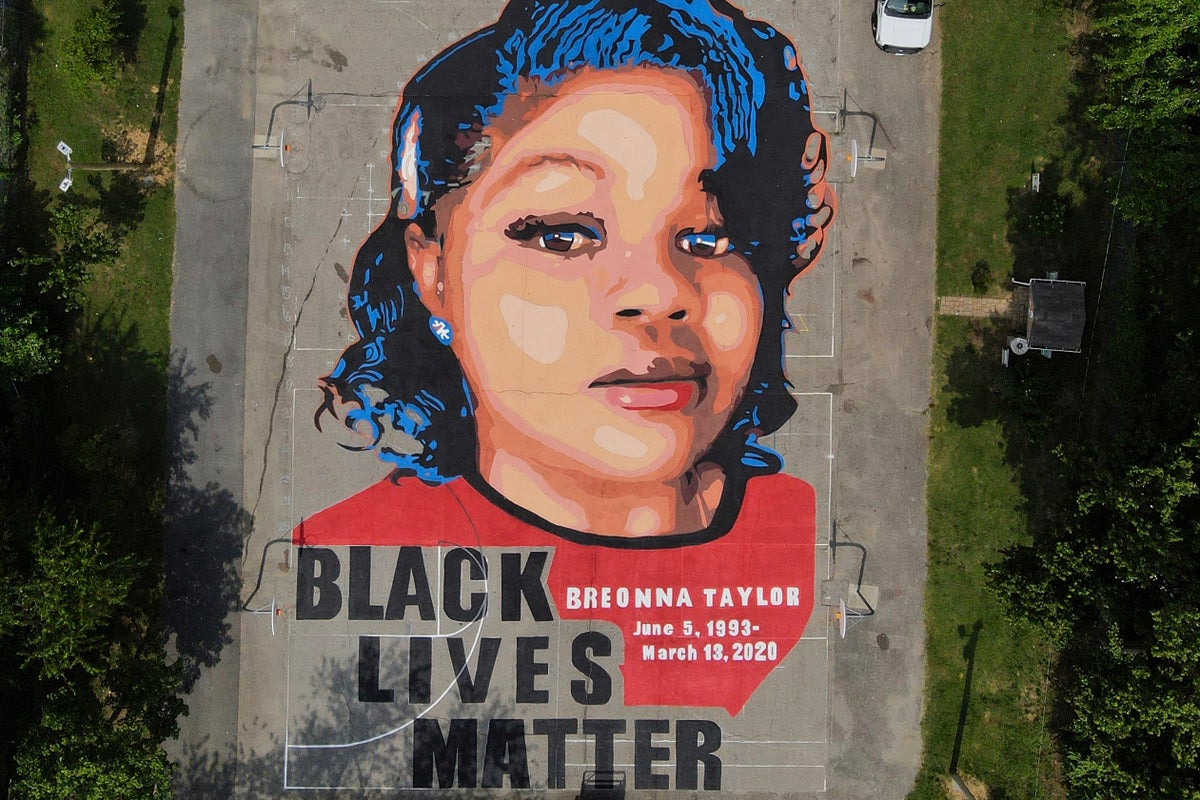
The Department of Justice's recent motion to dismiss civil rights charges against former Louisville police officers Joshua Jaynes and Kyle Meany represents a rare, clinical retreat dictated by the hard constraints of the "but-for" causation doctrine. In the realm of federal criminal law, the success of a prosecution often hinges not on the moral weight of an event, but on the ability to isolate a specific illegal act as the primary catalyst for a resulting injury. When a federal judge ruled that the death of Breonna Taylor was legally precipitated by the return fire of her boyfriend, Kenneth Walker—rather than the initial fraudulent warrant application—the prosecution’s logical chain was severed. This maneuver by the DOJ is not an admission of innocence, but a strategic liquidation of a case that no longer possesses a viable path to conviction under current judicial precedents.
The Causality Bottleneck in Federal Civil Rights Statutes
To understand why the DOJ is moving to drop the most serious charges, one must analyze the hierarchy of 18 U.S.C. § 242 and 18 U.S.C. § 241. These statutes are the primary tools for prosecuting official misconduct. They function on a tiered penalty structure where the severity of the sentence is indexed directly to the outcome of the rights violation.
If a violation results in death, the maximum penalty is life imprisonment or the death penalty. However, if the death cannot be legally attributed to the violation, the charge reverts to a basic rights violation, which carries significantly lower sentencing guidelines.
The prosecution’s original theory rested on a linear sequence:
- The Primary Violation: Officers Jaynes and Meany knowingly included false information in the search warrant affidavit to establish probable cause.
- The Resulting Infringement: The Fourth Amendment right against unreasonable search and seizure was breached when the warrant was executed.
- The Terminal Event: The execution of that warrant led to the exchange of gunfire and Taylor’s death.
In August 2024, U.S. District Judge Charles Simpson dismantled the link between step two and step three. By ruling that Kenneth Walker’s decision to fire at what he perceived as intruders was an "intervening cause," the court effectively moved the legal responsibility for the lethal outcome away from the fraudulent warrant. This creates a bottleneck where the government can prove the fraud (the lie on the paper) but cannot legally blame the lie for the bullets.
The Strategic Pivot from Felony to Misdemeanor Logic
The DOJ's request to dismiss the original charges is a tactical recalibration. When a judge removes the "death resulting" enhancement, the case undergoes a fundamental shift in its cost-benefit profile for the government.
The Evidentiary Burden Shift
Under the original indictment, the government had to prove that the officers' "willful" violation was the proximate cause of Taylor's death. With that element legally barred, the remaining charges—conspiracy and falsifying records—become the primary focus. While these are still felonies under 18 U.S.C. § 1519 (destruction, alteration, or falsification of records in federal investigations), they do not carry the same political or legal weight as the civil rights charges involving a fatality.
Resource Allocation and Jury Perception
Continuing to prosecute a "death resulting" charge that a judge has already gutted would likely result in a directed verdict for the defense. Prosecutors are opting to drop the weakened counts now to avoid a messy trial where a jury might be confused by the disconnect between the high-profile nature of the death and the technical limitations of the remaining charges.
This is a defensive play to preserve the integrity of the remaining counts. By narrowing the scope to the falsification of the warrant itself, the DOJ focuses the jury on a much simpler, more provable fact: Did the officers lie to a judge? This removes the emotional and legal complexity of the shooting itself, which the defense has successfully argued was a separate tactical event.
Internal Systemic Failures in Warrant Verification
The collapse of these specific charges exposes a systemic vulnerability in how "No-Knock" and high-risk warrants are vetted within police departments. The "Pillars of Accountability" in the warrant process—affiant credibility, supervisory review, and judicial oversight—all failed in this instance.
- The Credibility Gap: Jaynes claimed he verified with a postal inspector that a suspect was receiving packages at Taylor’s home. The postal inspector later denied this. This represents a failure of "Source Verification," the most basic requirement of investigative due diligence.
- The Supervisory Rubber Stamp: Kyle Meany, as a supervisor, validated the affidavit. His failure was not necessarily in the lie itself, but in the "Oversight Function." In a high-risk warrant environment, the lack of an independent audit of the affiant's claims creates a high-probability failure point.
- The Judicial Reliance: Judges typically rely on the "Good Faith" of officers. When that faith is weaponized, the judicial system has few internal mechanisms to catch the error before the warrant is executed.
The DOJ's current struggle is a direct result of the "Qualified Immunity" and "Proximate Cause" doctrines which shield officers even when the foundational documents of an operation are compromised.
The Three Pillars of Federal Civil Rights Prosecution Risk
Any federal prosecution of police officers faces a trifecta of risks that the Breonna Taylor case has hit sequentially.
- The Intent Threshold: Prosecutors must prove "willfulness"—that the officer intended to do what the law forbids. It is not enough to prove negligence or a mistake.
- The Causation Hurdle: As seen here, even if the intent is proven, the government must show the specific harm was a foreseeable result of that intent, without an intervening act (like a third party firing a weapon) breaking the chain.
- The Qualified Immunity Buffer: While this is a civil doctrine, its spirit permeates criminal proceedings through the "Objective Reasonableness" standard set in Graham v. Connor. If an officer's actions can be framed as reasonable within the chaotic context of a scene, criminal intent becomes nearly impossible to prove.
The DOJ's motion is an acknowledgment that Pillar 2 has been effectively destroyed by the court's ruling. Without causation, the "death resulting" charges are a legal impossibility.
The Long-Term Impact on Civil Rights Enforcement
This dismissal will likely serve as a precedent for how "intervening acts" are used to shield officers from the consequences of pre-raid investigative failures. If an officer can lie to get a warrant, but then escape the most serious charges because the homeowner defended themselves, the incentive structure for truthful warrant applications is weakened.
The DOJ is now forced to pursue a "Documentary Integrity" strategy. They will attempt to convict Jaynes and Meany on the act of the lie itself. This is a cleaner legal path, but it carries a significant "Public Trust Deficit." To the public, the case is about a life lost; to the legal system, the case is now about a fraudulent form. This divergence between public expectation and legal reality is where the DOJ's strategy is most vulnerable.
The government’s next move will be to refile or proceed on a superseding indictment that focuses strictly on the 18 U.S.C. § 1519 charges. This narrows the battlefield. They are moving from a war over a death to a war over a paragraph in a search warrant. It is a necessary retreat to ensure that at least some form of conviction remains possible.
The strategic play here is to decouple the "paper trail fraud" from the "tactical execution." By conceding the shooting was an intervening act, the DOJ can now argue that the fraud stands alone as a completed crime the moment the pen hit the paper, regardless of the blood shed later. This minimizes the risk of a total acquittal while signaling to police departments that the "Sanctity of the Affidavit" remains a federal priority, even if the "Consequences of the Raid" are currently beyond the reach of federal prosecutors.
Would you like me to analyze the specific language used in the 18 U.S.C. § 1519 charges to determine the maximum remaining sentencing exposure for these officers?