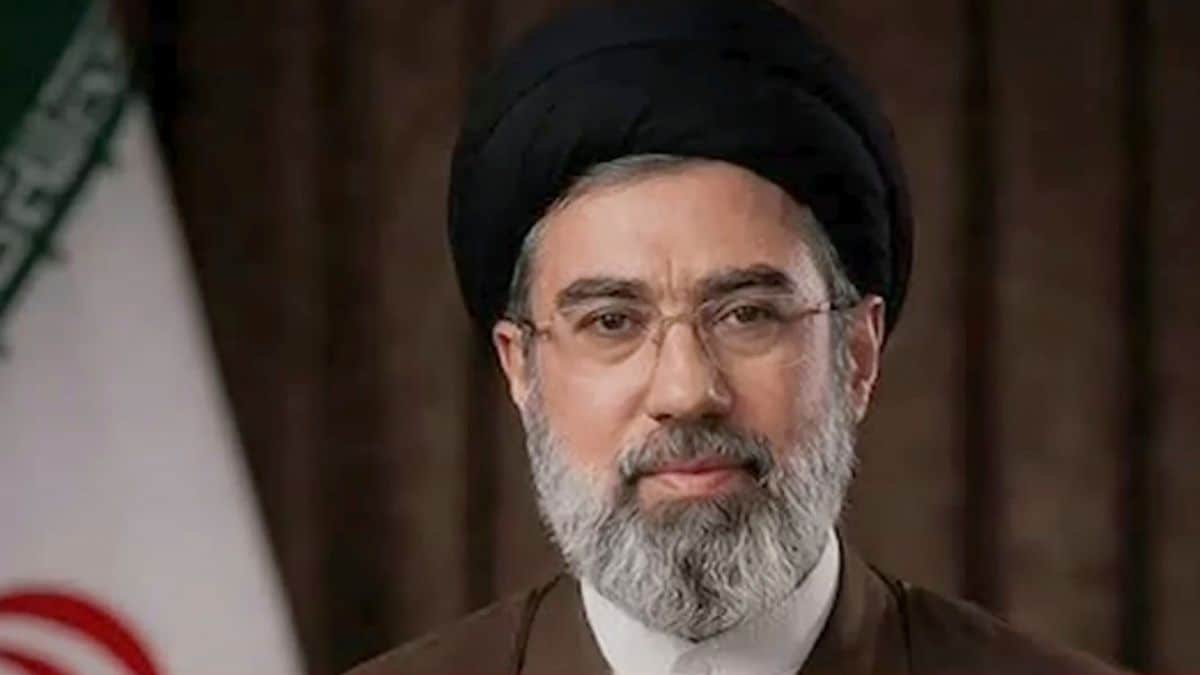
Ali Khamenei stood before the cameras for his annual Nowruz address and declared the "enemy" defeated. On the surface, it was the standard rhetorical playbook of the Islamic Republic: a mix of theological certainty and geopolitical bravado intended to mask a domestic economy in shambles. However, the subtext of this year’s Persian New Year message suggests something far more consequential than another round of saber-rattling against Israel or the West. For those tracking the internal mechanics of the Office of the Supreme Leader, the speech served as a carefully staged validation of a long-running project to consolidate power within the Khamenei bloodline, specifically centering on the Supreme Leader’s second son, Mojtaba Khamenei.
The timing is not accidental. As regional tensions with Israel reach a fever pitch, the aging Supreme Leader is using the specter of external "defeat" to silence internal dissent and pave the way for a transition that many in the Iranian establishment once thought impossible.
The Myth of the Defeated Enemy
Khamenei’s claim that the enemy has been vanquished ignores the brutal reality of Iran's current state. Inflation is rampant, the rial is a ghost of its former value, and the "Axis of Resistance"—Iran's network of regional proxies—is under more direct pressure from Israeli intelligence and kinetic strikes than at any point in the last decade. Yet, in the logic of the Revolutionary Guards (IRGC) and the hardliners in the Majlis, "victory" is defined not by economic prosperity, but by survival.
By declaring victory now, Khamenei is attempting to freeze the political frame. He is telling the Iranian public and the international community that the current hardline trajectory is irreversible. This isn't just a message for Washington or Tel Aviv. It is a message for the pragmatists within the Iranian system who still hope for a return to the nuclear deal or a loosening of social restrictions. The message is clear: the system has won, the hardliners are in charge, and there will be no pivot.
This environment of manufactured triumph is the perfect laboratory for a succession experiment. If the enemy is defeated, then the "heroic" leadership that oversaw that victory—and the heirs to that leadership—cannot be questioned.
The Shadow Prince Steps Into the Light
For years, Mojtaba Khamenei was a figure of whispers. He was the man in the background, the one who reportedly managed his father’s vast financial empire and held the leash of the Basij militia during the 2009 Green Movement crackdowns. He had no official title, no public portfolio, and seemingly no path to the Supreme Leadership, which is theoretically an elected position chosen by the Assembly of Experts.
That has changed.
The elevation of Mojtaba is no longer a conspiracy theory; it is a visible administrative shift. We are seeing a systematic clearing of the field. Potential rivals have been sidelined, discredited, or, in the case of former heavyweights like Ebrahim Raisi, tethered so closely to the current failing economy that their independent political capital has evaporated. Mojtaba, meanwhile, has been quietly accumulating "ijtihad"—the religious credentialing necessary to lead a theocracy.
To understand how this works, look at the bureaucratic flow. The Office of the Supreme Leader (the Beyt) has effectively become the shadow government of Iran, bypassing the presidency and the parliament on every major strategic decision. Mojtaba is widely believed to be the gatekeeper of this office. When the Ayatollah speaks of "victory," he is legitimizing the very apparatus his son has spent twenty years building.
The IRGC’s Fatal Calculation
The ultimate kingmaker in Iran is the Islamic Revolutionary Guard Corps. Historically, the IRGC has been wary of a hereditary monarchy. They overthrew a Shah; they are not inherently inclined to create a new one under a turban. However, the IRGC’s interests have shifted from ideological purity to institutional survival.
The Guard now controls the majority of the Iranian economy, from construction and telecommunications to oil smuggling and black-market finance. For the IRGC generals, Mojtaba Khamenei represents a "known quantity." He is a leader who understands the necessity of the Guard’s economic dominance and who will not sacrifice their regional influence for the sake of a diplomatic opening with the West.
The IRGC is betting that a Mojtaba-led Iran will be a garrison state. In this model, the "enemy" must always be at the gates, yet always be "defeated." This creates a permanent state of emergency that justifies the Guard’s iron grip on the nation’s resources. The Nowruz speech was the ideological seal on this bargain.
The Calculus of Risk
There is a significant danger in this strategy. The Iranian street has shown that its patience is not infinite. The "Woman, Life, Freedom" protests demonstrated a fundamental disconnect between the aging clerical elite and a youth population that views the rhetoric of "defeat of the enemy" as an insult to their intelligence.
If the transition to Mojtaba is handled poorly, or if it is perceived as a blatant dynastic grab, it could provide the spark for a level of civil unrest that the Basij cannot suppress. This is why the rhetoric regarding Israel is being dialed up. Nothing unites a fractured domestic front quite like the threat of foreign war. By framing the current moment as a historic victory over "Global Arrogance" and the "Zionist Entity," the regime is trying to make any opposition to the Khamenei family look like treason against the nation itself.
The Regional Fallout of a Dynastic Iran
A Mojtaba-led Iran would likely be more insular and more reliant on its proxy network than his father’s. While the elder Khamenei at least remembers a time before the Revolution—a time of different diplomatic possibilities—Mojtaba is a product of the crucible. His entire world view has been shaped by the Iran-Iraq war, the sanctions era, and the shadow war with Israel.
We should expect a hardening of the "Forward Defense" doctrine. This isn't just about ideology; it's about the practical need for the new leader to prove his "revolutionary" credentials to the hardliners who will be keeping him in power. The rhetoric of the Nowruz speech suggests that the regime has no intention of de-escalating in Lebanon, Yemen, or Iraq. In fact, they view their current posture as the winning hand.
The West often makes the mistake of thinking that economic pressure will force a change in behavior. In reality, the Iranian leadership uses that pressure to justify the very consolidation of power we are seeing now. They are not looking for an exit ramp. They are looking for a way to ensure the current system survives its most vulnerable moment: the death of the man who has sat at its center for thirty-five years.
The Nowruz address was not a report on the state of the union. It was a coronation speech delivered in advance. The "enemy" isn't just Israel or the United States; the "enemy" is any force—internal or external—that would prevent the Beyt from maintaining its grip on the Iranian future. By declaring that enemy defeated, Ali Khamenei is attempting to close the door on history and lock it from the inside.
Whether the lock holds depends entirely on whether the Iranian people accept a new Shah in the guise of a Saint. The "victory" Khamenei claims is a fragile one, built on the silence of a population and the loyalty of a military-industrial complex that values profit over prophecy.
The stage is set. The actors are in place. The only question remains how the audience reacts when the curtain finally falls on the current Supreme Leader and his son steps out from the shadows to take the bow.
The shift from a clerical meritocracy to a de facto dynasty marks the final evolution of the 1979 Revolution into a standard authoritarian survival project.
Check the flow of capital out of Iran into regional hubs. Follow the promotions within the IRGC’s intelligence wing. The names that appear alongside Mojtaba in the coming months will tell the real story of who will hold the reins of the world's most volatile theocracy.