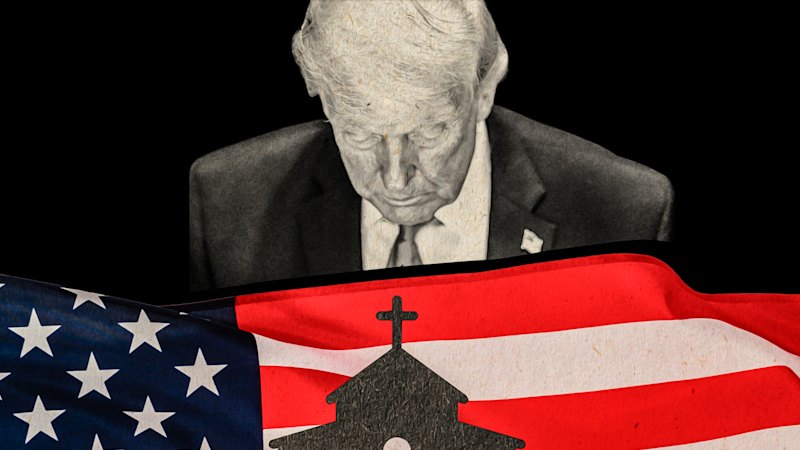
Donald Trump’s attempt to reposition himself as a moral arbiter or a religious authority often hits a wall when it meets the Vatican. While he has historically relied on a bedrock of American evangelical support, his recent maneuvers to assert dominance over religious narratives have backfired. The core of the friction lies in a fundamental misunderstanding of the Catholic Church's global hierarchy and the specific, stubborn priorities of the American evangelical voter. Trump isn't just fighting a political opponent; he is attempting to outmaneuver a two-thousand-year-old institution that operates on a timeline far longer than a four-year election cycle.
The tension reached a boiling point when Trump’s rhetoric began to veer into territory that traditional religious leaders view as borderline sacrilegious. By positioning himself as a "defender of the faith" while simultaneously disregarding core tenets of humility and charity championed by Pope Francis, Trump created a rift. This isn't just a spat between two powerful men. It is a structural failure of a political brand that assumes religious support is a monolithic, easily manipulated block.
The Evangelical Marriage of Convenience is Fraying
Evangelical support for Trump was never based on a belief in his personal piety. It was a cold, hard transaction. They wanted judges; he delivered them. They wanted the embassy in Jerusalem moved; he moved it. But the transactional nature of this relationship has a shelf life. When Trump attempts to "out-holy" the Pope, he steps outside the boundaries of that deal. Evangelicals don't need a preacher-in-chief. They need a brawler who protects their interests. When he starts trying to define theology, he looks less like a protector and more like a competitor to the very pastors who put him in power.
The numbers suggest a quiet fatigue. While the "Make America Great Again" hats are still visible in pews across the South, the fervor is shifting. Pastors are increasingly concerned that the MAGA movement is swallowing the church whole, replacing the Gospel with a nationalist identity. This isn't a minor concern. It’s a threat to the long-term survival of these institutions. When a political leader tries to claim spiritual authority, he forces religious leaders to choose between their faith and their partisan affiliation. Many are starting to choose the former, or at least, they are stopped being so vocal about the latter.
The Vatican Does Not Negotiate
Unlike a political party, the Holy See does not care about polling data in Iowa or New Hampshire. Pope Francis has consistently emphasized themes that run directly counter to the Trump platform: environmental stewardship, the plight of migrants, and the inherent dangers of unbridled capitalism. When Trump tries to frame himself as a superior moral choice, the Vatican responds with a different kind of power—soft, global, and deeply rooted in tradition.
The conflict is systemic. The Catholic Church operates as a global entity with a diverse constituency. Trump operates on a "nationalist first" policy. These two worldviews are mathematically incompatible. When Trump criticized the Pope’s stance on border security, he wasn't just attacking a man; he was attacking a central pillar of Catholic social teaching. This alienates a significant portion of the Catholic vote in swing states like Pennsylvania and Michigan—voters who might agree with Trump on abortion but cannot stomach an attack on the Vicar of Christ.
The High Cost of Moral Posturing
Trump’s strategy has always been to dominate the news cycle. However, religion is a different beast. You cannot "bully" a dogma. By attempting to occupy the moral high ground, Trump has exposed his own vulnerabilities. His evangelical base is noticing that his version of "faith" looks remarkably like a mirror. It is self-serving and transactional. This might work in a boardroom, but it fails in the sanctuary.
The danger for the Trump campaign is the "enthusiasm gap." If religious voters don't feel that their core values are being respected—or worse, if they feel their faith is being used as a cheap prop—they don't switch parties. They just stay home. A 5% drop in evangelical turnout in the Rust Belt is a death knell for a campaign that operates on razor-thin margins. The attempt to out-holy the Pope doesn't bring in new voters; it only makes the old ones question why they signed up in the first place.
The Secularization of the MAGA Movement
We are witnessing a shift where the political movement is becoming the religion itself. This is the "God Bless the USA Bible" era of the campaign. For a certain segment of the population, the political rally has replaced the Sunday service. But for the traditionalist, this is a bridge too far. There is a sacred-secular divide that Trump is stomping all over, and the dust he’s kicking up is blinding his most loyal supporters.
The sophisticated industry analyst looks at this and sees a brand overextending itself. Trump is trying to be the CEO, the General, and now the High Priest. In any other industry, this would be called "mission creep." It dilutes the core message. The more he tries to claim spiritual territory, the more he invites scrutiny into a personal life that rarely aligns with the values he claims to defend. This isn't just a PR problem. It's a fundamental branding crisis that no amount of social media shouting can fix.
Why the Pope Always Wins the Long Game
Popes come and go, but the office remains. Presidents are temporary. When Trump engages in a war of words with the Vatican, he is fighting a ghost. He cannot win an argument with an institution that thinks in centuries. The Pope’s "weapons" are encyclicals and quiet diplomatic pressure. Trump’s weapons are tweets and rallies. One is built on rock; the other is built on a shifting digital landscape.
The American religious landscape is currently a fractured mess of competing interests. By inserting himself into the center of it as a quasi-religious figure, Trump has forced a clarity that didn't exist before. People are being forced to decide if their primary identity is "Christian" or "Republican." For a long time, the two were seen as synonymous in many parts of the country. That era is ending. The friction between the White House (or the prospective one) and the Vatican is the catalyst for this divorce.
The Strategy of Disruption Meets the Wall of Tradition
Trump’s entire career has been built on disrupting established systems. He disrupted the real estate market, the television industry, and the GOP. But religion is the one system that is designed to resist disruption. It is built on the concept of unchanging truth. When Trump tries to "update" religious rhetoric to suit his political needs, he hits the one thing he cannot buy or break: conviction.
Supporters who once found his brashness refreshing are starting to find his religious posturing exhausting. There is a specific kind of "holy fatigue" setting in. It’s the feeling of being marketed to in a space that is supposed to be sacred. The more he tries to use the language of the pulpit, the more he sounds like a salesman. And in the world of faith, the salesman is always viewed with a healthy dose of skepticism.
The Real Power Dynamics of the Religious Right
The power in the evangelical world doesn't actually sit with the politicians. It sits with the donors and the media moguls who run the massive Christian broadcasting networks. These people are pragmatists. They backed Trump because he was a tool for their agenda. If that tool starts to think it’s the master—if Trump starts to believe his own hype as a religious icon—the donors will look for a new, more controllable tool.
This is the hidden crisis within the MAGA movement. It’s not just about the Pope. It’s about the fact that Trump is no longer sticking to the script. The script was: "I give you judges, you give me votes." The new script is: "I am the chosen one, follow me." That change in tone is driving a wedge between the campaign and the institutional church. It is a tactical error of historic proportions.
The Global Implications of a Religious Trade War
By alienating the Vatican, Trump also alienates a massive network of global influence. The Catholic Church is one of the few organizations that can rival a superpower in terms of reach and intelligence gathering. When a US leader is at odds with the Pope, it affects diplomacy in Latin America, Europe, and Africa. It makes the US look isolated and intellectually shallow. It turns a domestic political strategy into a global liability.
The evangelical world is also global. Missions are a massive part of their culture. When the American president uses language that makes it harder for missionaries to operate in Catholic-dominated countries, he is hurting the very people he claims to represent. This is the "how" of the failure. It is a failure to understand the interconnected nature of global faith networks.
Faith as a Weapon or a Shield
For Trump, religion has always been a shield. It protects him from criticism and provides a loyal phalanx of supporters. But by trying to "out-holy" the Pope, he has turned that shield into a weapon—one that he is pointing at his own allies. You cannot demand the loyalty of the faithful while simultaneously mocking the structures they hold dear.
The disconnect is palpable. At a certain point, the "tough guy" act stops being effective in a religious context. You can be a tough guy for the church, but you cannot be a tough guy to the church. Trump is crossing that line, and the resulting silence from the pews is louder than any shout at a rally. He is discovering that while he can own a building or a brand, he cannot own a soul.
The political math for the upcoming cycle depends on a unified religious front. That unity is currently in shambles, not because of the opposition, but because of the candidate’s own ego. The attempt to dominate the spiritual narrative was a bridge too far. It was a play for power in a realm where power is measured by sacrifice, not by acquisition. Trump is playing a high-stakes game with a deck he doesn't fully understand, against an opponent that has seen empires rise and fall while remaining essentially the same.
The path forward for the MAGA movement requires a retreat from the religious front. It needs to return to the transactional, policy-driven relationship that worked in 2016. But Donald Trump has never been good at retreating. He only knows how to double down. In the world of high-end real estate, that might work. In the world of theology and global faith, it is a recipe for a very public, very permanent failure. The pews are watching, and for the first time, they aren't just listening to the message—they are questioning the messenger.
Instead of a coronation, Trump has invited a crusade. And history shows that crusades rarely end well for the person who started them. The collision of ego and ancient tradition has only one logical outcome. The institution will endure; the politician will eventually become a footnote.
Stop treating the pulpit as a podium.