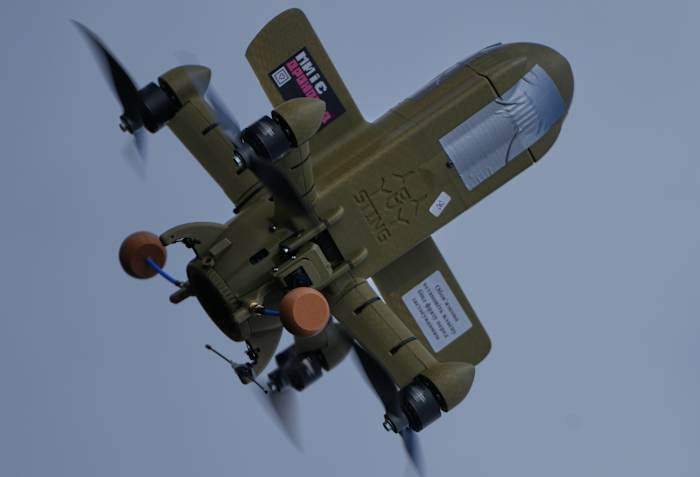
The theater of modern warfare has officially dissolved its borders. Volodymyr Zelenskyy recently confirmed a development that shifts the entire calculus of global security: Ukrainian forces are actively intercepting Iranian-made Shahed drones within Middle Eastern airspace. This is not a hypothetical exercise or a localized skirmish. It is the first time a nation currently under invasion has projected its defensive capabilities thousands of miles away to strike the same weapons systems on a different front.
For months, the flow of suicide drones has moved primarily from Tehran to Moscow. Now, the expertise gained in the blood-soaked suburbs of Kyiv and Kharkiv is being exported back toward the source. By engaging these targets in the Middle East, Ukraine is effectively attempting to decapitate the supply chain before it ever reaches European soil.
The Technical Reality of the Long Range Intercept
Intercepting a Shahed-136 is an exercise in managing low-cost attrition. These drones are essentially flying lawnmower engines strapped to cellular GPS units and high explosives. They are slow, loud, and relatively easy to spot on radar if you have the right equipment. The challenge is the math. If a drone costs $20,000 and the missile used to stop it costs $2 million, the defender loses even when they succeed.
Ukrainian mobile fire groups have mastered the art of the "cheap kill." Using a combination of heavy machine guns, electronic jamming, and older Soviet-era shoulder-fired missiles, they have maintained an interception rate that often exceeds 80 percent. By deploying these specific tactics in the Middle East, Ukraine provides a blueprint for regional powers that have previously struggled with swarm tactics.
The "how" involves a sophisticated integration of Western intelligence and Ukrainian field experience. We are seeing the deployment of specialized units that don't just wait for a radar blip; they understand the flight harmonics and loitering patterns of Iranian hardware better than anyone on the planet.
Why Kiev is Fighting a War on Two Fronts
The decision to operate in the Middle East is not a gesture of charity. It is a cold, calculated move to strain the Iranian military-industrial complex. Every drone destroyed over a desert in the Levant is one less drone that can target a power substation in Lviv.
Disrupting the Russian Iranian Axis
The relationship between Moscow and Tehran has evolved from a marriage of convenience into a foundational military alliance. Russia provides satellite imagery and advanced fighter jet technology; Iran provides the mass-produced loitering munitions that keep the Ukrainian air defense system occupied. By taking the fight to the Middle East, Ukraine forces Iran to reconsider the cost of its exports.
If Tehran cannot guarantee the security of its own airspace or the success of its regional proxies because Ukrainian operators are in the mix, the internal political pressure changes. This is about creating a multi-front dilemma for the Kremlin’s primary supplier.
The Intelligence Goldmine
Operating in these third-party territories allows Ukrainian intelligence (HUR) to capture intact components. In Ukraine, drones often explode upon impact or are shredded by anti-aircraft fire. In the Middle East, different terrain and engagement rules sometimes allow for the recovery of nearly pristine flight controllers and engines.
These recovered parts reveal exactly how Iran bypasses global sanctions. We find chips from washing machines, high-end American microprocessors bought through shell companies, and Austrian engines redirected through three different continents. Analyzing these "in the wild" allows Ukraine to update its electronic warfare signatures in real-time.
The Geopolitical Risk of Ukrainian Presence
This expansion of the conflict is fraught with danger. The Middle East is a powderkeg of competing interests, and the introduction of a high-functioning European combat force adds a volatile new variable.
There is the constant threat of a miscalculation. If a Ukrainian unit accidentally engages a target belonging to a different regional power, the diplomatic fallout would be catastrophic for Kiev’s standing with its Western backers. Furthermore, Russia has already signaled that it views this as a direct escalation. The Kremlin sees Ukrainian activity in the Middle East as proof that the war is no longer a "special military operation" but a global campaign orchestrated by NATO.
Yet, for Zelenskyy, the risk of inaction is higher. Allowing the Shahed production lines to run at full capacity without interference ensures a permanent state of terror for Ukrainian civilians.
The End of Localized Conflict
The traditional view of war as something contained within specific map coordinates is dead. We are entering an era where expertise is the most valuable commodity, and that expertise moves fast. Ukrainian pilots and drone operators are the most battle-hardened specialists in the world right now. Their presence in the Middle East confirms that the defense of a nation now begins thousands of miles from its own border.
This isn't just about shooting down drones. It is about a fundamental shift in how mid-tier powers project influence. Ukraine is proving that you don't need a massive blue-water navy to exert pressure across the globe; you just need better data and a more refined kill chain than your enemy.
The drones will keep flying, and as long as they do, the crews from Kyiv will be there to meet them. The desert has become the new testing ground for the survival of the Ukrainian state. If you want to see the future of global warfare, stop looking at the trenches in the Donbas and start looking at the skies over the Middle East.
Governments and defense contractors are watching these intercepts with a level of scrutiny we haven't seen since the Cold War. They are seeing that the most effective defense isn't always the most expensive one; it's the one that adapts the fastest to the shifting wind.
Strategic depth no longer means having a large country. It means having the reach to strike the hand that feeds your oppressor.