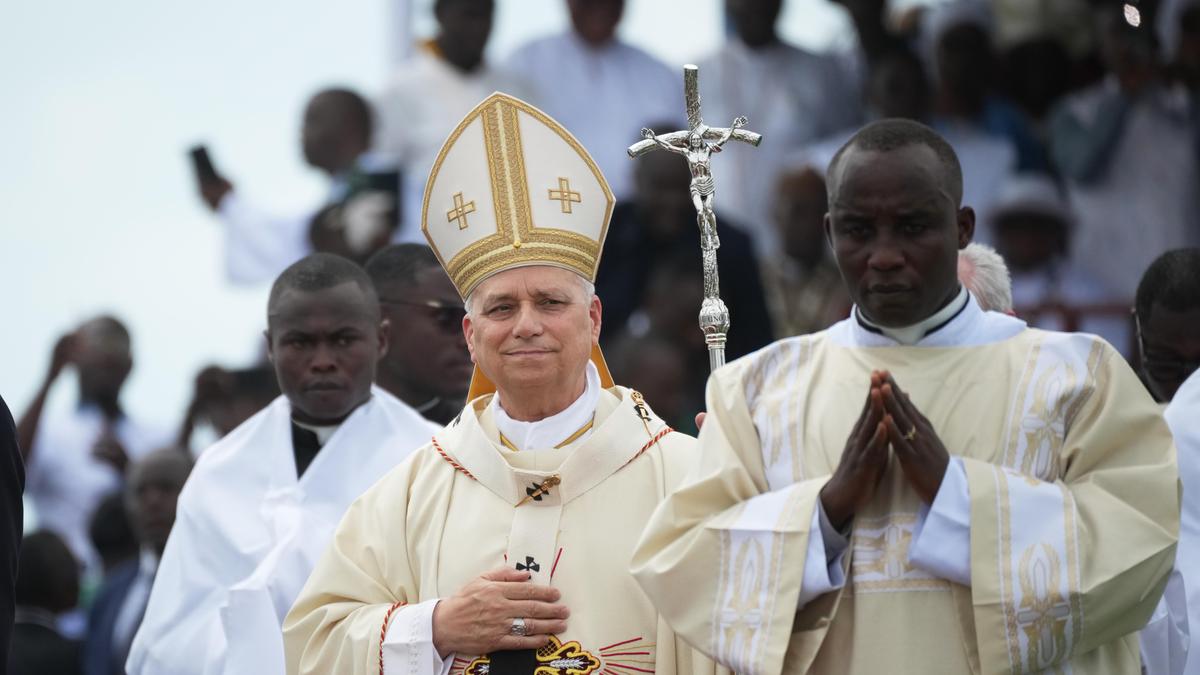
Morality is a terrible lens for evaluating software. When Pope Francis issued his warning against AI fueling "polarization, conflict, fear and violence," he wasn’t just being cautious; he was being nostalgic. The Vatican's critique treats AI as a sentient catalyst for chaos rather than what it actually is: a mirror. We aren't seeing a new era of machine-led hatred. We are seeing human nature at scale, processed through the most efficient feedback loops ever built.
To suggest that algorithms are the root cause of modern tribalism is a comfortable lie. It lets humans off the hook. It implies that if we just "fixed" the math, we’d all go back to civil discourse and global harmony. This is the "lazy consensus" of the techno-skeptic elite. They want to regulate the mirror because they don't like the reflection. Don't forget to check out our previous post on this related article.
The Myth of Algorithmic Radicalization
The standard argument, echoed from the pulpit to the halls of the EU, is that AI "traps" users in echo chambers. The theory goes that a neutral person logs on, gets fed a diet of extremist content by a profit-hungry bot, and emerges a radical.
Data suggests otherwise. Research from NYU’s Center for Social Media and Politics has repeatedly shown that the most "radicalized" individuals are actually the ones consuming the most diverse media—not because they are being persuaded, but because they are looking for things to be angry about. AI doesn't create the conflict; it reduces the friction required to find the enemy. If you want more about the context here, Engadget offers an excellent breakdown.
Conflict is the natural state of competing human interests. Before the first neural network was ever trained, we had the Thirty Years' War, the Crusades, and two World Wars. We didn't need a Large Language Model to tell us who to hate. AI is simply the first technology that gives us exactly what we ask for, and it turns out, we ask for war.
Fear as a Feature, Not a Bug
The Pope’s concern about "fear and violence" misses the fundamental mechanic of security. In the defense sector, AI is currently the only thing standing between functional infrastructure and total collapse.
Critics cry "autonomous weapons" as if a human-in-the-loop is a guarantee of ethics. History is a graveyard of "human-in-the-loop" atrocities. A machine doesn't get tired. It doesn't get scared. It doesn't commit a war crime because its adrenaline is spiking or because it wants revenge for a fallen comrade.
By pushing for a blanket moral slowing of AI development in the name of "peace," we are effectively advocating for a world where human error and human bias remain the primary drivers of kinetic conflict. That isn't a safer world. It’s just a world where we can blame a person instead of a process.
The "Human Centric" Trap
The term "human-centric AI" has become a hollow buzzword. It sounds noble. In reality, it is a demand that AI be crippled to match our own cognitive limitations.
The Vatican argues that we shouldn't delegate decisions to machines that affect the "social and political" lives of people. Why not? Humans have a miserable track record in these areas. We are riddled with cognitive biases—recency bias, confirmation bias, ingroup favoritism.
If an AI can allocate resources more equitably than a corrupt local government, or predict a famine weeks before a human analyst can, is it "immoral" to use it because it lacks a soul? The insistence on "humanity" at all costs is often just an insistence on maintaining the power structures that humans currently occupy.
Digital Colonialism vs. Algorithmic Sovereignty
There is a valid concern buried under the Vatican's rhetoric: the concentration of power. But the Pope frames this as a moral failure of the creators. It’s actually a failure of architecture.
When a handful of companies in Silicon Valley control the models that define "truth," that isn't just a risk of polarization. It’s a risk of monoculture. The solution isn't "less AI." The solution is more AI, distributed widely, and trained on local data.
We don't need a global "AI for Peace" treaty. We need a world where a village in sub-Saharan Africa has the same access to high-compute reasoning as a hedge fund in Manhattan. The Vatican calls for "global regulation," which is code for "centralized control." Centralized control is the fastest path to the very "polarization and violence" they claim to fear, as every nation and faction scrambles to be the one holding the leash of the regulator.
The Cost of Precaution
The "Precautionary Principle" is the silent killer of progress. It dictates that if an action or policy has a suspected risk of causing harm, in the absence of scientific consensus, the burden of proof falls on those taking the action.
Applied to AI, this is a death sentence. You cannot prove a negative. You cannot prove that an AI will never be used to fuel a riot. But you can see the certain harm of not using it.
Every year we delay the integration of AI into healthcare, transport, and energy management because of "ethical concerns," people die. They die in car accidents that a machine would have avoided. They die from late-stage cancers that a computer would have caught in Stage 1. They die in energy crises that a smart grid would have mitigated.
Where is the Pope's condemnation for the "fear and violence" caused by technological stagnation?
Stop Asking for Permission to Innovate
The discourse around AI and "human values" is fundamentally a power struggle. The church, the state, and the old-guard media are losing their monopoly on the narrative. They are losing their role as the arbiters of truth.
When an AI provides a direct answer without the filter of an institution, the institution calls it "misinformation" or "polarizing." When an AI allows individuals to bypass traditional gatekeepers, the gatekeepers call it a "threat to democracy."
We are moving from a world of Top-Down Truth to a world of Bottom-Up Verifiability. It’s messy. It’s loud. It’s sometimes violent. But it is more honest than the manufactured "peace" of a controlled information environment.
The Truth About Bias
We are told AI is biased.
Newsflash: Your priest is biased. Your teacher is biased. Your parents are biased.
The difference is that I can audit a model. I can run $10^6$ tests on an algorithm to find the exact point where it deviates from neutrality. I can’t do that to a human judge. I can’t "patch" the subconscious prejudices of a border guard.
The Vatican’s push to keep AI out of sensitive social areas is a push to keep those areas opaque. It is a defense of the "black box" of human intuition, which has served the powerful far better than it has served the marginalized.
The False Choice
We are being sold a false choice between "Safe, Regulated AI" and "Chaos."
In reality, the choice is between "Stagnant, Controlled AI" and "Rapid, Open Evolution." The latter carries risks, yes. But the former guarantees a slow decline into a world managed by the same flawed systems that got us into this mess.
If AI fuels polarization, it’s because we are polarized.
If it fuels fear, it’s because we are afraid.
If it fuels violence, it’s because we haven't outgrown our desire to hurt each other.
Don't blame the tool for the hand that swings it. And certainly don't listen to the people whose primary interest is making sure you never put the tool down.
The era of Institutional Morality is over. The era of Algorithmic Reality is here. Adapt or get left behind in the pews.