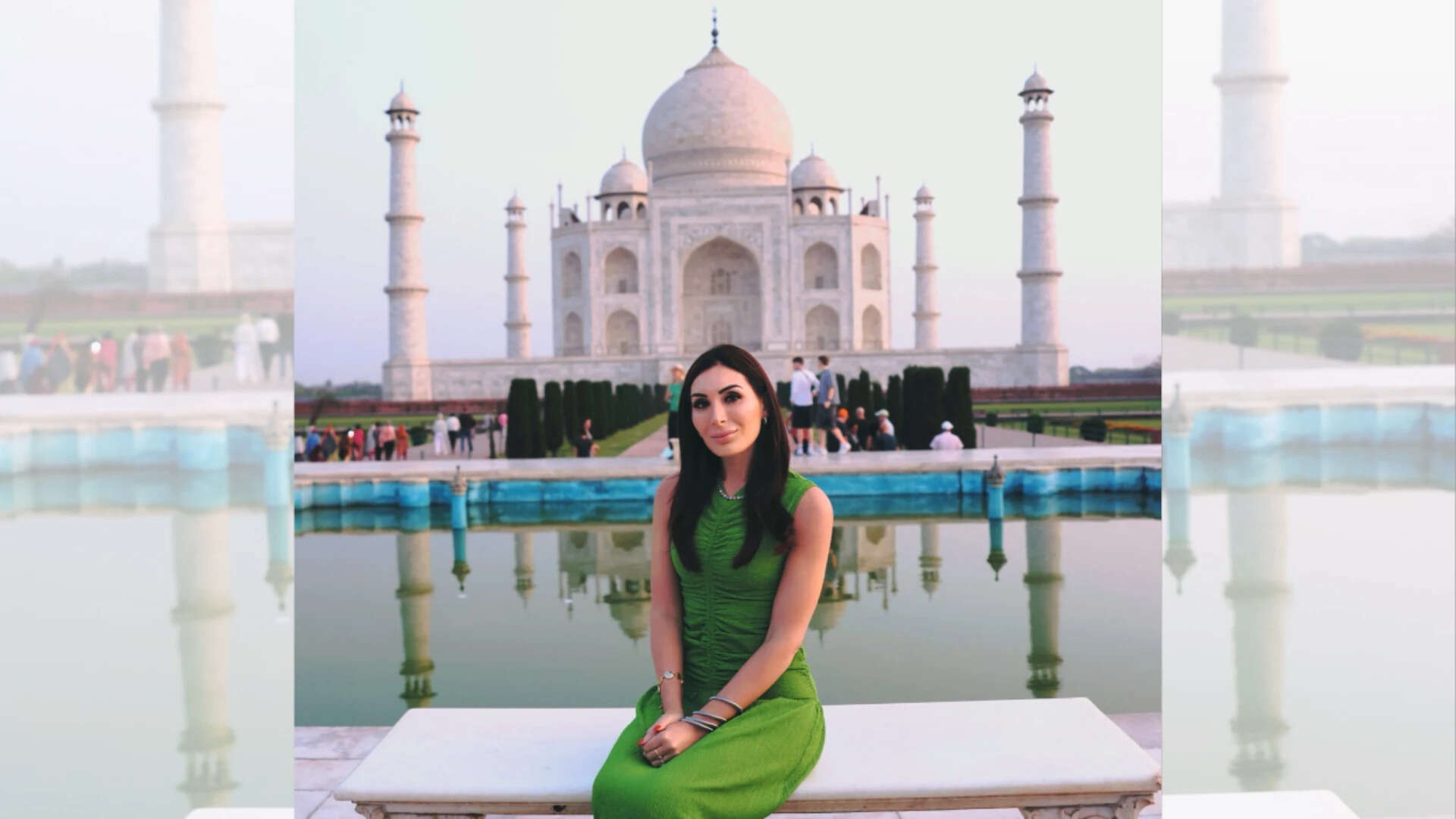
The Taj Mahal is not merely a building. It is a global shorthand for architectural perfection, a UNESCO World Heritage site that draws millions of visitors to Agra every year. Yet, in the current political climate, this ivory-white marble mausoleum has become a flashpoint for a much uglier confrontation. When far-right activist Laura Loomer recently suggested that the Taj Mahal does not belong in India or is somehow an affront to its identity, she wasn't just making a historical error. She was tapping into a coordinated effort to rewrite the cultural DNA of the Indian subcontinent.
Mehdi Hasan's swift rebuttal—pointing out that the Taj Mahal is perhaps the most famous example of Islamic architecture on the planet—was factually accurate, but it only scratched the surface of a deeper, more systemic crisis. The "controversy" isn't about whether the building is beautiful. It is about who has the right to claim the history of a nation and whether a 400-year-old masterpiece can survive the modern appetite for revisionist nationalism.
The Architecture of Exclusion
To understand why a building finished in 1648 is suddenly "controversial" in 2026, you have to look at the mechanics of cultural erasure. The Taj Mahal was commissioned by the Mughal Emperor Shah Jahan to house the tomb of his favorite wife, Mumtaz Mahal. It is the pinnacle of Indo-Islamic architecture, a style that fused Persian, Ottoman Turkish, and Indian elements into something entirely new.
Modern detractors often attempt to decouple the "Indian" from the "Islamic." By suggesting the monument is a foreign imposition, they ignore the reality that the artisans, the materials, and the very soil it stands on are inextricably Indian. This isn't just a debate for historians. It is a calculated move to marginalize the contributions of the millions of Indian Muslims who see the Taj as part of their ancestral pride. When public figures suggest that such a monument "doesn't belong," they are laying the groundwork for a hierarchy of citizenship based on faith rather than birthright.
The Myth of Tejo Mahalaya
One of the most persistent and debunked theories surrounding the site is that it was originally a Hindu temple named Tejo Mahalaya. Despite the Archaeological Survey of India (ASI) repeatedly testifying in court that there is no evidence to support this, the claim refuses to die. It survives because it is useful.
In investigative circles, we call this "seeding the doubt." You don't need to prove a lie is true; you only need to make the truth feel like just another opinion. By framing the Taj Mahal as a "stolen" Hindu site, activists transform a symbol of love and architectural genius into a symbol of grievance. This narrative follows a predictable pattern seen in other parts of the world where historical monuments are weaponized to settle modern scores. The danger here is that once a monument is stripped of its historical context, it becomes vulnerable to neglect or, worse, state-sanctioned "restoration" that alters its original character.
Economic Suicide via Cultural War
Beyond the ideological battle, there is a cold, hard economic reality that the agitators ignore. The Taj Mahal is the primary engine of India's tourism economy. It is the reason international airlines fly into Delhi and why luxury hotel chains invest billions in the region.
If the rhetoric surrounding the Taj Mahal continues to sour, the brand of "Incredible India" suffers. International travelers are notoriously skittish. They seek out cultural landmarks for their beauty and history, not to be caught in the crossfire of a religious tug-of-war. To disparage the Taj Mahal is to attack the very thing that gives India its soft power on the global stage. You cannot claim to be a rising global superpower while simultaneously trashing your most recognizable cultural asset.
The Global Pattern of Iconoclasm
This isn't an isolated Indian problem. We have seen this play out in various forms across the globe.
- The Buddhas of Bamiyan: Destroyed by the Taliban in 2001 to erase pre-Islamic history.
- Palmyra: Systematically dismantled by ISIS to strip a region of its Roman and Semitic heritage.
- European Cathedral Debates: Recent arguments over the "secularization" or "repurposing" of historic churches.
The common thread is the belief that history is a zero-sum game. If "they" built it, "we" cannot celebrate it. This logic is a poison. It suggests that a nation’s identity must be monolithic, ignoring the messy, beautiful, and complex layers that actually make a civilization great.
The Role of the Digital Megaphone
The exchange between Hasan and Loomer illustrates how social media platforms have turned historical nuance into a blood sport. Complex questions of heritage are reduced to 280-character barbs. Loomer’s comments weren't intended to provoke a scholarly debate; they were designed to trigger a base and generate engagement.
Hasan’s response, while grounded in fact, highlights the exhaustion of the expert class. How many times must a historian explain that the Taj Mahal is Islamic? How many times must a geographer point out it is in India? The repetition is the point. The goal of the revisionist is to exhaust the truth-tellers until they stop correcting the record. Once the corrections stop, the myth becomes the new reality.
Protecting the Marble from the Mud
The Taj Mahal faces literal threats from pollution—the yellowing of its marble due to airborne particles and the receding Yamuna River. But the figurative mud being thrown at it is far more corrosive. Preserving the Taj Mahal for the next century requires more than just chemical cleaning of the stone. It requires a defense of the historical record.
The international community, including bodies like UNESCO, must move beyond simple "observation" and recognize that cultural heritage is now being attacked via information warfare. When a world-famous monument is targeted by high-profile political actors, it isn't just "drama." It is a warning sign of a society's shifting values.
A nation that cannot find pride in its diverse history is a nation that is shrinking. The Taj Mahal stands as a testament to what is possible when different cultures collide and create something greater than the sum of their parts. To deny its Islamic roots is to deny its existence. To deny its Indian identity is to deny the hands that built it.
Those who seek to diminish the Taj Mahal often claim they are doing so to "restore" a nation's dignity. In reality, they are chipping away at the very foundation of what makes that nation a wonder of the world. The next time a politician or a pundit questions the legitimacy of a 400-year-old masterpiece, look past the rhetoric. Look at the shadows they are trying to cast over the light of the marble.
The Taj Mahal will likely outlast its current critics, but only if we refuse to let the history books be rewritten in the ink of modern resentment. Demand that your leaders treat cultural heritage as a non-negotiable trust, rather than a political football to be kicked around for clicks.