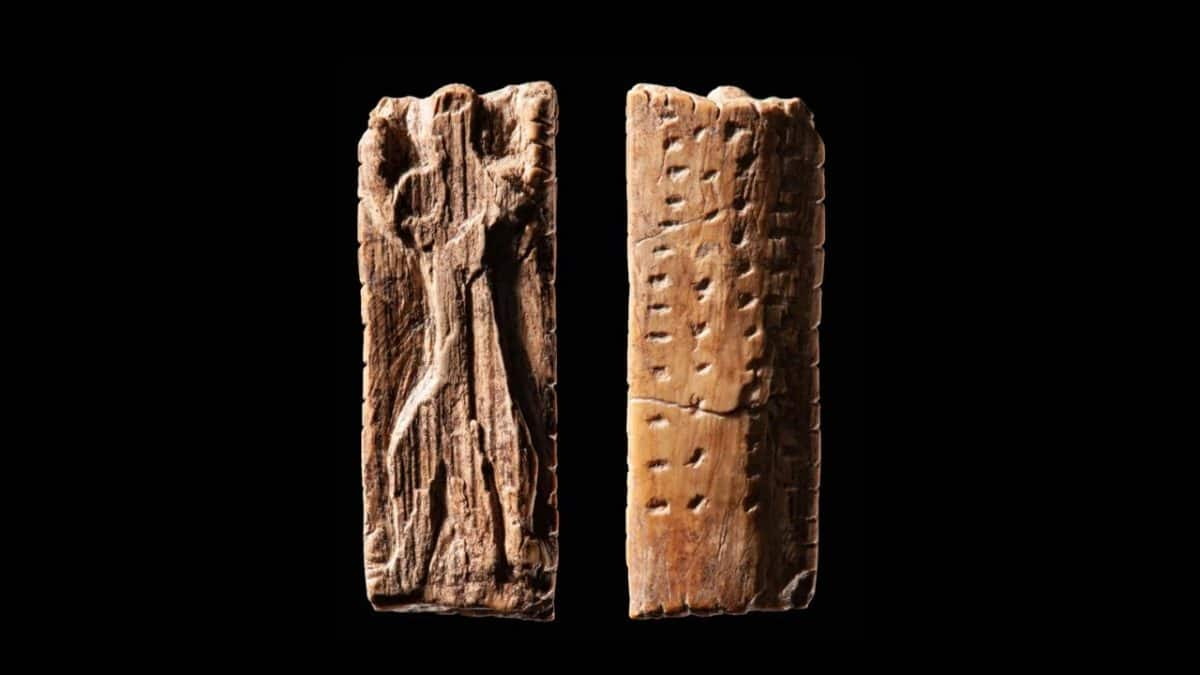
You’ve been told the same story since grade school. Writing started in Mesopotamia or Egypt about 5,000 years ago. It’s a clean, comfortable timeline that credits "civilization" with the invention of the recorded word. But that timeline is looking increasingly shaky. New research into 40,000-year-old European cave art suggests our hunter-gatherer ancestors were actually using a sophisticated proto-writing system to track the world around them long before the first Pharaoh ever sat on a throne.
We’re not talking about simple doodles of bison and deer. Scattered among the famous cave paintings of Lascaux and Altamira are tiny, repetitive marks—dots, lines, and Y-shapes. For decades, archaeologists walked right past them to look at the "pretty" pictures. Now, it turns out those marks might be a calendar.
The Code Hiding in Plain Sight
For over a century, these geometric signs were dismissed as mere decoration or "random" graffiti. However, Ben Bacon, an independent researcher based in London, teamed up with professors from Durham University and University College London to see if there was a deeper pattern. They analyzed hundreds of examples of these marks across Europe.
They found something startling. The marks weren't random at all.
Specifically, the "Y" sign—two diverging lines—appears to function as a symbol for "giving birth." When you look at the placement of these marks alongside animal imagery, a pattern emerges. The number of dots or lines associated with a specific animal often correlates perfectly with the lunar months of that animal's reproductive cycle.
Basically, these Ice Age hunters were using a "phenological" calendar. They weren't just drawing animals; they were recording biological data about when these animals would mate or migrate. This helped them survive. If you know exactly when the reindeer are going to be at the river crossing or when the salmon are running, you don't starve.
Why This Challenges Everything We Know
The traditional definition of writing is "glottography"—the recording of spoken language. These cave signs are technically "semasiography," which means they convey ideas or information directly without necessarily being tied to specific words.
If we accept these marks as a form of information storage, it pushes the origin of "writing-like" behavior back by some 30,000 years. That’s a massive leap. It suggests that the cognitive hardware for complex notation didn't suddenly appear when humans started building cities. It was already there, used by people who slept in caves and hunted mammoths.
People often assume hunter-gatherers were primitive. That's a mistake. Their survival depended on a staggering amount of data. They had to be master botanists, zoologists, and meteorologists. It makes perfect sense that they’d develop a system to store that data outside of their own brains.
Decoding the Y Sign
The "Y" symbol is the smoking gun in this theory. The researchers looked at the birth cycles of modern equivalent animals like cattle, horses, and mammoths. They found that the "Y" symbol appeared in the sequence of marks at a position that matched the month the animal usually gives birth.
Think about the mental leap required for this. You have to observe a biological event, correlate it with the cycles of the moon, and then create a physical symbol to represent that abstract concept. It’s a level of sophisticated thinking that many historians previously thought was impossible for Paleolithic humans.
Skepticism and the Scientific Pushback
Not every archaeologist is ready to tear up the textbooks just yet. Some critics argue that these marks could be interpreted in a dozen different ways. Maybe they're tally marks for successful hunts. Maybe they're tribal markers.
The biggest hurdle for this theory is that we can't interview the authors. We have the data, but we lack the "Rosetta Stone" to confirm the intent. However, the statistical correlation between the marks and the lunar/birth cycles is hard to ignore. It’s too consistent to be a coincidence across thousands of miles and tens of thousands of years.
The Long Legacy of the First Marks
If this research holds up, it means the "cradle of civilization" wasn't just in the Middle East. It was everywhere humans were trying to make sense of their environment. The transition from these lunar calendars to the cuneiform of Sumer isn't a jump from "nothing" to "something." It’s a refinement of a technology that had been simmering for eons.
This changes how we view the people of the Upper Paleolithic. They weren't "pre-historic" in the sense of being stuck in a timeless void. They were keeping records. They were temporal beings who understood the past and planned for the future using stored data.
How to See This for Yourself
You don't need a PhD to appreciate the complexity of these marks. If you're interested in the deep history of human communication, look beyond the "big" art.
- Check the databases: Sites like the Bradshaw Foundation have extensive high-resolution galleries of cave art. Look for the small dots and lines next to the animal figures.
- Follow the Durham University research: The team led by Paul Pettitt and Robert Kentridge continues to publish on Paleolithic visual culture. Their papers go into the grueling detail of the statistical models used to verify these patterns.
- Visit the sources: If you’re ever in southwestern France or northern Spain, visit the caves that are still open to the public, like Lascaux II or Niaux. Seeing the scale of these "notations" in person changes your perspective on ancient intelligence.
Stop thinking of writing as a 5,000-year-old invention. Start thinking of it as a 40,000-year-old evolution. The next time you check your calendar on your phone, remember that you’re using a high-tech version of a tool that started as a few scratches on a limestone wall in the dark. We’ve been trying to hack time for a very, very long time.