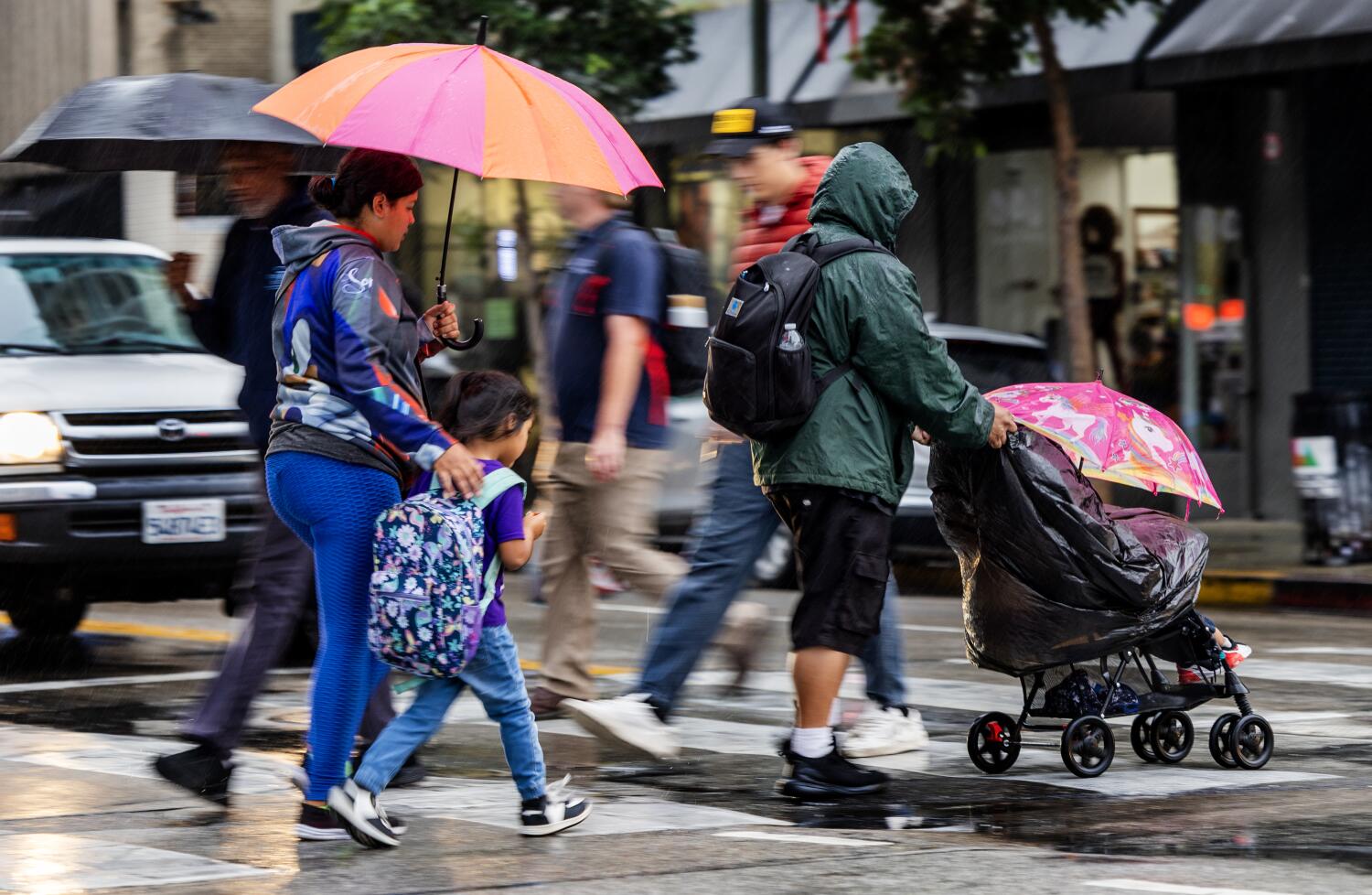
The arrival of a low-pressure system off the Southern California coast transforms Los Angeles from a high-efficiency logistics hub into a high-friction environment. While casual reportage focuses on the inconvenience of "weekend rain," a structural analysis reveals a complex interplay between synoptic-scale meteorology and urban infrastructure limits. The impending weather event is not a singular phenomenon but a sequence of atmospheric transitions—moisture advection, orographic lift, and convective instability—that test the resilience of the Los Angeles Basin’s drainage and transport systems.
The Mechanics of the Pacific Trough
The current meteorological setup is driven by a mid-latitude cyclone originating in the Gulf of Alaska, tracking southeast toward the California Bight. This system functions as a heat engine, drawing moisture from the subtropical Pacific. The efficiency of this moisture transport is the primary variable determining whether the region experiences a light drizzle or a localized flood event.
The Moisture Advection Flux
The volume of precipitation depends on the Precipitable Water (PW) values within the atmospheric column. When a "cold core" low interacts with warmer sea surface temperatures, the resulting lapse rate—the rate at which temperature decreases with altitude—becomes steep. This instability is the catalyst for thunderstorms. Unlike stratiform rain, which provides a steady, manageable flow, convective cells (thunderstorms) produce high-intensity bursts that exceed the infiltration capacity of urban surfaces.
Orographic Enhancement Factors
The Transverse Ranges, including the San Gabriel and Santa Monica mountains, act as physical barriers to incoming moisture. As air is forced upward (orographic lift), it cools and condenses more rapidly. This creates a precipitation gradient where foothill communities receive significantly higher totals than coastal basins. For every 1,000 feet of elevation gain, the probability of runoff-generating rainfall increases by a measurable margin, directly impacting downstream channel flow.
The Infrastructure Friction Coefficient
Los Angeles is an engineered environment designed for rapid water shedding rather than absorption. The concrete-lined Los Angeles River and its tributaries operate as a high-velocity conveyance system. The transition from dry to wet conditions creates a "first flush" effect, where accumulated oils, rubber particulate, and debris are swept into the drainage network.
Hyper-Urbanized Runoff Dynamics
The high ratio of impervious surfaces (asphalt and concrete) to permeable soil ensures that nearly 90% of rainfall becomes immediate runoff. In a natural landscape, this figure is closer to 10%. This 9-to-1 ratio creates a hydraulic surge.
- Infiltration Deficit: The soil reaches saturation within the first 0.25 inches of rain, after which every subsequent drop contributes to surface flow.
- Channel Capacity: The Army Corps of Engineers designed the basin's channels for specific "hundred-year" flow rates. However, localized debris blockages or extreme convective bursts can cause localized overtopping even during moderate events.
- Pavement Slipperiness: The initial stages of a rain event are the most hazardous for transit. Months of accumulated petroleum deposits on the I-5 and I-405 corridors emulsify with the first few millimeters of water, drastically reducing the coefficient of friction for tires.
Quantifying the Risk of Convective Instability
The specific forecast for thunderstorms introduces a layer of stochastic risk. While standard rain is predictable through satellite modeling, the exact location of a lightning strike or a downburst is impossible to pinpoint more than an hour in advance.
The CAPE Variable
Meteorologists track Convective Available Potential Energy (CAPE). If the CAPE values exceed 500 Joules per kilogram (J/kg) in the Los Angeles Basin, the risk of vertical cloud development increases. This leads to:
- Intense Cloud-to-Ground Lightning: Potential for power grid interruptions and localized fires in areas with dry fuel loads.
- Small Hail: Rapid cooling in the upper atmosphere can produce ice pellets that further reduce road traction.
- Urban Flash Flooding: When a thunderstorm remains stationary over a specific drainage sub-basin, it can dump 0.5 inches of water in 15 minutes, overwhelming catch basins designed for lower intensities.
The Economic and Operational Impact
Rainfall in a Mediterranean climate is an economic disruptor. The "Los Angeles Weekend" economy, heavily reliant on outdoor hospitality, entertainment, and film production, faces immediate contraction during precipitation events.
Logistics and Supply Chain Bottlenecks
The Ports of Los Angeles and Long Beach, which handle a significant percentage of U.S. imports, experience slowed throughput. Crane operations for container loading are restricted during high winds or lightning, creating a backlog that ripples through the drayage trucking network. Furthermore, the average speed on Southern California freeways drops by an estimated 25-40% during rain, increasing the "last-mile" delivery costs for e-commerce and retail sectors.
Grid Resilience and Energy Demand
While rain generally lowers ambient temperatures and reduces air conditioning load, it introduces mechanical stress to the power grid. Saturated soil can lead to tree falls on overhead lines, and moisture intrusion in aging underground transformers remains a persistent vulnerability in neighborhoods with legacy infrastructure.
Structural Limitations of Current Forecasting
Despite advances in High-Resolution Rapid Refresh (HRRR) modeling, the interaction between the Pacific marine layer and incoming cold fronts remains difficult to simulate with 100% accuracy. The "rain shadow" effect caused by the Channel Islands can occasionally bifurcate incoming moisture plumes, leading to "missed" forecasts where one neighborhood is drenched while another stays dry.
Users should distinguish between a Winter Storm Warning (high confidence of significant impact) and a Weather Advisory (nuisance-level impact). This weekend's event sits in the transition zone, requiring a strategy of "defensive mobility"—minimizing transit during the peak frontal passage, typically identified by the tightening of isobars on a surface pressure map.
The strategic play for residents and operators is the decoupling of activities from outdoor dependencies. Operations involving heavy machinery, electrical maintenance, or high-volume transit should be front-loaded or deferred to the post-frontal window. The primary threat remains the human factor: the mismatch between high-speed driving habits and the low-friction reality of the wet asphalt. Institutional resilience during this window is measured not by the ability to ignore the weather, but by the speed at which logistics are adjusted to account for the increased friction of the aqueous environment.