The pre-dawn air in Lakemba carries a specific, electric chill. It is the kind of cold that seeps through the soles of polished dress shoes and the hem of a flowing thobe. Somewhere in the distance, a police siren cuts through the quiet of suburban Sydney, a sound so common it usually goes ignored. But this morning, as thousands of men, women, and children converge on the mosque for Eid al-Fitr, that siren feels different. It feels like a reminder.
For Adam—a father of three who spent his childhood playing cricket in the sun-baked streets of Western Sydney—this day should be pure celebration. It marks the end of Ramadan, a month of fasting, reflection, and late-night coffee runs. Yet, as he pulls his car into a side street, his eyes instinctively dart to the rearview mirror. He is looking for more than a parking spot. He is looking for a look. A gesture. A reason to keep his children a little closer to his side. Don't miss our recent post on this related article.
This is the duality of being Muslim in Australia today. It is a life lived in the vibrant light of faith and the long, creeping shadow of a rising tide.
The Weight of the Gaze
Statistics are cold. They tell us that incidents of Islamophobia in Australia have spiked significantly, often correlating with geopolitical tensions half a world away. Data from the Islamophobia Register Australia suggests a sharp increase in reported incidents—verbal abuse in supermarkets, graffiti on community centers, the tearing of hijabs in broad daylight. But statistics cannot capture the internal flinch Adam feels when a stranger stares a second too long at his wife’s headscarf on the train. To read more about the background here, Reuters provides an in-depth breakdown.
The "dry" news reports call this a "trend." For the people walking into the mosque today, it is an atmosphere. It is the invisible tax paid for the simple act of belonging. When a conflict erupts in the Middle East, a high school student in Melbourne suddenly finds herself being asked to answer for actions she didn't commit, by people she thought were her friends. The stakes are not just political; they are deeply, painfully personal.
Consider Sarah. She is twenty-two, a law student, and she wears her identity with a mix of pride and a calculated, weary caution. For her, Eid is a day of joy, but it is also a day where the contrast between her internal peace and the external world is most jarring.
"You spend thirty days focusing on being the best version of yourself," she says, adjusting her silk scarf. "Then you step outside, and you realize some people only see you as a walking headline."
A Feast in the Eye of the Storm
Despite the weight, the celebration does not buckle. It expands.
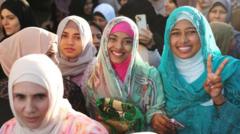
Inside the mosque, the air is thick with the scent of expensive oud and the cheap, sugary fragrance of children’s lollies. There is a cacophony of greetings—Eid Mubarak—exchanged in a dozen different accents. Here, the "Muslim community" ceases to be a monolithic block used in political debates. It is a kaleidoscope. There are Lebanese grandfathers with hands like weathered leather, young Sudanese men in crisp white tunics, and Malaysian families sharing Tupperware containers of spicy beef rendang.
The sheer defiance of their joy is the real story.
While the news cycles focus on the friction, the community focuses on the glue. They are building a world within a world. This isn't about ignoring the rising Islamophobia; it is about refusing to let it define the boundaries of their happiness. When they stand shoulder to shoulder in prayer, the gaps between them disappear. The lawyer stands next to the taxi driver. The refugee stands next to the third-generation business owner. For twenty minutes, the outside world—with its polls and its pundits—is silenced.
But the silence is temporary.
The Cost of Staying Quiet
The real problem lies elsewhere, far from the prayer mats and the festive tables. It lives in the "quiet" Islamophobia—the resumes that get tossed aside because the name sounds too "foreign," or the subtle exclusion from office social circles. This systemic friction creates a slow-burning exhaustion.
Imagine trying to run a marathon while someone is constantly tugging at your shirt. You can still run. You might even win. But you are burning twice the energy of everyone else just to stay on the track.
This exhaustion is what the headlines miss. They report on the "clash of cultures" but rarely on the mental load of constant self-editing. Young Australian Muslims often feel they must be twice as polite, twice as successful, and twice as patriotic just to be seen as "one of the good ones." It is a performance that never ends.
The Backyard Revolution
The response to this pressure isn't always a protest or a press release. Sometimes, it’s a barbecue.
By midday, the parks of Lakemba, Auburn, and Broadmeadows are transformed. Smoke rises from public grills. The smell of charred lamb and halloumi fills the air. This is the "Great Australian Dream" filtered through a different lens. If you walked past, you might see a group of teenagers playing football, their laughter indistinguishable from any other group of kids in the country.
This is the human element that gets buried under the weight of "rising tensions." These are people who pay taxes, worry about the housing market, cheer for the Matildas, and argue about the best way to cook a steak. Their "otherness" is a construction of those who refuse to look closer.
But the tension is a stubborn shadow. Even in the park, there is a heightened awareness. Community leaders have had to coordinate with local police to ensure security for these gatherings. The presence of a patrol car at a religious festival is a bittersweet sight—a sign of protection, yes, but also a stark admission that protection is required.
The Mirror and the Mask
As the sun begins to set on Eid, the sugar highs of the children begin to fade, and the reality of the coming work week looms. For Adam, Sarah, and thousands like them, tomorrow means putting the mask back on.
It means navigating a world where their presence is often debated as a "problem" to be solved rather than a part of the fabric. They will return to offices and classrooms where the news cycle continues to churn out stories that paint them in broad, dark strokes. They will hear the commentary. They will see the social media threads.
But they will also remember the feeling of the prayer rug beneath their foreheads and the taste of the first date after a month of hunger.
The struggle of the Australian Muslim community isn't just about fighting hate; it is about the right to be ordinary. It is the desire to celebrate a holiday without it being a political statement. It is the longing for a day when the "rising Islamophobia" is a historical footnote rather than a daily weather report.
Adam buckles his youngest son into his car seat. The boy is clutching a small plastic toy and wearing a smudge of chocolate on his cheek. He is happy. He is safe. He is unaware that he is at the center of a national conversation.
Adam looks at him and realizes that the fight isn't about changing the minds of the people who scream on street corners. It is about ensuring that by the time his son is a man, he doesn't have to look in the rearview mirror quite so often.
The car pulls away from the curb, moving past the mosque where the lights are beginning to dim. The celebration is over, but the quiet, persistent act of existing continues. In the dark, the crescent moon hangs low in the sky, sharp and bright, refusing to be eclipsed by the clouds moving in from the coast.
The shadow is there, but so is the light.
Would you like me to find more specific data on Australian social cohesion reports to ground this narrative further?