The air at Prestbury Park usually smells of expensive cigars, damp wool, and the electric, metallic tang of shared anxiety. But by the Friday of the 2026 Cheltenham Festival, the scent had changed. It smelled like woodsmoke and revolution.
For decades, the script of this week followed a predictable, almost liturgical rhythm. The giants of the sport—the powerhouse stables with budgets rivaling small nation-states—would arrive with their "bankers." These were horses so decorated and so heavily backed that their victories felt less like sporting achievements and more like inevitable bureaucratic filings. We, the punters, were merely witnesses to a coronation.
Then came 2026.
If you stood by the parade ring on Tuesday afternoon, you could feel the tectonic plates shifting. The silence that followed the opening races wasn’t the usual hush of focused study. It was the stunned quiet of a crowd watching a magic trick go wrong. The favorites weren't just losing; they were fading into the background, overtaken by horses whose names the casual fans couldn't pronounce and whose colors were unfamiliar to the grandstand's elite.
The Myth of the Unbeatable
To understand why 2026 felt like a fever dream, you have to understand the math of the "super-stable." In a typical year, a handful of trainers dominate the entries. They have the best gallops, the most sophisticated heart-rate monitors, and the primary pick of the finest bloodstock from France and Ireland.
Consider a hypothetical owner we will call "The Collector." He spends seven figures on a five-year-old because the data says the horse has a lung capacity that defies biology. For years, that data was gospel. If the horse was fit and the ground was right, the result was a mathematical certainty.
But something happened to the physics of the turf this year. The data points failed.
The ground was a treacherous, shifting mosaic of "good to soft" in places and "heavy" in others—the kind of unpredictable surface that makes a $500,000 price tag look like a clerical error. In these conditions, the sleek, pampered superstars of the major yards looked fragile. They were built for drag races on perfect carpets. They were not built for a dogfight in the Cotswold mud.
The Small Yard’s Revenge
In a drafty barn three hours away from the bright lights of the winner’s enclosure, a trainer with three employees and a tractor that hasn't started since 2023 was watching the same rain clouds.
This is the human element the spreadsheets always miss.
When a horse from a massive operation runs, it is a unit of production. When a horse from a "backyard" trainer runs, it is often the culmination of a decade of hope. 2026 was the year these smaller operations stopped playing by the rules of the elite. They realized that while they couldn't outspend the giants, they could outwait them.
We saw it in the middle-distance hurdles. While the favorites were being ridden with the heavy pressure of expectation, the outsiders were ridden with the liberated desperation of those who have nothing to lose. The jockeys on the 33/1 shots weren't looking over their shoulders at the cameras. They were hunting.
The statistics tell a stark story. By the time the Gold Cup loomed on Friday, the percentage of winning favorites was at its lowest point in the modern era. The "expected" winners were falling away at the third-to-last fence, their engines sputtering not because of a lack of talent, but because of a lack of grit.
The outsiders had grit in abundance. They had been raised on hilly fields, trained on improvised tracks, and fed a diet of relentless work rather than scientific optimization.
The Psychology of the Long Shot
There is a specific kind of madness that takes over a crowd when the underdog starts to move. It’s a low rumble that starts in the cheap seats and migrates toward the Royal Box.
On Wednesday, during the late afternoon gloom, a grey horse with a patchy coat and a pedigree that suggested he should be pulling a cart rather than sprinting up the Cheltenham hill made his move. He was a 50/1 shot. Nobody had mentioned him in the morning previews. The pundits had dismissed him as "making up the numbers."
But as he jumped the last, two lengths behind the reigning champion, the atmosphere changed. It wasn't just about the money anymore. It was about the fundamental human desire to see the hierarchy toppled.
We live in a world that feels increasingly scripted. Algorithms tell us what to buy, who to vote for, and which movies we’ll like. For three and a half minutes on a Wednesday in March, the algorithm was broken. The grey horse didn't know he was a 50/1 shot. He didn't know his trainer was struggling to pay the feed bill. He just knew that the horse in front of him was tired.
He won by a head.
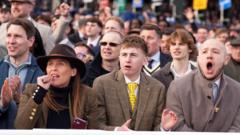
The roar that went up was different from the polite applause that greets a favorite. It was visceral. It was the sound of thousands of people realizing that the "impossible" was actually just "difficult."
The Invisible Stakes
It’s easy to look at the betting slips and see 2026 as a year of financial volatility. But the real stakes were emotional.
For the sport of horse racing, the dominance of a few massive owners had begun to feel like a slow-motion existential crisis. If the same people win every year, the story stops being a story. It becomes an audit.
2026 saved the narrative. It reminded the public that a horse is not a machine and a race is not a foregone conclusion. It gave a generation of smaller breeders and trainers a reason to keep going. They saw that the giants were mortal. They saw that a well-aimed stone from a David could still find its mark against a Goliath.
Even the losing punters felt it. There is a strange, bitter comfort in losing a bet to a genuine surprise. It validates the reason we watch in the first place: the hope of witnessing something that shouldn't happen.
The Weight of the Crown
By the final day, the tension was suffocating. The big-name jockeys looked haggard. Their faces were caked in mud, but beneath the grime, you could see the cracks in their confidence. They had spent the week being hunted, and they knew it.
Every time they turned into the straight, they could hear the thundering hooves of a "nobody" behind them.
The Gold Cup itself became a microcosm of the entire week. The favorite was a beautiful, soaring creature that moved with the grace of a dancer. He led for most of the race, looking every bit the champion he was supposed to be. But as they crested the hill for the final time, the rain turned into a freezing slant.
From the middle of the pack emerged a horse that had been bought for the price of a used sedan. He was mud-colored, awkward, and possessed a stride that looked like he was fighting the ground rather than running on it.
He didn't outrun the favorite. He outlasted him.
He put his head down and refused to accept the reality of the situation. He ignored the fatigue, the cold, and the weight of the history that said he shouldn't be there. When he crossed the line first, the silence in the stands lasted for three full seconds before the explosion.
People looked at their programs, then at each other, then back at the track.
The Lesson of the Cotswolds
We often try to organize our lives to minimize risk. We want the "safe" career, the "guaranteed" investment, the "sure thing." We convince ourselves that if we just gather enough data, we can predict the future.
The 2026 Cheltenham Festival was a three-mile-long, rain-soaked reminder that the world doesn't work that way.
Life is messy. It is unpredictable. It is full of 50/1 shots that have no business winning but do so anyway because they were willing to stay in the race when the favorites decided it was too cold to keep running.
The form books from that week are now useless. They sit in trash cans or at the bottom of drawers, relics of a time when we thought we knew what was going to happen.
The sport changed that week. Not because the rules were different, but because the spirit was. The "outsider" is no longer just a betting term. It is a philosophy. It’s the understanding that the greatest victories don’t come from the best equipment or the biggest budget, but from the refusal to be intimidated by the shadow of a giant.
As the crowds filtered out of the gates on Friday evening, stepping over discarded betting slips and navigating the deep, dark mud of the parking lots, there was a sense that something had been settled. The giants would be back next year, of course. They would buy more horses, hire more analysts, and try to reclaim their territory.
But they would do so knowing that somewhere, in a quiet stable on the edge of nowhere, someone is currently grooming a horse that hasn't been told it’s supposed to lose.
The mist settled over Cleeve Hill, swallowing the grandstands and the finish line. The 2026 Festival was over, but the echoes of those unexpected hooves remained. The outsiders didn't just win the races; they reminded us that the most important things in life can never be measured by an odds-maker.
They reminded us that sometimes, the only way to win is to be the one who refuses to stop when the rain starts to fall.